Category: World

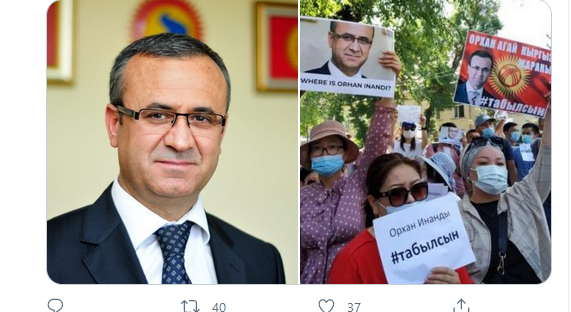
  • Protests continue in Kyrgyzstan 25 days into disappearance of Orhan İnandı

    Protests continue in Kyrgyzstan 25 days into disappearance of Orhan İnandı

    Around 300 people gathered in front of government house in Bishkek on Friday calling on Kyrgyz authorities to find educator Orhan İnandı, who is feared to have been abducted by Turkish intelligence due to his alleged links to the Gülen movement, the Stockholm Center for Freedom reported.

    According to the 24.kg news agency, some 300 people, including students, alumni and parents of Sapat school network students attended the protests. İnandı is the founder and president of the Sapat schools. He went missing in Bishkek on the night of May 31 and is allegedly being held against his will in the Turkish Embassy in Bishkek, according to his lawyer and family.

    The press service of the Kyrgyz Internal Affairs Ministry told 24.kg that they would immediately inform the public as soon as they have information to share “without interfering with the work of the investigators.” The officials said they are investigating all possibilities.

    Over the past five years scores of men alleged by Turkish authorities to have links to the Gülen movement, living in countries around the world, have been arbitrarily detained and forcibly returned to Turkey. There they are incarcerated on bogus terrorism charges in violation of due process rights and protections.

    Turkish President Recep Tayyip Erdoğan has been targeting followers of the Gülen movement, a faith-based group inspired by Turkish cleric Fethullah Gülen, since the corruption investigations of December 17-25, 2013, which implicated then-Prime Minister Erdoğan, his family members and his inner circle.

    Dismissing the investigations as a Gülenist coup and conspiracy against his government, Erdoğan designated the movement as a terrorist organization and began to target its members. He intensified the crackdown on the movement following a coup attempt on July 15, 2016 that he accused Gülen of masterminding.

    In addition to Bishkek, since June 1 protests have been taking place in major capitals around the world including Washington, Berlin, London and Brussels in support of the Turkish educator, demanding his release. The United Nations Human Rights Committee has called on Turkey to promptly take all measures necessary to establish the whereabouts of İnandı and said the government should ensure that İnandı would not be subjected to torture and inhuman treatment, guarantee his physical and mental integrity and immediately place him under the protection of the law.

    On Thursday US Congressman Tom Suozzi, a Democrat from New York, raised the issue on Twitter and said the disappearance of İnandı “is gravely disturbing and represents a troubling pattern of forced disappearances employed by the Turkish government.”

    Taalaygül Toktakunova, the attorney for the İnandı family, on Tuesday posted pictures of a person suspected of involvement in the educator’s alleged abduction along with photos of Ekberov Ulan, a former official from the Kyrgyz Interior Ministry, publicly asking Ulan to confirm whether he was in fact the suspect in the photo.

    Noting that Ulan’s whereabouts are unknown and that he is said to have left Kyrgyzstan, Toktakunova called on the former official to contact the İnandı family and remove their doubts regarding his suspected role in the educator’s disappearance.

    Rights organizations have also asked Kyrgyz authorities to exert efforts for the release of İnandı. Human Rights Watch (HRW) called on Kyrgyz authorities to investigate the disappearance of İnandı and “ensure his safety and that he is not unlawfully removed to Turkey.” According to HRW, allowing İnandı’s rendition to Turkey would violate Kyrgyzstan’s obligations under the Convention against Torture and Other Cruel, Inhuman, or Degrading Treatment or Punishment, which it ratified in 1997.

  • Top court to review rights defender, former MP Gergerlioğlu’s application on July 1

    Turkey’s Constitutional Court will review an application submitted by rights defender and former MP from the pro-Kurdish Peoples’ Democratic Party (HDP) Ömer Faruk Gergerlioğlu, who has been behind bars in prison for 85 days, during its session on July 1.

    Gergerlioğlu demanded the annulment of a lower court decision stripping him of the parliamentary status.

    Gergerlioğlu was stripped of his status in parliament on March 17 after conviction of disseminating “terrorist propaganda” in a 2016 social media post, where he commented on a story that reported on outlawed Kurdish militants calling on the Turkish state to take a step towards peace.

    A two-and-a-half-year jail sentence handed down to him on Feb. 21, 2018 was upheld by the Supreme Court of Appeals on Feb. 19, 2021, and the 55-year-old politician, who has shone a light on controversial topics including torture and prison strip-searches in Turkey’s prisons and detention centers, was taken into custody at his home on April 2 and sent to prison.

    In his application, Gergerlioğlu referred to the top court’s recent ruling on the case of Enis Berberoğlu, an MP from the main opposition Republican People’s Party (CHP). The court decided unanimously in January that Berberoğlu’s right to stand for elections and engage in political activities had been violated by the lower courts.

    Berberoğlu was initially sentenced to 25 years in prison in 2017 on espionage charges for providing the Cumhuriyet newspaper with a video purporting to show Turkey’s National Intelligence Organization (MİT) trucking weapons into Syria.

    Speaking to the Ahval news website in May, Gergerlioğlu said he was arrested in an inhumane and humiliating manner, adding, “These things happened because I am so outspoken about human rights violations.”

    “My imprisonment is the result of authorities taking revenge for my standing up against human rights violations in Turkey,” said Gergerlioğlu.The Governing Council of the Inter-Parliamentary Union (IPU), a global organization of national parliaments, has said in a recent decision that Gergerlioğlu’s continued detention was arbitrary and should be immediately ended.

    The IPU argued that the former MP was “serving a harsh prison term as a result of the legitimate use of his right to freedom of expression,” noting that he simply sent a tweet in which he forwarded an existing news report and included an implicit call for peace negotiations to take place.

  • Pro-gov’t journalist claims he assisted in reinstatement of post-coup victims to jobs

    A journalist known for his close ties to the Justice and Development Party (AKP) government has claimed involvement in the reinstatement of thousands of people who were removed from their state jobs over alleged links to the Gülen movement following 2016 coup attempt, local media reported on Monday.

    Turkish President Recep Tayyip Erdoğan and his ruling AKP label the faith-based Gülen movement, inspired by Islamic preacher Fethullah Gülen, as a terrorist organization and accuse the group of orchestrating an abortive putsch that took the lives of 251 civilians on July 15, 2016.

    The Turkish government declared a state of emergency (OHAL) following the coup attempt and carried out a massive purge of state institutions, summarily dismissing more than 130,000 public servants including academics, teachers, military personnel, diplomats and police officers with emergency decree-laws subject to neither judicial nor parliamentary scrutiny.

    In a video recently released by the Turkish media, Süleyman Özışık says he took the files of thousands of people who were dismissed from their state jobs in the aftermath of the coup attempt to Interior Minister Süleyman Soylu and that they were reinstated afterward.

    “I told them they could hold me to account if those people didn’t turn out to be innocent. They did their research, and it turned out they were all victims of slander. They were all reinstated,” Özışık is heard saying in a video posted on June 18, 2020 on the YouTube channel of the Internethaber news website, which he owns together with his brother Hadi Özışık.

    According to the latest official data, the State of Emergency Procedures Investigation Commission (OHAL Commission), set up by the government to look into complaints from individuals who were adversely affected by government decrees during the state of emergency in Turkey has rejected 101,058 applications out of the 115,130 it has processed since its establishment in summer 2017.

    The commission, which was established as an appeals body under pressure from the Council of Europe in order to relieve the ECtHR of a huge workload emanating from tens of thousands of Turkish applicants who were unable to take their cases to Turkish courts, has reinstated only 14,072 people so far, including dozens reinstated after their death.

    Speaking to the OdaTV online news website, Mehmet Ruşen Gültekin, a former public prosecutor at the Supreme Court of Appeals, underlined that Özışık’s move amounted to an attempt to influence the judiciary since the OHAL Commission serves as a judicial body.

    “The Interior Ministry, a political body, works as a judicial organ. Is this a journalist’s job [to be involved in people’s trials]? Of course, it isn’t. These are unethical actions,” Gültekin added.

    As part of the four-year crackdown that continues to target real and alleged members of the Gülen movement, a total of 301,932 people have been detained while 96,000 others have been jailed, according to official data, while scores of others had to flee the country to avoid prosecution.

  • The biggest, long awaited event is coming soon; “Colors of Voices” Singing Contest

    The biggest, long awaited event is coming soon; “Colors of Voices” Singing Contest

    The biggest, long awaited event is coming soon; “Colors of Voices” Singing Contest. The International Festival of Language & Culture (IFLC) has been working hard to organize online events amidst Covid-19 and create content for social media. Among 1350 young participants from all over the world, 24 qualified to represent their respective countries in the upcoming Grand Final.

    The winners of the contest will be determined by the distinguished judges and the audience. Bill Timoney, a familiar face from prior IFLC events, as well as his excellent acting background, will be hosting the show and Chris Kirkpatrick, Peter Daverington, and Brandon J. Dirden will be accompanying him during the show with their valuable comments.The popular vote will make 30% of the final evaluation and the jury vote 70%.

    IFLC performed live last on a stage in Sydney, Australia in 2019 before the pandemic hit . They toured the USA and performed in NYC, Washington DC, Houston and Los Angeles just before they flew to Down Under. The children of the world, as IFLC name them “Colors of the World”, have been travelling to world capitals to give hope and showcase their culture through arts and music. IFLC has not given up its activities due to Covid-19 and tackled successfully with the challenges and organized an online event in October 2020.

    The organizing committee decided to organize a singing contest to give an opportunity to more young talents across the world. IFLC will continue to organize online events till we go back to normal and live events hopefully in 2022.

    A UNIQUE CLASSIC / A CLASSIC LIKE NO OTHER

    The international “Colors Of Voices” Singing Contest will be broadcast live on IFLC’s Youtube channel. The contestants will dazzle the audience with their spectacular performances and colourful traditional costumes. The visual graphic team designed a virtual stage to make the show as realistic as possible. They used 3D visual effects, and green screen techniques to make you watch the show in the comfort of your home.

    First, second, and third place winners will get $1000, $750, and $500, respectively. It has also been announced that the best song choice, best costume choice, and honorable mention winners will each get $300. All contestants will receive a participation certificate and a gift.On Saturday, June 26, the show will be streamed live at 2 p.m. EST, 8 p.m. CEST on the IFLC’s YouTube channel.

  • Pro-gov’t journalist denies claims of extorting Turkish business tycoon

    A journalist known for his close links to the ruling Justice and Development Party (AKP) has denied allegations that he demanded €10 million from Sezgin Baran Korkmaz, a businessman who fled Turkey in late 2020 due to money laundering charges, to get the government to drop the case, local media reported on Friday.

    The allegations were first voiced by Sedat Peker, the head of one of Turkey’s most powerful mafia groups, who said in a YouTube video posted on June 6 that journalist Veyis Ateş had served as a mediator between Kormaz and the Turkish government to clear the money laundering charges against the businessman.

    Habertürk daily columnists Fatih Altaylı and Sevilay Yılman then revealed that Korkmaz contacted both of them separately and confirmed Peker’s claims, adding that Ateş demanded €10 million to change the situation in the businessman’s favor.

    Ateş, who recently resigned from his position as prime time newscaster at the pro-government Habertürk TV, late on Friday answered journalist İsmail Saymaz’s questions on Halk TV, denying the claims against him.

    Korkmaz, who participated in Friday’s program via a live phone-in, reiterated the claims against the journalist, adding that he refused to give Ateş €10 million so that he would convince some elements of the government to drop the charges against him.

    “He’s lying to my face right now. He needs to explain who he wanted the money for,” Korkmaz said.

    Saymaz also stated that he listened to the recording of a phone call between Ateş and Korkmaz and that he heard the journalist saying, “They want the amount I told you before.”

    Ateş continued to deny the claims, challenging Korkmaz to come back to Turkey and file a criminal complaint against him.

    Korkmaz was business partners with Jacob and Isaiah Kingson, the executives of a Salt Lake City biodiesel company who pleaded guilty in US federal court to a $511 million tax credit scheme in March 2020.

    Turkish prosecutors in December had issued a detention warrant for Korkmaz, the CEO of SBK Holding, following a joint probe by Turkey’s financial crimes unit and tax auditing authorities into an alleged $132 million money-laundering scheme in Turkey. A Turkish court issued an arrest warrant for Korkmaz in May.

    Peker late on Friday posted a series of tweets, claiming that Ateş was able to stay calm in the face of the allegations against him and the recording Korkmaz has because he has close links to Turkish Interior Minister Süleyman Soylu.

    Once a staunch supporter of Turkish President Recep Tayyip Erdoğan, Peker has since early May been setting the country’s political agenda through videos he posts on YouTube. Having fled to Dubai, the mafia boss has been making shocking revelations about state-mafia relations, drug trafficking and murders implicating state officials and their family members.

  • German foreign minister calls for new refugee deal with Turkey

    German Foreign Minister Heiko Maas has stressed the need to make a new agreement on refugees with Ankara, Deutsche Welle reported on Monday, citing the German Die Welt daily.

    Mass drew attention to the enormous refugee burden on Turkey in an interview he gave to Die Welt.

    “We need to update our cooperation with Turkey with respect to migration,” the German minister said.

    Maas argued that updating the refugee agreement Turkey and the European Union signed in 2016 would be to the benefit of the EU, adding, “Despite all problems with the Turkish government, we have to appreciate the significant migrant burden this country has taken on for us.”

    Mass reminded that Turkey has been hosting approximately 4 million refugees.

    As part of a new agreement, Turkey would also have to be provided with additional funds from the EU. “I don’t want to put any numbers on it, but it’s perfectly clear that it will not work without money,” said Maas.

    Mass also stated that EU member countries are not ready for a proposed rescue mission off the Libyan coast.

    “Even if new a mission is launched, we can’t welcome every migrant into Europe,” he said, stressing the need for combatting the factors that cause people to flee their homeland in the first place.

    Turkey and the EU had agreed in 2016 on a deal that aimed to cut the influx of Syrian refugees arriving in Greece. According to the deal, the EU had promised the allocation of 6 billion euros in aid to Turkey to be provided in two installments, which would be used for projects to help migrants.

    Despite the deal, Turkish President Tayyip Erdoğan has repeatedly criticized EU officials for failing to provide Turkey with sufficient support to ease the country’s huge refugee population.

    Erdoğan was accused last year of using migrants as bargaining chips by pushing them towards the Greek border.

  • Top court rules no rights violation in case of police chief found dead in jail

    Turkey’s Constitutional Court has ruled there was no rights violation concerning the imprisonment of a former police intelligence chief who was found dead in his prison cell in Ankara 40 days after his detention in 2018, Bold Medya reported.

    Former police intelligence chief Zeki Güven was found dead in July 2018 in his cell at Ankara’s Sincan Prison. He had been dismissed from his position as assistant chief of police in Bolu province over links to the faith-based Gülen movement in 2015, and a detention warrant was later issued accusing him of being an “executive member of a terrorist organization.”

    Turkish authorities believe the Gülen movement orchestrated a coup attempt on July 15, 2016, although the movement strongly denies any involvement.

    According to an official statement, Güven died of a heart attack; however, given previous incidents and deaths in Turkish prisons, his death was considered suspicious.

    An individual petition filed by Güven’s family at the Constitutional Court was rejected by the court, which ruled that the former police chief’s right to life was not violated during his imprisonment.

    His family claimed in their petition to the top court that although Güven was suffering from high blood pressure, he was given his medication too late after his arrest, he was long denied the food required by his diet and did not receive a timely medical intervention during the alleged heart attack he suffered in prison. The family also complained that no investigation had been launched into the people whose negligence might have played a role in the death of the former police chief.

    In May 2018 Zeki Güven and his wife, former judge Sevda Güven, were arrested by a court after they were taken into custody while shopping at a mall in Eskişehir.

    When Güven was arrested, former police chief Hanefi Avcı said: “He is a very important man, I hope he’s well interrogated. If he speaks, light can be shed on many things.”

    There are claims that Güven was taken out of jail for interrogation, that he was taken to the Ankara Police Station, where he was subjected to torture, which allegedly led to his death.

    In a letter he wrote to his wife, who was also jailed in another province due to alleged Gülen links, Güven complained that the food served to him in prison was too salty, that he was not given his glasses or his medication.

    The Stockholm Center for Freedom (SCF) reported in one of its studies titled “Suspicious Deaths and Suicides In Turkey” that there has been an increase in the number of suspicious deaths in Turkey, most in jails and detention centers, where torture and ill-treatment are practiced. In the majority of cases, authorities concluded they were suicides or natural deaths without any effective, independent investigation.

    Turkish President Recep Tayyip Erdoğan has been targeting followers of the Gülen movement, inspired by US-based Turkish Muslim cleric Fethullah Gülen, since the corruption investigations of December 17-25, 2013, which implicated then-Prime Minister Erdoğan, his family members, and his inner circle.

    Dismissing the investigations as a Gülenist coup and conspiracy against his government, Erdoğan designated the movement as a terrorist organization and began to target its members. He intensified the crackdown on the movement following the abortive putsch on July 15, 2016 that he accused Gülen of masterminding.

  • Turkey moves to extradite businessman Korkmaz after arrest in Austria

    (Re-leads with extradition announcement)

    The Turkish Embassy in Austria on Sunday announced that a process had begun to extradite Turkish businessman Sezgin Baran Korkmaz, hours after his detention by Ausrian authorities.

    ‘As of June 19th, we have begun the process for his (Korkmaz’s) extradition upon the orders we have received from the (foreign) ministry,’’ Cumhuriyet newspaper cited Turkish Ambassador to Vienna Ozan Ceyhun as saying.

    Korkmaz, a Turkish businessman involved in a money laundering scheme in the United States and accused of involvement in large-scale corruption in Turkey, was taken into custody by Austrian authorities upon the United States’ request, BBC Turkish reported on Sunday.

    Korkmaz was detained over a new investigation launched in the United States for remaining silent despite having knowledge of laundering of crime-related money, his lawyers told BBC Turkish.

    The businessman’s partners in the United States, the Kingston Brothers admitted of fraudulently claiming subsidies of more than $500 million from the U.S. government, some $130 million of which was allegedly sent to Turkey for laundering.

    Turkish authorities have sought Korkmaz’s arrest since December over the involvement of his SBK Holding in the decade-long scheme by Jacob and Isaiah Kingston, dubbed Mormon Crime Brothers in Utah. Ahval has covered the case in detail since 2018.

    “I am an investor. Foreign investors come from abroad and I put their money to work here,” BBC Turkish cited Korkmaz as saying in a previous statement as the businessman rejected allegations. Korkmaz said he wouldn’t know if the money came from illicit activities.

    Korkmaz returned to the Turkish news cycle when infamous mafia boss Sedat Peker, in one of his nine hour-long tell-all videos laying out allegations of corruption and criminal activity among government circles, accused Interior Minister Süleyman Soylu of tipping the businessman off before the December raids seeking his arrest.

    Peker also said Paramount Hotel, the luxury vacation spot located in the touristic town Bodrum in southwestern Turkey that Korkmaz owns, has hosted many high-level government officials, including judges, prosecutors and police chiefs. According to the mobster, several pro-government journalists also frequented the premises.

    Pro-government journalist Veyis Ateş was accused of having demanded 10 million euros from Korkmaz to help him avoid prosecution, allegedly acting in the name of Soylu. Ateş denies ever having asked for such a bribe, while Korkmaz says he has a voice recording to prove it. Several journalists and Peker himself say they have listened to part of the recording in question.

    On Sunday morning, opposition deputy and investigative journalist Ahmet Şık shared a voice recording on YouTube, saying it was the recording in question. In the muffled audio, two men are heard discussing how to mediate the situation, consistent with what journalists Sevilay Yılman, Fatih Altaylı and İsmail Saymaz have written about last week.. AHVALNEWS

  • Turkish police detain 52 military cadets on terror, coup accusations

    At least 52 military cadets have been detained by the Turkish police over alleged terror and coup accusations, the Bold news portal reported.

    Police raids were conducted across 17 provinces late on Saturday night as part of an investigation based in İstanbul. According to a statement from the İstanbul Chief Public Prosecutor’s Office, detention warrants were issued for 46 former military cadets as well as 6 noncommissioned officers and specialized sergeants.

    The cadets and officers were expelled from the Turkish military following a failed coup in 2016 as part of a government-led crackdown on the Gülen group, which the Turkish government accuses of masterminding the attempt. The group denies any involvement.turkeypurge

  • Documents show Turkish diplomats spied on Erdoğan critics in Senegal

    Documents obtained by Nordic Monitor show that Turkish Embassy in Senegal spied on Turkish citizens in the country and forwarded the illegal profiling list to Ankara, which led to the launch of groundless judicial procedures against them.

    According to a December 12, 2018 decision by prosecutor Birol Tufan, the Ankara Chief Public Prosecutor’s Office launched a separate investigation (file no.2018/27354) into 14 Turkish nationals who were listed in espionage files dispatched by Turkish diplomats in Senegal without any concrete evidence of wrongdoing. They were charged with “membership in a terrorist group” by Tufan.

    The profiling documents may have been sent to Ankara by Nilgün Erdem Arı or Nihat Civaner, who were the Turkish ambassadors to Senegal between 2014 and 2019.

    Critics of the Erdoğan government abroad, especially members of the Hizmet/Gülen movement, have been facing surveillance, harassment, death threats and abduction since President Recep Tayyip Erdoğan decided to scapegoat the group for his own legal troubles. They have often been denied consular services such as power of attorney and birth registry, as well as having their passports revoked. Their assets in Turkey are seized and their family members at home risk criminal charges.

    Orhan İnandı, the founder and president of the Turkish-Kyrgyz Sapat school network operating in Kyrgyzstan, has been missing in Bishkek for 21 days and is feared to have been abducted by Turkey’s National Intelligence Organization (MİT) due to his alleged links to the Gülen movement. İnandı was included in a similar profiling document that was sent to Ankara by the Turkish Embassy in Bishkek.

    It is also known that Turkish embassies are spying on the private and confidential information of citizens who have registered for consular services. Nordic Monitor this week published a Turkish foreign ministry communiqué, stamped secret, showing that the Turkish Embassy in Kosovo profiled 78 people who had listed their professions as teachers when they made applications with the consulate for various citizen services. Similar work has apparently been done in other Turkish diplomatic missions at the request of the Security General Directorate (Emniyet), the main law enforcement agency in Turkey, which was politicized with a mass purge of some 30,000 officers from the police force.

    As previously disclosed by Nordic Monitor, the foreign ministry sent lists of profiled Turkish nationals in two CDs to the Ankara Chief Public Prosecutor’s Office, the national police and Turkey’s intelligence agency MIT on February 19, 2018 via an official document for further administrative or legal action, the punishment of their relatives back in Turkey and the seizure of their assets.

    Public prosecutor Adem Akıncı, who received the foreign ministry document on February 23, 2018, forwarded the classified CDs including information on 4,386 Erdoğan critics to the Organized Crimes Unit of the Ankara Police Department for further action. The police conveyed the results of its investigations to the public prosecutor.

    According to judicial documents released by the Ankara 4th High Criminal Court on January 16, 2019, the foreign ministry compiled a long list of foreign entities that were owned and/or operated by people who were seen as close to the movement.

    Moreover, Nordic Monitor revealed how MIT infiltrated refugee camps in Greece in order to spy on opponents who were forced to flee to Greece to escape an unprecedented crackdown in neighboring Turkey.

     Foreign Minister Mevlüt Çavuşoğlu confirmed systematic spying on Turkish government critics on foreign soil as by Turkish diplomatic missions in February, 2020. Çavuşoğlu said Turkish diplomats assigned to embassies and consulates have officially been instructed by the government to conduct such activities abroad. “If you look at the definition of a diplomat, it is clear. … Intelligence gathering is the duty of diplomats,” Çavuşoğlu told Turkish journalists on February 16, 2020 following the Munich Security Conference, adding, “Intelligence gathering and information collection are a fact.”

     Judicial document dated December 12, 2018 reveals spying on critics .(The addresses and names of the Turkish nationals have been redacted for security reasons.):

    Documents show Turkish diplomats spied on Erdoğan critics in Senegal