Category: Politics

  • Family of Gülistan Doku battered by police and detained in front of Justice Ministry

    The family of Gülistan Doku, a young Kurdish woman who went missing on January 5, 2020, was battered by the police yesterday and detained in front of Turkey’s Ministry of Justice, Turkish media reported.

    The family was staging a sit-in at the ministry since their request for a meeting with Justice Minister Bekir Bozdağ was rejected. The family was released from detention a few hours later.

    The family has been staging protests in front of a courthouse in Tunceli since July 2021, saying the police covered up the fate of their daughter and failed to do its job. Their protests have attracted police intervention.

    The ruling Justice and Development Party (AKP) and its ally the Nationalist Movement Party (MHP) rejected a request from the Peoples’ Democratic Party (HDP) on Thursday to establish a parliamentary commission to investigate the fate and whereabouts of the missing young woman.

    The request was supported by other opposition parties such as the Republican People’s Party (CHP) and the İYİ (Good) Party.

    Speaking about the inquiry, HDP deputy Şevin Coşkun said investigations into Doku’s whereabouts had not been effectively carried out.

    “It is the responsibility of all of us to bring the fate and whereabouts of Gülistan Doku to light; an investigation commission should be established as soon as possible so that the perpetrators are identified and brought to justice,” she said.

    Minister Soylu said on Twitter that the authorities had done everything in their power to find Doku.

    However opposition deputies such as Sezgin Tanrikulu from the CHP have pointed out that the authorities were deliberately blocking investigations into the circumstances of Doku’s disappearance.

    Doku, 21, went missing in Tunceli, where she was attending university. She was last seen arguing with her boyfriend, Zaynal Abarakov, in front of a bakery. Later, images of her sitting on a bridge over a reservoir emerged, prompting authorities to believe she had died by suicide and police searching the reservoir.

    However, there was no sign of Doku’s body, and the family filed a complaint against Abarakov. According to the Tunceli Public Prosecutor’s Office there was no indication that someone had jumped into the reservoir at the time Doku was said to have been seen at the bridge. Doku’s family argued that this was a clear indication that their daughter had not died by suicide and that Abarakov could be responsible for her disappearance.

    The Justice for Gülistan Committee, a civil society organization that is monitoring her case, claimed the police had failed to carry out its responsibilities. According to the committee, the testimonies of Doku’s friends were not taken for hours after they reported her missing.

    One woman identified as Dilek said that after she spoke to law enforcement, the phrase “Gülistan said she would throw herself into the lake” was added to her statement without her knowledge. Police records also indicate conflicting accounts about the day Doku disappeared.

    The committee believes Abarakov’s stepfather Engin Y., who is also a policeman, is involved in a coverup. Engin Y. was part of the investigation and was the first police officer to report that “an object had dropped into the lake” at the time Doku went missing. Engin Y.’s report informed the course of the investigation and the search of the lake.

    Engin Y. is also currently under investigation for sharing confidential information and documents in the case with the press.

    According to Doku’s sister, Aygül Doku, her sister and Abarakov had a disagreement the day before she disappeared. Abarakov tried to force Doku into a car, but she managed to get away. Doku’s family is demanding that the authorities conduct a thorough investigation and determine what happened to the young woman. Stockholm Center for Freedom
  • 3 AKP politicians who studied abroad on scholarships from İstanbul Municipality face complaints

    The İstanbul Municipality has filed criminal complaints against three politicians from the ruling Justice and Development Party (AKP) who went overseas on scholarships from the municipality while it was run by the AKP, the Sözcü daily reported on Wednesday.

    The three AKP politicians in question are İstanbul women’s branch president Rabia İlhan Kalender and lawmakers Fatma Betül Sayan Kaya and Ravza Kavakçı Kan.

    A report drafted by a municipal commission has found that the three women were hired by the municipality in the 2000s and went abroad to study after working for a short period at the municipality or not working at all. The report said a municipal guideline on scholarships was violated and that the municipality suffered a financial loss. The municipality paid around 130,000 euros for Kalender and $70,000 for Kaya, who is also a former minister, and more than $160,000 to Kan.

    Ekrem İmamoğlu from the main opposition Republican People’s Party ended the years-long rule of the AKP in İstanbul by twice defeating the party’s candidate for mayor in the 2019 local elections and has been revealing documents detailing illegal spending and irregularities in the municipality during the AKP’s time running the city.

    The municipality filed the complaints against the three politicians at the Bakırköy Courthouse in İstanbul and demanded that they pay back the scholarships they were given.

    The Cumhuriyet daily was the first to bring the case of Kan to public attention in 2019, reporting that on the day she was recruited by the İstanbul Municipality in 2008, she went to the US to work on a Ph.D. on a scholarship from the municipality.

    According to the report, Kan was recruited as a human resources specialist at Metro A.Ş., a subsidiary of the municipality, on Dec. 16, 2008. On the day, she was employed, Kan travelled to the US to study for a Ph.D. in political science on a scholarship from the municipality.

    İstanbul Mayor İmamoğlu said he finds it difficult to understand why Metro A.Ş., which works on transportation, provided a five-year scholarship to one of its employees so that she could get a Ph.D. in political science in the US.

    İmamoğlu also said Kan did not perform the compulsory work at the municipality, required for four years, 11 months in return for using the municipality’s resources.

    Kan returned from the US in September 2013 and was elected to parliament in 2015 and 2018. During her five years of doctoral work in the US, Kan was paid a monthly stipend of one-and-a-half times the minimum wage in Turkey. turkishminute

  • Turkey’s opposition bloc leaves AKP-MHP alliance behind: MetroPoll

    Turkish President Recep Tayyip Erdoğan’s Public Alliance, which includes his ruling Justice and Development Party (AKP) and its ally, the far-right Nationalist Movement Party (MHP), would have been left in the dust by the country’s opposition bloc if a general election were to have been held in January, according to a survey conducted by the Ankara-based MetroPoll.

    The results of the survey, titled “Turkey’s Pulse – January 2022” and conducted between Jan. 8 and 12 on 1,508 people in 28 provinces, were shared Friday by the pollster on social media.

    When asked “Which political party would you vote for if a general election were to be held this Sunday?” 34 percent of respondents said they would vote for the ruling AKP, while only 5.9 percent said they would support the MHP, which is below Turkey’s election threshold.

    Turkey has a 10 percent election threshold, which means if a party fails to get 10 percent of the national vote in the general election, they lose the opportunity to be represented in parliament.

    According to MetroPoll, the figures show the results after the proportional distribution of undecided, unresponsive or protesting votes, which corresponds to 22.6 percent of respondents.

    While the AKP-MHP vote would have stood at 39.9 percent in total in a January election, the parties comprising the rival Nation Alliance — the main opposition Republican People’s Party (CHP) and the nationalist İYİ (Good) Party — would have received 41.7 percent in total, with the CHP garnering 28.4 percent of the vote and İYİ 13.3 percent.

    The pro-Kurdish Peoples’ Democratic Party (HDP) stood at 11.6 percent, while the Democracy and Progress Party (DEVA) received 2.6 percent of the vote.

    The poll showed that Turkey’s opposition bloc would have left the AKP-MHP alliance behind in terms of electoral support in a January election, although the AKP’s votes increased by 2 percent compared to the previous Metropoll survey conducted in December.

    In the last general election, held in June 2018, the AKP garnered a nationwide vote of 42.6 percent. However, public surveys have increasingly been showing the party’s public support to be slipping.

    Erdoğan, whose ruling AKP has been in power as a single-party government since 2002, was elected president in 2014 and reelected in 2018. His election in 2018 was under a presidential system as Turkey switched from a parliamentary to a presidential system of governance with a public referendum in 2017. Under the presidential system, Erdoğan is accused of establishing one-man rule, destroying the separation of powers and silencing dissent.

    The AKP government launched a massive crackdown on non-loyalist citizens following a failed coup in July 2016 as thousands of people were jailed on trumped-up terrorism or coup charges.

  • Jailed Kurdish leader urges Erdoğan to end Öcalan’s ‘isolation’ amid claims of rift

    Jailed Kurdish leader urges Erdoğan to end Öcalan’s ‘isolation’ amid claims of rift

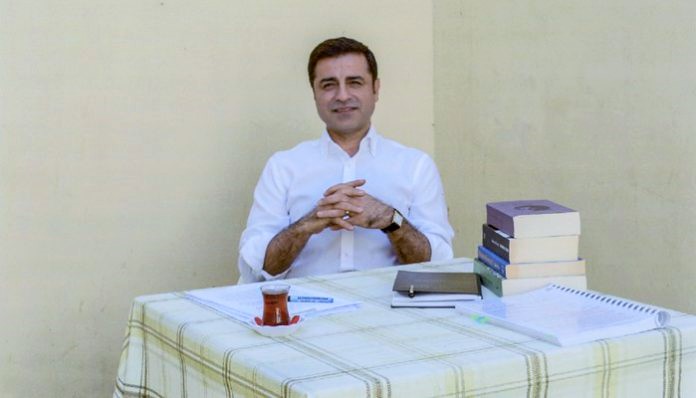
    Jailed Kurdish politician Selahattin Demirtaş has called on Turkish President Recep Tayyip Erdoğan to end the “isolation” imposed on Abdullah Öcalan, jailed leader of the outlawed Kurdistan Workers’ Party (PKK), and let him speak in the wake of Erdoğan’s recent claims about a rift between the two Kurdish figures, Turkish media outlets reported.

    Erdoğan surprised many when he said at a party meeting last week that Demirtaş will have to “give an accounting” to Öcalan, using the names of the prisons where they’re incarcerated, Edirne and İmralı, respectively, and hinting at a rift between the two.

    Demirtaş responded to Erdoğan from prison through his lawyers and said he would only give an accounting to an independent judiciary.

    Speaking to the Yeni Yaşam daily about Erdoğan’s remarks, again through his lawyers, Demirtaş suggested that Erdoğan should end Öcalan’s “isolation,” which refers to his inability to speak with his lawyers for years, and let him make a statement regarding the recent allegations.

    “How do you know what Mr. Öcalan, whom you have kept in isolation for years, said? Then, end the isolation, let Öcalan meet with his lawyers and his family regularly, [and] let’s find out together what he has to say,” Demirtaş said, adding that it wasn’t “moral” for Erdoğan to impose severe isolation on Öcalan and at the same time speak on his behalf.

    The former HDP leader said Erdoğan’s claims were aimed at creating confusion among the country’s Kurdish population before the June 2023 general election and that nobody should believe or take seriously such “nonsense rhetoric.”

    When asked his thoughts on whether Erdoğan’s statements were just comments or if they were based on information received during a recent meeting with Öcalan, Demirtaş said he had no concrete information that there had been a meeting with Öcalan. “The only thing we know is that the isolation has been going on for years in its most extreme form,” he said.

    Demirtaş further said there must be a meeting between government representatives and Öcalan, who has been jailed in a high-security prison on İmralı Island in the Sea of Marmara since 1999, because there were some issues that couldn’t be resolved without his participation in such talks.

    Demirtaş added that it was “wrong and dangerous” for Erdoğan to build his intentions to have a meeting on İmralı, if he has them, on such cheap remarks aimed at causing a rift between him and Öcalan and that they would make everyone think that Erdoğan has no intention of ending the fight between the PKK and the Turkish government but is only aiming at garnering more votes in the upcoming elections.

    The president also claimed two days before the İstanbul Metropolitan Municipality elections, which were repeated on June 23, 2019, that there was a leadership struggle between Öcalan and Demirtaş.

    However, Erdoğan’s remarks weren’t enough to change the minds of Kurdish voters, who cast strategic votes after the HDP urged them to, for the candidate of the main opposition Republican People’s Party (CHP), Ekrem İmamoğlu, contributing to his victory against the ruling Justice and Development Party (AKP) candidate.

    Turkish authorities had conducted direct talks with Öcalan for over two years until the summer of 2015, when the death of two police officers near the Syrian border became the official reason for their collapse.

    Since then, there have been continuing clashes between the PKK, listed as a terrorist organization by Turkey, the US and the EU, and Turkish security forces. More than 40,000 people, including 5,500 security force members, have been killed in four decades of fighting between the Turkish state and the PKK. turkishminute

  • Mother of 3 arrested on Gülen charges, leaving children to the care of relatives

    A mother of three was arrested on Thursday for alleged links to the Gülen movement, leaving her children to the care of relatives, the Bold Medya news website reported.

    Döndü Deniz was handed down a nine-year sentence and sent to a prison in southeastern Mardin province. She broke down in court when she heard the judges’ decision and said her three children — Sema, 9, Belma, 7, and Semra, 5 — were waiting for her at home.

    Deniz’s husband Hıdır Deniz was also arrested two years ago on similar charges and sentenced to nine years, seven months in prison. The couple are accused of working for private tuition centers affiliated with the movement, depositing money to the now-closed Bank Asya and using the ByLock smartphone messaging app.

    Turkey has considered ByLock, once widely available online, a secret tool of communication among supporters of the movement, since a coup attempt in July 2016 despite the lack of any evidence that ByLock messages were related to the abortive putsch, leading to the arrest of thousands who were using it.

    The Gülen movement, a faith-based group inspired by Turkish cleric Fethullah Gülen, is accused by the government and President Recep Tayyip Erdoğan of masterminding the failed coup and is labeled a “terrorist organization,” although the movement denies involvement in the coup attempt or any terrorist activity.

    The purge has damaged the unity of many families and left children to the care of relatives. Such separations have had a negative impact on the mental and physical well-being of the children. In cases where grandparents are responsible of the child’s care, they cannot meet every need, especially in education and schoolwork. SCF

  • Former court clerk who perished while fleeing Turkey’s crackdown laid to rest on Greek island

    Nurdan Şenocak Gündüz, 34, a former court clerk who died with her husband while trying to flee to Greece, was laid to rest on the Greek island of Kos on Saturday although none of her family members could attend the funeral due to bureaucratic obstacles, Turkish media reported.

    Speaking to the Kronos news website, Gündüz’s brother, Bilal Şenocak, said consenting to his sister being buried on Kos was a difficult decision for the family. “Thankfully the Muslim community on Kos arranged the funeral,” he said. “We could not go to Kos to identify my sister’s remains and bring her body back to Turkey. We were unable to obtain a visa, and neither the Turkish nor the Greek consulates helped us despite calls from opposition politicians and prominent public figures.”

    Gündüz and her husband died on December 3 after a speedboat carrying them overturned in the Aegean Sea.

    Şenocak said they heard about his sister’s death on social media and confirmed the news through friends in Athens. Their attempts to obtain a visa failed, and the family had to consent to burying Gündüz in Greece since it had been over a month since her death.

    “We found out that if the body was in the morgue for more than a month, they would have to send it back to Turkey after removing the internal organs,” said Şenocak. “We did not want to subject my sister’s body to more suffering so we consented for her to be buried where she was.”

    Gündüz and her husband, a former public prosecutor, were among the thousands of civil servants who were expelled from public service in Turkey in the aftermath of a failed coup attempt in the country in July 2016.

    Following the abortive putsch, the Turkish government declared a state of emergency and carried out a massive purge of state institutions under the pretext of an anti-coup fight. More than 130,000 public servants, including 4,156 judges and prosecutors, as well as 29,444 members of the armed forces, were summarily removed from their jobs for alleged membership in or relationships with “terrorist organizations” by emergency decree-laws subject to neither judicial nor parliamentary scrutiny.

    According to Şenocak, his sister and brother-in-law were successful people but could not find a job after their dismissal. Nobody wanted to give them a job and they felt increasingly marginalized from society.

    In addition to the thousands who were jailed, scores of people have fled Turkey since the coup attempt due to the massive witch-hunt carried out by the Turkish government against alleged members of the Gülen movement, inspired by Turkish Muslim cleric Fethullah Gülen. Many have tried to illegally flee Turkey as the government had canceled the passports of thousands of people.

    Turkish President Recep Tayyip Erdoğan has been targeting followers of the Gülen movement, a faith-based group since the corruption investigations of December 17-25, 2013, which implicated then-prime minister Erdoğan, his family members and his inner circle.

    Dismissing the investigations as a Gülenist coup and conspiracy against his government, Erdoğan designated the movement as a terrorist organization and began to target its members. He intensified the crackdown on the movement following a coup attempt on July 15, 2016 that he accused Gülen of masterminding. Gülen and the movement strongly deny involvement in the abortive putsch or any terrorist activity.

    Dismissed civil servants lost 70 percent of their average monthly income, a circumstance that reduced them to dire financial straits. The biggest problem they have been facing is economic hardship (97.9 percent) followed by psychological problems (88.6 percent), loss of social prestige and social exclusion (83.7 percent), disintegration of social circles (83.1 percent), unemployment/lack of employment (80.4 percent) and lack of social security (73.2 percent), respectively. SCF

  • Press Freedom in Turkey: 2021 in Review

    The Turkish government continued to muzzle the press in 2021 in a variety of ways, including imprisoning journalists and using regulatory authorities to exert financial pressure.

    According to the Committee to Protect Journalists (CPJ) Turkey, once the world’s worst jailer of journalists, is now ranked sixth in CPJ’s 2021 prison census after releasing 20 jailed journalists in the last year, but this doesn’t mean media freedom has improved in the country.

    Journalism is still associated with terrorism in Turkey, and journalistic work is used as evidence against journalists in the overwhelming majority of convictions. In most of the trials, the evidence is typically made up of social media posts, news stories, articles or TV broadcasts.

    Turkey has dropped precipitously since it was ranked 100th among 139 countries when Reporters Without Borders (RSF) published its first worldwide index in 2002, the year the ruling Justice and Development Party (AKP) came to power. The country was ranked 153rd out of 180 countries in the 2021 World Press Freedom Index.

    According to a report by the Center for American Progress (CAP), despite heavy censorship, two key trends undercut President Recep Tayyip Erdoğan’s efforts to control the media landscape: “rising distrust toward the media and increasing fragmentation in the ways that Turks get their news.”

    Cognizant of these trends, the Turkish government continued to increase its control over social media through restrictive laws. According to Freedom House’s yearly report on global Internet freedom, Internet freedom continued to decline for a third year in a row in Turkey. Hundreds of websites were blocked, online content deemed critical of President Erdoğan or his ruling AKP was removed from websites and social media platforms, while online activists, journalists and social media users were harassed both physically and online for their social media posts.

    Here is some of the most important news from 2021 in the field of press freedom:

    Press Freedom in Turkey: 2021 in Review – Stockholm Center for Freedom (stockholmcf.org)

  • Veteran actor faces 2 years in prison on charges of insulting the Turkish nation

    A veteran actor has been indicted on charges of insulting the Turkish nation on social media and faces up to two years in prison, Turkish Minute reported.

    İlyas Salman, 72, is accused in the indictment of insulting the Turkish nation, the Republic of Turkey, the Turkish Parliament and government and legal institutions of the state in a video he posted on social media on Jan. 25, 2021. The charges are based on Article 301 of the Turkish Penal Code (TCK), which criminalizes public denigration of “Turkishness, the Republic or Grand National Assembly of Turkey.”

    In the video Salman criticizes the policies of the ruling Justice and Development Party (AKP) and the people who vote for the party, which has been in power as a single-party government since 2002.

    In his statement to the prosecutor, Salman said he did not intend to insult any person or any state institution and that his remarks were within the limits of freedom of expression. The actor said he is opposed to the government and that he criticizes it for a better future for the country.

    An investigation into Salman was launched in September. The actor will appear before an İstanbul court in March.

    The infamous Article 301 of the TCK was frequently used in the 2000s to prosecute intellectuals on charges of insulting Turkishness. In the wake of widespread criticism from local and international rights groups and the European Union, the AKP government amended the controversial article in 2008 and made permission from the Justice Ministry a prerequisite for the launch of investigations based on this article. SCF

  • Turkey’s top court runs counter to ECtHR precedent in case of jailed journalist

    In a ruling running counter to a precedent set by the European Court of Human Rights (ECtHR) in an application concerning the imprisonment of journalist Nazlı Ilıcak, the Turkish Constitutional Court found no rights violations in the case of journalist Cemal Azmi Kalyoncu, who was jailed in a mass crackdown following a failed coup in Turkey in 2016 and was jailed for almost four years on bogus terrorism charges.

    According to Turkish Minute, Kalyoncu, who used to work for the now-closed Aksiyon weekly magazine, was among the dozens of journalists who were jailed in the aftermath of the failed coup. The magazine was closed down by the government along with dozens of others media outlets due to its affiliation with the Gülen movement following the coup attempt.

    The Turkish government accuses the Gülen movement of masterminding the failed coup on July 15, 2016, labeling it as a terrorist organization. The movement strongly denies any involvement in the abortive coup and any terrorist act.

    Along with fellow journalists, Kalyoncu was convicted of membership in the Gülen movement and sentenced to prison. He was released along with five other journalists in June 2020 after the country’s Supreme Court of Appeals overturned their sentences, saying the defendants’ actions did not constitute sufficient evidence to prove their affiliation with the group.

    Kalyoncu took his case to the Constitutional Court, claiming that his rights to personal liberty and security as well as his right to freedom of expression were violated due to his imprisonment.

    The court rejected the journalist’s petition in a ruling that was published in the Official Gazette on Friday, saying the journalist’s imprisonment was based on plausible grounds.

    Kalyoncu’s tweets and news reports were presented as evidence in the indictment.

    The top court’s decision came in contrast to the recent ruling by the ECtHR, which faulted Turkey in the imprisonment of journalist Ilıcak.

    Ilıcak, who was convicted on terrorism-related charges for previously working at media outlets considered close to the Gülen movement, was also among the journalists who were arrested following the failed coup.

    In mid-December the court ruled that working for media outlets close to the Gülen movement and expressing doubts about the Turkish government’s narrative on the failed coup were not plausible grounds for terrorism-related charges.

    Faulting Turkey for violating Ilıcak’s rights to liberty and security as well as freedom of expression, the ECtHR stated that the charges that led to her imprisonment for more than three years weren’t plausible.

    Turkish President Recep Tayyip Erdoğan and his Justice and Development Party (AKP) government launched a war against the Gülen movement, a worldwide civic initiative inspired by the ideas of Muslim cleric Fethullah Gülen, following corruption investigations in late 2013 that implicated then-prime minister and current President Erdoğan’s close circle.

    The war against the movement culminated after the attempted coup because Erdoğan and his AKP government accused the movement of masterminding the abortive putsch and initiated a widespread purge aimed at cleansing sympathizers of the movement from state institutions, dehumanizing its popular figures and putting them in custody.

    A total of 319,587 people have been detained and 99,962 arrested in operations against supporters of the Gülen movement since the coup attempt, Turkey’s Interior Minister Süleyman Soylu said on November 22.

    In addition to the thousands who were jailed, scores of other Gülen movement followers had to flee Turkey to avoid the government crackdown. SCF

  • Rights violations in Turkish prisons increased in 2021, says Diyarbakır Bar’s annual report

    Rights violations in Turkish prisons increased in 2021, says Diyarbakır Bar’s annual report

    The annual report on the violation of human rights in Turkish prisons published on Thursday by the Diyarbakır Bar Association has revealed that rights violations increased in 2021 and that prison conditions had worsened.

    The report said that as of November 30, 295,754 people were in prison, 1,977 of them minors. According to the report mistreatment increased in prisons, but claims of mistreatment were not investigated and the perpetrators were often not held accountable.

    Lawyer Diyar Çetedir, from the bar, said Turkish prisons had become centers for torture and mistreatment, where inmates were subject to humiliating and degrading practices. She added that the only way to stop such practices was to hold perpetrators accountable and to have transparent and effective investigations into claims of mistreatment.

    In some cases inmates who wanted to obtain a hospital report documenting injuries sustained during mistreatment or torture were prevented from doing so by prison authorities. Prison doctors were also reluctant to issue reports confirming mistreatment.

    The report said minors were not spared as they were subjected to physical violence by both prison guards and other inmates. Administrators were found to be ineffective in preventing conflicts among their prison populations.

    Those inmates who did not have money to pay were not given cleaning products or face masks. The lack of protective products was criticized especially since prisoners with COVID-19 increased over the last year.

    Moreover, quarantine cells continued to be filthy, damp and poorly maintained. Sick inmates who needed to visit the hospital frequently were made to stay in quarantine cells for days and sometimes even weeks.

    The situation of critically ill prisoners was alarming, said the report. Over the year, a number of sick inmates had died in prison because they were not released to seek proper treatment. “The death of sick prisoners can only be prevented with improved regulations where they receive better quality care and are released in time,” the report said.

    Human rights activists and opposition politicians have frequently criticized the authorities for not releasing critically ill prisoners so they can seek proper treatment. Human rights defender and Peoples’ Democratic Party (HDP) deputy Ömer Faruk Gergerlioğlu said ill prisoners were not released until they were at the point of no return.

    According to the Human Rights Association (İHD), as of June 2020 there were more than 1,605 sick inmates in Turkish prisons, approximately 600 of whom were critically ill. Although most of the seriously ill patients had forensic and medical reports deeming them unfit to remain in prison, they were not released. Authorities refuse to free them on the grounds that they pose a potential danger to society. SCF