Blog

  • France Recalls Ambassador from Australia

    France Recalls Ambassador from Australia

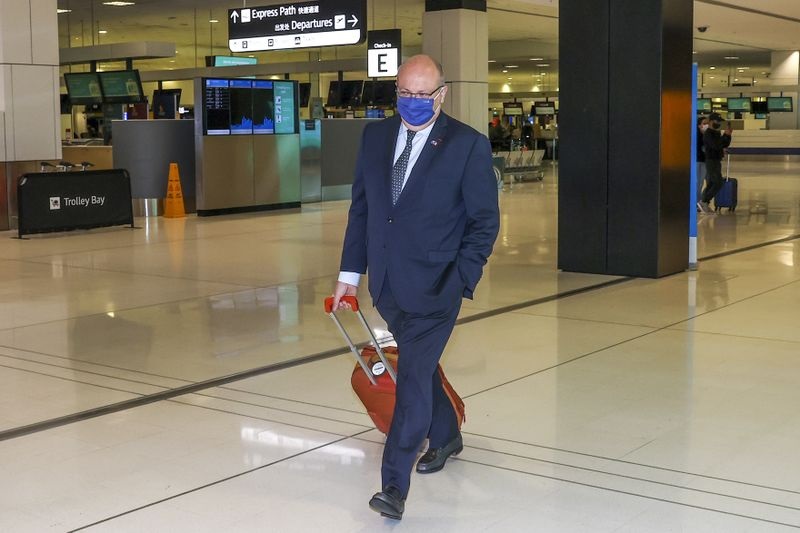
    France’s ambassador to Australia described Saturday as a “huge mistake” Australia’s surprise cancellation of a major submarine contract in favour of a US deal, delivering a final protest as the envoy was recalled from the country in an unprecedented show of anger among the allies.

    Jean-Pierre Thebault delivered his comments as he left his residence in the pandemic locked down capital of Canberra.

    “This has been a huge mistake, a very, very bad handling of the partnership,” Thebault said, explaining that the arms agreement between Paris and Canberra was supposed to be based “on trust, mutual understanding and sincerity.”

    Paris recalled its ambassadors to Australia and the United States on Friday to protest a deal among the United States, Australia and Britain to supply Australia with a fleet of at least eight nuclear-power submarines.

    Thebault flew out of Australia on a flight to Doha, Qatar, around 17 hours after the announcement from Paris.

    The US deal scraps a $90 billion-dollar contract with French majority state-owned Naval Group, signed in 2016, to build 12 conventional diesel-electric submarines.

    “I would like to be able to run into a time machine and be in a situation where we don’t end up in such an incredible, clumsy, inadequate, un-Australian situation,” the French ambassador added.

    Australian Foreign Minister Marise Payne’s office earlier had issued a statement responding to the diplomat’s recall and noting Canberra’s “regret” over its ally’s withdrawal of its representative.
    “Australia understands France’s deep disappointment with our decision, which was taken in accordance with our clear and communicated national security interests,” the statement said. It added that Australia values its relationship with France and looked forward to future engagements together.
    Payne and Defence Minister Peter Dutton are currently in the United States for annual talks with their US counterparts and their first with President Joe Biden’s administration.
    Before he was recalled, French envoy Thebault said on Friday he found out about the US submarine deal: “Like everybody, thanks to the Australian press.”

    “We never were informed about any substantial changes,” Thebault said. “There were many opportunities and many channels. Never was such a change mentioned.”

    After the US deal was made public this week, Prime Minister Scott Morrison said he told French President Emanuel Macron in June that there were “very real issues about whether a conventional submarine capability” would address Australia’s strategic security needs in the Indo-Pacific.
    Morrison has not specifically referred to China’s massive military buildup which had gained pace in recent years.
    Morrison was in Paris on his way home from a Group of Seven nations summit in Britain where he had talks with soon-to-be-alliance partners Biden and British Prime Minister Boris Johnson. Thebault said he had also been at the meeting with Macron and Morrison.

    Morrison mentioned “there were changes in the regional situation,” but gave no indication that Australia was considering changing to nuclear propulsion, Thebault said.
    “Everything was supposed to be done in full transparency between the two partners,” he added.
    Thebault said difficulties the project had encountered were normal for its scale and large transfers of technologies.
    French Foreign Minister Jean-Yves Le Drian said in a statement on Friday that recalling the two ambassadors, on request from Macron, “is justified by the exceptional seriousness of the announcements” made by Australia and the United States.
    Le Drian said Australia’s decision to scrap the submarine purchase in favour of nuclear subs built with US technology is “unacceptable behaviour between allies and partners.”

    Senior opposition lawmaker Mark Dreyfus called on the Australian government to fix its relationship with France.
    “The impact on our relationship with France is a concern, particularly as a country with important interests in our region,” Dreyfus said.
    “The French were blindsided by this decision and Mr. Morrison should have done much more to protect the relationship,” he added. 9news
  • Covid patient In Sydney was released from hospital after 399 days

    The heartfelt moment a Sydney Covid patient was released from hospital after 399 days has been captured, and he had one important message.

    A Covid-19 patient who spent more than a year recovering in a Sydney hospital has urged people not to wait and get vaccinated now.

    David Avila Mellado, 69, was finally released from Westmead Hospital earlier this month after a marathon 399 days of treatment.

    “I have in my heart everybody I remember,” he said.

    “When I do exercise in the corridor, I know everyone, everyone they say to me, ‘hello David’. I feel happy because I don’t remember many people, but they know me.”

    He was first admitted in July last year and his condition deteriorated rapidly, landing him in ICU for seven weeks.

    Once he was well enough he was transferred to the respiratory observation unit.

    Mr Avila Mellado then worked with speech pathologists, physios and other medical professionals to help regain his strength.

    His tracheostomy tube was removed in August after more than a year of not being able to breathe on his own or talk.

    Staff formed a wall of honour and clapped him as he walked out of the hospital that had been his home for 399 days.

    But his journey to recovery doesn’t end there.

    Western Sydney Health said Mr Mellado will continue rehabilitation beyond Westmead Hospital.

    Respiratory observation nurse unit manager Trudy Darling described Mr Avila Mellado as part of the family.

    “We miss him and it’s sad to see him go, but he needs to get back to his family,” she said.

    While leaving hospital Mr Avila Mellado issued an impassioned plea to Australians.

    “Many people, they don’t want the vaccine. But it’s (Covid-19) real. So they have to understand, they have to get the vaccine, they have to help the other people too,” he said.

    “My recommendation and the final idea is tell the people: don’t wait. Try to get the vaccine as soon as possible.”

    There are 1231 Covid-19 cases being treated in NSW hospitals now, with 231 of those in intensive care – 108 of whom are on a ventilator. NEWS

  • Darko Desic hands himself in 30 years after escaping from Grafton Correctional Centre

    A NSW man who has been on the run since escaping from prison almost 30 years ago has handed himself into police

    Darko Desic broke out of the Grafton Correctional Centre on the night of August 1, 1992, 13 months into a three-and-a-half-year sentence for cannabis cultivation.

    On Sunday, September 12, he handed himself in to police.

    For the last 29 years, the 64-year-old has been living and working as a labourer doing cash-in-hand jobs on Sydney’s Northern Beaches, the Daily Telegraph reports.

    But the coronavirus pandemic hit him hard and he was made homeless.

    “He said he’s been living in Avalon, just doing labouring and odd jobs for cash for almost three decades,” a police source told the newspaper.

    “He’s been completely law abiding, never come under attention, never been spoken to.

    “He told us he never caused anyone any trouble so no one ever looked at him twice.

    “But COVID stopped all the cash work, he’s become homeless over the past couple of weeks and he slept on the beach on Saturday night and said ‘stuff it, I’ll go back to prison where there’s a roof over my head’.”

    Police said Yugoslavian-born Desic used a hacksaw blade and bolt cutters to escape the prison back in 1992.

    The 64-year-old claimed he escaped because he feared he would be deported to Yugoslavia, where he expected to be punished for fleeing without completing compulsory military service, once he served his sentence, police added.

    Desic was charged with escape prisoner from lawful custody and faced court on Tuesday where he was formally refused bail.

    He is set to face court again later this month.

    Desic was mentioned on the once popular TV series Australia’s Most Wanted when someone thought they saw him in Nowra, south of Sydney. ABC, 7News

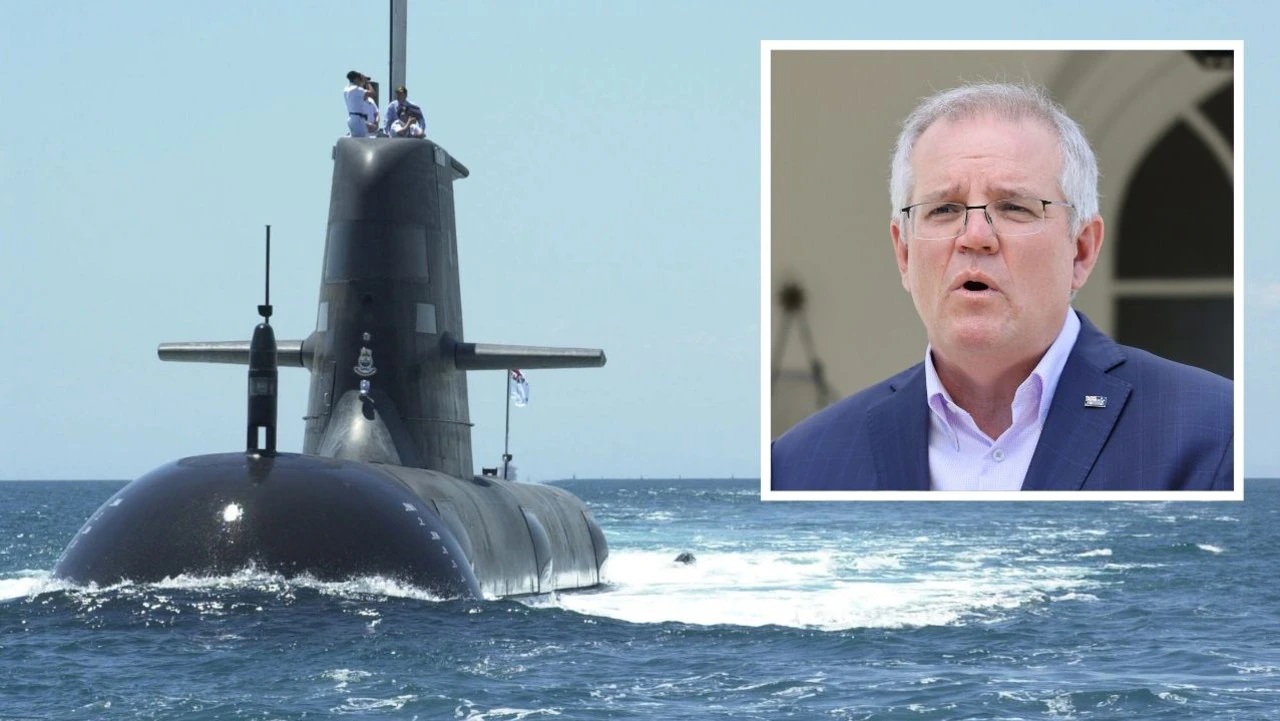
  • Australia to acquire nuclear-powered submarines in new British-American deal

    Australia to acquire nuclear-powered submarines in new British-American deal

    Australian, US and UK leaders made the major security announcement on Thursday morning.

    Australia is on the brink of a major overhaul of its $90-billion submarine building program, as part of a new formal three-way alliance with the United States and the United Kingdom.

    In a further significant move, the new submarines will be nuclear-powered.

    The federal government had initially struck a deal with French company Naval Group for the mammoth program to overhaul defence’s ability to protect Australian waters and interests.

    But after delays and problems with the deal, a joint virtual announcement was made on Thursday morning by Prime Minister Scott Morrison, UK Prime Minister Boris Johnson and US President Joe Biden.

    Mr Morrison said the three “friends of freedom” would launch an 18-month investigation into building the nuclear-powered submarines in Adelaide.

    “But let me be clear. Australia is not seeking to acquire nuclear weapons or establish a civil nuclear capability,” Mr Morrison said.

    “We will continue to meet all our nuclear non-proliferation obligations.”

    It is unclear exactly what this means for the Naval Group deal.

    The three nations also committed to a three-way partnership, called AUKUS, which will largely be focused on deeper defence and security ties.

    Mr Johnson said the AUKUS aims to preserve peace and stability in the Indo-Pacific region.

    “We’re opening a new chapter in our friendship,” he said.

    “The first task of this partnership will be to help Australia acquire a fleet of nuclear-powered submarines.”

    The 18-month consultation period will determine workforce and training requirements, production timelines and safeguards on nuclear non-proliferation agreements.

    It will be the first time Australia has acquired submarines with nuclear propulsion systems.

    Mr Biden said it was a historic step to deepen and formalise co-operation between the three nations.

    “We all recognise the imperative of ensuring peace and stability in the Indo-Pacific over the long-term,” he said.

    Mr Morrison said it was a next-generation partnership, built on a strong foundation of trust.

    “We have always seen the world through a similar lens,” he said.

    “We have always believed in a world that favours freedom, that respects human dignity, the rule of law, the independence of sovereign states and the peaceful fellowship of nations.”

    It’s badged as a way to secure stability in the Indo-Pacific region but appears aimed at bringing countries together in a show of strength against China.

    Previous Australian submarines were diesel-electric-powered, and the move to nuclear will come with a recommitment by all three nations to nuclear non-proliferation. SBS

  • Former bureaucrat missing for 9 months turns up in Ankara prison: daughter

    A former Turkish bureaucrat who had been missing since late 2020 and was suspected of being a victim of enforced disappearance has been found and is currently in a prison in Ankara, Turkish Minute reported, citing his daughter.

    “Yesterday I got a call [informing me] that my father was in prison. I waited for some time to confirm it, but I can share the news now. My father is alive,” announced Nursena Küçüközyiğit, the daughter of Hüseyin Galip Küçüközyiğit, on Twitter on Tuesday.

    Since the disappearance of her father on December 29, Nursena had been campaigning on social media, going from one courthouse to another and knocking on the doors of local and international human rights organizations in a bid to find her father and make sure that an effective investigation was carried out to locate him.

    “I only know that my father is alive. I am very happy. We had been waiting for this news for a long time. We got it today. My father is in a quarantine cell at Sincan L-type Prison,” Nursena said in remarks to the Kronos news website.

    The young woman said the news about the location of her father was first given to her grandmother by someone who introduced himself as a police officer in a phone call at around 1 a.m. on Tuesday. “Your son has been arrested. He is in Sincan Prison now. You can come and visit him,” the police officer told the grandmother, according to Nursena.

    Hüseyin Galip Küçüközyiğit was a successful lawyer who served as the chief legal counsel for the Turks Abroad and Related Communities Agency (YTB). He was fired from his job by a government decree in the aftermath of a coup attempt in July 2016. He was later sentenced to six years, three months in prison for “membership in a terrorist organization” due to his alleged ties to the Gülen movement, a faith-based group inspired by Turkish cleric Fethullah Gülen. Küçüközyiğit was released from pretrial detention pending appeal.

    In May Nursena filed an application with the European Court of Human Rights requesting an interim measure concerning her father’s case after Turkey’s Constitutional Court rejected a similar request.

    Nursena said since she has not yet visited her father in prison, she has no idea how he is doing and what kind of treatment he was subjected to.

    She said a regional appeals court as well as the country’s Supreme Court of Appeals upheld the prison sentence given to her father while he was missing and that she thinks his arrest is based on these court rulings.

    A medical student, she said she had to allocate most of her time to trying to find her father while he was missing and was unable to attend most of the classes at her university. “I will be able to spend more time on my courses now,” she added.

    The news about Küçüközyiğit prompted many to question what might have happened to the former bureaucrat during the time he was missing.

    Ömer Faruk Gergerlioğlu, a lawmaker from the pro-Kurdish Peoples’ Democratic Party (HDP) and a prominent human rights activist, tweeted: “I wonder how will the state answer the question of where he was for nine months. Camera footage showed he was being followed by three people.”

    President Recep Tayyip Erdoğan has been targeting followers of the Gülen movement since the corruption investigations of December 17-25, 2013, which implicated then-Prime Minister Erdoğan, his family members and his inner circle.

    Dismissing the investigations as a Gülenist coup and conspiracy against his government, Erdoğan designated the Gülen movement as a terrorist organization and began to target its members. He intensified the crackdown on the movement following the coup attempt, that he accused Gülen of masterminding. Gülen and the movement strongly deny involvement in the abortive putsch or any terrorist activity.

    Amnesty International issued an urgent call for action at the beginning of February for a thorough investigation of Küçüközyiğit’s disappearance.

    Nearly 30 people have reportedly been abducted by Turkish intelligence since 2016. Most of the abductions targeted members of the Gülen movement. Many of the abductees mysteriously reappeared in police custody in Ankara after six to nine-month absences.

    Apparently intimidated, most of them had kept their silence after their reappearance. Speaking at a court hearing in February 2020, one of the abductees, Gökhan Türkmen, revealed that he had been held incommunicado at a black site in Ankara run by Turkey’s intelligence agency and subjected to severe torture during his 271-day stay. Türkmen was the object of threats and was sexually harassed and abused during his enforced disappearance. He also alleged that he was visited in prison and threatened no less than six times by officials who introduced themselves as intelligence officers, pressuring him to retract his allegations of abduction and torture made at the February hearing. SCF

  • The federal government looking at ways to get more Pacific workers on Australian farms

    It comes as changes are announced to two schemes that bring workers to regional Australia from Pacific nations.

    Government says it is looking at ways to get more people from Pacific island nations into Australia to fill workforce shortages on farms.

    As plans for a new agriculture visa to bring in workers from overseas are finalised there is a critical shortfall of labour, forcing some farmers to lose their stock.

    The government says more than 27,000 Pacific islanders are ready to work in Australia, but a crucial barrier remains: quarantine arrangements and caps on international arrivals are preventing the majority from getting here.

    Minister for International Development and the Pacific Zed Seselja says he’s working with the states and territories on alternative solutions.

    “There’s been innovative approaches. We’ve seen farm quarantine. We’ve seen dedicated facilities. We’ve seen hotel quarantine. What we don’t want to see is those bumper crops going to waste,” he told SBS News.

    Senator Seselja is calling on the states to consider circumstances for Pacific nations with no COVID-19 cases.

    “We need to look afresh at places like Tonga and Samoa, who have zero community transmission. That means that we should be welcoming them with open arms,” he said.

    The government on Tuesday announced reforms to the Pacific Labour Scheme and Seasonal Worker Program, which bring workers to regional Australia from Pacific nations.

    Under the changes, businesses will be able to access these through a single online application.

    Labor market testing will be valid for 12 months instead of six, and workers will be allowed to complete training while in Australia.

    To meet immediate demand, workers already in Australia for three years can apply for an additional 12-month stay while COVID-19 travel restrictions remain.

    Some businesses will also be able to double their recruitment cap of SWP workers, while the age limit of 45 will be scrapped across both programs.

    Senator Seselja said arrivals under the agriculture visa are expected to still be months away.

    “It will take some time. There will need to be bilateral agreements with individual countries before workers can come,” he said.

    “In the short term, and in the medium term and beyond, the Pacific Labour Scheme and the Seasonal Worker Program are going to be the primary means of bringing workers. The ag-visa will complement that over time.”

    Labor’s foreign affairs spokeswoman Penny Wong said the overhaul failed to address Pacific workers’ vulnerability to mistreatment.

    “Instead of improving the schemes, [the government] has sold Pacific workers out to satisfy his National Party colleagues, while doing nothing to solve critical worker shortages for farmers who need workers now,” she said.

    The opposition is also calling for an urgent national quarantine system to give farmers more access to staff.

    Senator Seselja said strong protections under workplace laws won’t be compromised as recruitment programs for Pacific workers expand.

    “We’ve been listening to industry … they continue to make sure that we balance strong worker protections with usability and flexibility for employees so they can get the workers that they need,” he said. SBS

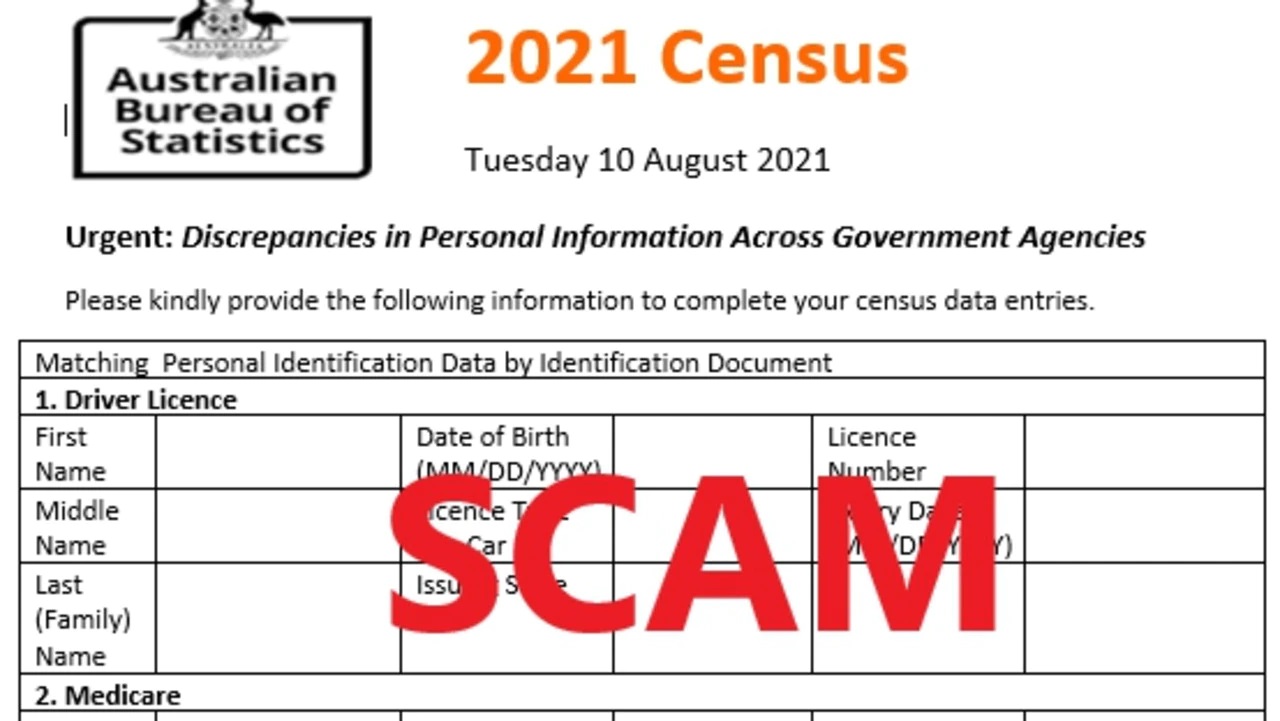
  • Aussies are being warned of a new scam pretending to be from the Australian Bureau of Statistics.

    Aussies are being warned of a new scam pretending to be from the Australian Bureau of Statistics.

    A ‘convincing’ new scam is circulating with fraudsters trying to nab the personal details of Aussies via email.

    Aussies are being warned of a new scam pretending to be from the Australian Bureau of Statistics.

    Scamwatch issued the alert on Monday, urging people to be aware of the email fraud.

    The email pretends to be from the Australian Bureau of Statistics (ABS) and looks like a Census data form.

    However, authorities warn the ABS only ever sends emails from a http://gov.au address, and will never request private information by email.

    “This convincing new scam is an attempt to steal your personal info,” Scamwatch said.

    News of the scam came as the ABS on Monday urged households that haven’t completed their Census form yet to do so quickly.

    Failure to complete the compulsory form can result in a fine of up to $222 a day.

    As of 8am Monday, an estimated 9.4 million forms in the 2021 Census had been completed.

    Australian Statistician Dr David Gruen said it was a good result so far, but urged others to get on board.

    “There are still some households that haven’t responded and it’s critical that everyone is counted,” he said.

    “The Census is the only data insight that provides a picture of the social and cultural make up of every community in Australia, so every response matters.” NEWS

  • At least 106 people died in Turkish prisons since July 2016: report

    At least 106 people died in Turkish prisons since July 2016, the Bold news portal reported.

    41 of these reportedly died of complications related to cancer, while the rest died as a result of a wide range of causes, including but not limited to the following: Heart attack, Covid-19, diabetes and respiratory diseases.

    Since the beginning of the purge in Turkey in the aftermath of the failed July 15 coup attempt, at least half of million people have been investigated while 96,000 others have been jailed due to alleged links to the Gülen group. According to the Turkish Interior Ministry, there are currently 25,655 people in Turkey’s prisons who were jailed over alleged terror, coup links.

    The purge has resulted in a drastic increase of political prisoners in Turkish prisons, some of whom are severely ill.

    According to the Human Rights Association (İHD), there are more than 1,605 sick prisoners in Turkish prisons, approximately 604 of whom are critically ill. Although most of the seriously ill patients have forensic and medical reports deeming them unfit to remain in prison, they are not released. Authorities refuse to release them on the grounds that they pose a potential danger to society. In the first eight months of 2020, five critically ill prisoners passed away because they were not released in time to receive proper medical treatment.

    Since April 2020, four seriously ill prisoners over the age of 70 have died in penal institutions; five inmates suffering from cancer died shortly after they were released; and 16 died of chronic illnesses while imprisoned. TurkeyPurge

  • How vaccine passports will work use in Australia?

    Work is progressing on the introduction of vaccine passports for international travel and domestic use – as states and territories get closer to achieving the vaccine thresholds set for reopening Australia.

    Vaccine passports are set to become a crucial tool for identifying vaccination status as Australia progresses towards a reality of living with COVID-19.

    Work is progressing to introduce the COVID-19 vaccination certificates to provide proof of vaccination for international travel as well as for domestic use.

    The federal government says international vaccine passports will be available for fully-vaccinated Australians in coming weeks as it prepares for the return of overseas travel.

    But it is unclear when the passports will be put into use for overseas travel with international borders still closed.

    It is also not clear when the certificates would be rolled out for domestic use to unlock potential privileges such as allowing people to attend venues or events.

    Here is what we know so far about how vaccine certificates could work.

    Vaccine passports for international travel

    The vaccine passport is expected to be available for international travel either on the traveller’s phone or in a printed form.

    Tourism Minister Dan Tehan on Wednesday said the final details of the vaccine passport were being worked through.

    “We are in the process of planning that – so that in the coming weeks we will have a system up and ready,” he told reporters.

    He indicated this would help facilitate both the return of outbound and inbound international travel for Australians when vaccination thresholds reach 80 per cent.

    “Australians will be able to travel overseas again and Australians will be able to return home in greater numbers,” he said.

    The certificate would consist of personal information – like what is on a passport – with a QR code.

    it is understood that Australians coming back into the country won’t need to display the certificate because it will be embedded in an individual’s passport.

    An Australian going overseas wanting to use documentary evidence would get access to an international app and use a digital seal or a QR code that can be scanned overseas.

    The certificates would be able to prove vaccine status internationally; and recognise vaccines approved by the Therapeutic Goods Administration, such as the AstraZeneca, Pfizer and Moderna vaccines.

    ‘It’s not just about crossing borders’

    Biometric and identity expert Dr Ted Dunstone said implementing the vaccine passport for international travel presented a complex challenge, with difficulties remaining around providing proof of vaccination overseas.

    “There’s a very big jigsaw puzzle of technology, policy and other considerations that need to fit together,” he told SBS News.

    “It’s not just about crossing borders. Crossing borders is part of the story but when I’m in a country, if I want to go to a cafe or do anything, I’m going to need to be able to present whatever credentials.”

    In France, people now need a health pass – or proof of vaccination – to gain access to restaurants, bars, museums and sports venues.

    In the United States, different rules also already apply for vaccinated and unvaccinated international arrivals entering the country.

    People who have had vaccines approved by the World Health Organisation are able to self-monitor for COVID-19 symptoms and get tested three to five days after arriving.

    However, those who are unvaccinated must self-quarantine for seven days following their arrival.

    Dr Dunstone also said concerns remain about the potential for these systems to become targets of fraud or a black market for certificates.

    “None of these systems are foolproof and they all come with trade-offs,” he said.

    Vaccine certificates for domestic use

    The federal government is also exploring how vaccine certificates could provide proof of vaccination via check-in apps, like the ones currently used to scan QR codes for entry into venues.

    This would allow the vaccine certificate to display information to show an individual’s vaccination status – fully vaccinated, not fully vaccinated or exempt from vaccination.

    Mr Tehan said the domestic system was aimed at making it easier for Australians to display proof of vaccination across Australia.

    “We will be looking at developing a QR code which works with state and territory apps so where you are required to prove you’ve got a vaccination certificate, you’ll be able to do so in a very simple way,” he said.

    “It will also mean when you’re going to other events – whether it be concerts or the theatre – that you’ll be able to demonstrate quite clearly your vaccination certification.”

    When will the vaccination passports become necessary?

    The government has indicated overseas travel will resume once states hit the 80 per cent vaccination threshold for those aged 16-plus; and when a robust home quarantine system is established.

    Domestically, the reopening plan based on 70 per cent to 80 per cent vaccine thresholds also marks the time when lockdowns are set to be phased out.

    Currently, around 39 per cent of the population in Australia aged over 16 is fully vaccinated.

    Tourism and Transport Forum chief executive Margy Osmond said the industry welcomed progress towards proof of vaccination certificates.

    “We think it’s very much a go-er, but the issue will be also giving businesses sufficient time to prepare for the demand when we do open and people go: ‘I’ve got my vaccination pass and I’m off’,” she told SBS News.

    Labor’s health spokesperson, Mark Butler, said businesses were desperate for certainty around the plan.

    “Business is ready to go. There is demand for international passports from our airlines, from other countries, but we don’t have a plan from Scott Morrison to actually make it work,” he told reporters. SBS

  • Armored vehicles should not be used in residential areas, says expert following death of young boy

    Security forces must stop using armored vehicles in cities and residential areas, an expert has said, following the demise of Mihraç Miroğlu, 7, who was crushed to death in southeastern Turkey last week, Deutsche Welle Turkish service (DW) reported.

    Speaking to DW, Mehmet Emin Tümür, co-chair of the Diyarbakır branch of the Mechanical Engineers Chamber, said armored vehicles are too heavy and too large for residential areas.

    “These vehicles have too many blind spots, and it’s very difficult to sense your surroundings,” he said. “If these vehicles are driven above the speed limit, it becomes very difficult to control them.”

    Tümür said the vehicles need to be fitted with better sensory devices if they are to be used in cities. He added that it was quite dangerous for them to be used in city traffic and pedestrian areas because they were developed to be used in fields and warzones.

    “These vehicles need to be fitted with alarm systems that will warn people of their approach,” he said. “Drivers also need to slow their speed by 40 to 50 percent in addition to extra sensory devices that warn of the presence of a person on the street.”

    The killing of civilians by military vehicles is common in Turkey’s Southeast, where there is a heavy military presence due to ongoing clashes between the Turkish military and the outlawed Kurdistan Workers’ Party (PKK).

    According to a report by the Human Rights Association (İHD) Diyarbakır branch, 36 people, including six women and 16 children, have been killed and 85 were injured in 63 accidents involving armored vehicles over the past 10 years.

    According to Nahit Eren, chair of the Diyarbakir Bar Association, soldiers involved in accidents with armored vehicles are seldom punished. “Drivers are rarely sentenced to prison time, while some only receive a fine,” he said. “This causes the soldiers driving these vehicles to behave recklessly.”

    Eren urged parliament’s Committee for Human Rights to conduct a thorough investigation into deaths caused by armored vehicles.

    The police officer who caused Miroğlu’s death was freed after testifying to a prosecutor. In his statement the police officer claimed he was not driving the vehicle very fast and that he regrets the tragedy.

    The İdil Public Prosecutor’s Office launched an investigation into the incident, which was classified as a fatal traffic accident. SCF