Blog

  • Turkey’s top court runs counter to ECtHR precedent in case of jailed journalist

    In a ruling running counter to a precedent set by the European Court of Human Rights (ECtHR) in an application concerning the imprisonment of journalist Nazlı Ilıcak, the Turkish Constitutional Court found no rights violations in the case of journalist Cemal Azmi Kalyoncu, who was jailed in a mass crackdown following a failed coup in Turkey in 2016 and was jailed for almost four years on bogus terrorism charges.

    According to Turkish Minute, Kalyoncu, who used to work for the now-closed Aksiyon weekly magazine, was among the dozens of journalists who were jailed in the aftermath of the failed coup. The magazine was closed down by the government along with dozens of others media outlets due to its affiliation with the Gülen movement following the coup attempt.

    The Turkish government accuses the Gülen movement of masterminding the failed coup on July 15, 2016, labeling it as a terrorist organization. The movement strongly denies any involvement in the abortive coup and any terrorist act.

    Along with fellow journalists, Kalyoncu was convicted of membership in the Gülen movement and sentenced to prison. He was released along with five other journalists in June 2020 after the country’s Supreme Court of Appeals overturned their sentences, saying the defendants’ actions did not constitute sufficient evidence to prove their affiliation with the group.

    Kalyoncu took his case to the Constitutional Court, claiming that his rights to personal liberty and security as well as his right to freedom of expression were violated due to his imprisonment.

    The court rejected the journalist’s petition in a ruling that was published in the Official Gazette on Friday, saying the journalist’s imprisonment was based on plausible grounds.

    Kalyoncu’s tweets and news reports were presented as evidence in the indictment.

    The top court’s decision came in contrast to the recent ruling by the ECtHR, which faulted Turkey in the imprisonment of journalist Ilıcak.

    Ilıcak, who was convicted on terrorism-related charges for previously working at media outlets considered close to the Gülen movement, was also among the journalists who were arrested following the failed coup.

    In mid-December the court ruled that working for media outlets close to the Gülen movement and expressing doubts about the Turkish government’s narrative on the failed coup were not plausible grounds for terrorism-related charges.

    Faulting Turkey for violating Ilıcak’s rights to liberty and security as well as freedom of expression, the ECtHR stated that the charges that led to her imprisonment for more than three years weren’t plausible.

    Turkish President Recep Tayyip Erdoğan and his Justice and Development Party (AKP) government launched a war against the Gülen movement, a worldwide civic initiative inspired by the ideas of Muslim cleric Fethullah Gülen, following corruption investigations in late 2013 that implicated then-prime minister and current President Erdoğan’s close circle.

    The war against the movement culminated after the attempted coup because Erdoğan and his AKP government accused the movement of masterminding the abortive putsch and initiated a widespread purge aimed at cleansing sympathizers of the movement from state institutions, dehumanizing its popular figures and putting them in custody.

    A total of 319,587 people have been detained and 99,962 arrested in operations against supporters of the Gülen movement since the coup attempt, Turkey’s Interior Minister Süleyman Soylu said on November 22.

    In addition to the thousands who were jailed, scores of other Gülen movement followers had to flee Turkey to avoid the government crackdown. SCF

  • Rights violations in Turkish prisons increased in 2021, says Diyarbakır Bar’s annual report

    Rights violations in Turkish prisons increased in 2021, says Diyarbakır Bar’s annual report

    The annual report on the violation of human rights in Turkish prisons published on Thursday by the Diyarbakır Bar Association has revealed that rights violations increased in 2021 and that prison conditions had worsened.

    The report said that as of November 30, 295,754 people were in prison, 1,977 of them minors. According to the report mistreatment increased in prisons, but claims of mistreatment were not investigated and the perpetrators were often not held accountable.

    Lawyer Diyar Çetedir, from the bar, said Turkish prisons had become centers for torture and mistreatment, where inmates were subject to humiliating and degrading practices. She added that the only way to stop such practices was to hold perpetrators accountable and to have transparent and effective investigations into claims of mistreatment.

    In some cases inmates who wanted to obtain a hospital report documenting injuries sustained during mistreatment or torture were prevented from doing so by prison authorities. Prison doctors were also reluctant to issue reports confirming mistreatment.

    The report said minors were not spared as they were subjected to physical violence by both prison guards and other inmates. Administrators were found to be ineffective in preventing conflicts among their prison populations.

    Those inmates who did not have money to pay were not given cleaning products or face masks. The lack of protective products was criticized especially since prisoners with COVID-19 increased over the last year.

    Moreover, quarantine cells continued to be filthy, damp and poorly maintained. Sick inmates who needed to visit the hospital frequently were made to stay in quarantine cells for days and sometimes even weeks.

    The situation of critically ill prisoners was alarming, said the report. Over the year, a number of sick inmates had died in prison because they were not released to seek proper treatment. “The death of sick prisoners can only be prevented with improved regulations where they receive better quality care and are released in time,” the report said.

    Human rights activists and opposition politicians have frequently criticized the authorities for not releasing critically ill prisoners so they can seek proper treatment. Human rights defender and Peoples’ Democratic Party (HDP) deputy Ömer Faruk Gergerlioğlu said ill prisoners were not released until they were at the point of no return.

    According to the Human Rights Association (İHD), as of June 2020 there were more than 1,605 sick inmates in Turkish prisons, approximately 600 of whom were critically ill. Although most of the seriously ill patients had forensic and medical reports deeming them unfit to remain in prison, they were not released. Authorities refuse to free them on the grounds that they pose a potential danger to society. SCF

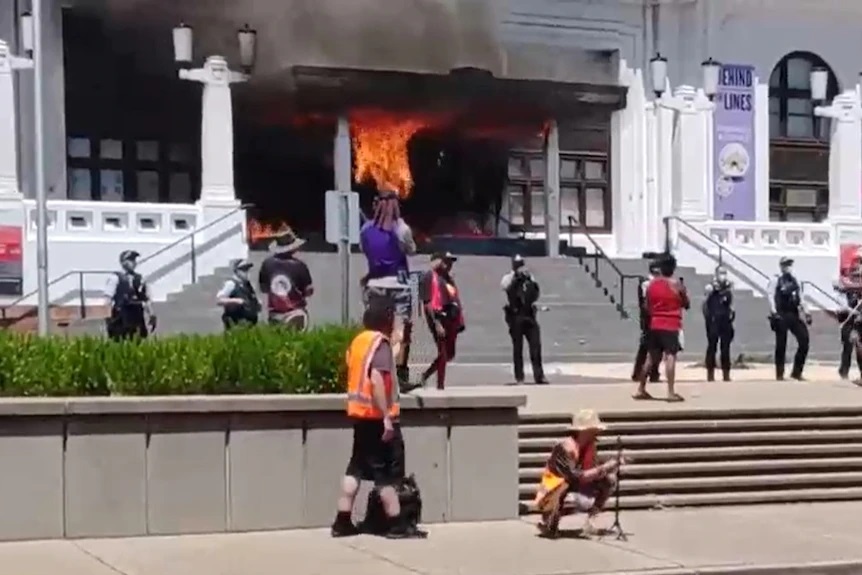
  • Old Parliament House’s front door set on fire a second time as protests in Canberra continue

    Old Parliament House’s front door set on fire a second time as protests in Canberra continue

    The front entrance of Old Parliament House has been set on fire for the second consecutive week as protests continue outside the building.

    A line of police officers moved the demonstrators away from the building after the doors began to burn.

    After the blaze was put out, several dozen protesters continued to confront police officers and the media.

    Crowds began gathering last week ahead of the 50th anniversary of the Aboriginal Tent Embassy, which was established on Australia Day in 1972.

    However, the ABC has been told the protesters are not associated with the embassy.

    Old Parliament House now houses the Museum of Australian Democracy, which was forced to close last week due to the previous fire.

    It remains unclear how Thursday’s fire started, though last week’s blaze began when a group of people lit a ceremonial fire next to the doors.

    Flames from Thursday’s fire had reached the building’s roof line when emergency crews arrived about 11:30am.

    No fire damage within Old Parliament House, authorities say

    Superintendent Sam Evans from ACT Fire and Rescue said ACT Fire Rescue received notifications of the fire at 11:36am via multiple 000 calls and the automated fire alarm system on site.

    “On arrival the front facade of the building well alight, fire control was achieved within 15 to 20 minutes,” he said.

    “There has been no fire extension inside the structure, although the installation sprinkler system within the building did activate.

    “There is water and smoke damage inside the structure, but no fire damage within the structure. It has been confined to the front facade of the building.”

    Andrew Harper from the Australian Museum of Democracy said damage to the building would be assessed in the days to come, and the building would reopen to the public as soon as possible.

    “We will be doing a clean-up over the next few days and we will be assessing the damage, and we will be closed for some time,” he said.

    “As soon as we can we will be back open and sharing this iconic building with the public.”

    Mr Harper said safety was the number one concern while the blaze was brought under control, but the clean-up would likely be a more strenuous process.

    “Of course, our primary concern is with safety and that’s what we’ve dealt with today, but then we’ll get to the recovery of the building and the care of it as soon as we can,” he said.

    “Most of the fire was at the front and the water is in that front part of the building, so there are areas that we think will be quite okay and there are other areas we’d be more concerned about checking out as soon as we can.

    “The front doors are the original front doors from 1927, so they’re are iconic part of the building. I don’t know yet as to whether they’ll be salvageable or not.”

    Commander Linda Champion from the Australian Federal Police said the fire likely began during a smoking ceremony performed by protesters, which police were aware of and had approved to occur.

    “There was a small smoking ceremony and that is something that we had agreed with a lot of the members who were attending each day as part of a peaceful protest,” she said.

    “It then became a little bit out of hand and then when ACT police went to respond, that’s when it was greatly exacerbated.”

    Minister condemns ‘criminal damage’
    Ben Morton, who as Special Minister of State is responsible for the historic building, denounced the actions that led to the fire.

    He released a statement regarding the fire, saying “criminal damage has no place in our democracy”.

    “Our democratic success is based on the principles of freedom, respect, fairness and equality of opportunity,” Mr Morton said.

    “No system of government is perfect. In our democracy, the freedom to peacefully protest is one that we can and should celebrate.”

    Mr Morton said that, while all Australians had the right to peaceful protest, the actions allegedly taken by protesters would subvert the message that peaceful protesters were trying to send.

    “Today’s actions at Old Parliament House were not peaceful,” he said.

    “The resulting damage undermines the message that peaceful protesters seek to deliver.”

    Mr Morton thanked fire responders for dealing with the fire, and said the government would expect criminal actions would be appropriately resolved by the justice system.

    “It is the government’s expectation that all illegal activity should be dealt with by the police and the courts to the full extent possible,” he said.

    “I thank the first responders. They should not have to put themselves in harm’s way to deal with the fire.”

    Mr Morton also confirmed all damages would be fixed, and the historic building would be fully restored to its original condition.

    ACT Chief Minister Andrew Barr also condemned the alleged acts of the protesters, saying he was disappointed by the damaging of the heritage-listed building.

    “People have a right to protest but that protest must be peaceful, and the actions that we’ve seen in setting fire to a heritage listed building, really disappointing and should be condemned.” ABC

  • Motherless children left to care of relatives after father sent to prison over Gülen links

    Two motherless children aged 7 and 2 were left to the care of their relatives in different cities after their father was sent to prison last Thursday to serve a terrorism-related sentence due to his alleged ties to the Gülen movement, Bold Medya news website reported.

    Muhammed Hanefi Aksoy was working at a student dormitory affiliated with the movement before it was shut down in 2016. He was sentenced to seven years, six months in prison on conviction of membership in a terrorist organization for working at a Gülen-affiliated institution, having an account at the now-closed Bank Asya, one of Turkey’s largest commercial banks at the time, and using the ByLock encrypted messaging app.

    His wife Nagihan Aksoy died in September in a traffic accident. She was a former teacher dismissed from her job by an emergency decree due to her alleged links to the Gülen movement. Two-year-old Fatih is currently staying with his uncle in Yalova province, and Hümeyra is with her aunt in Nevşehir province, 700 kilometers away. Their father is in a prison in İzmir.

    Turkey’s Justice and Development Party (AKP) government launched a war against the Gülen movement, a worldwide civic initiative inspired by the ideas of Muslim cleric Fethullah Gülen, after the corruption investigations of December 17-25, 2013 that implicated then-prime minister and current President Recep Tayyip Erdoğan’s family members and inner circle.

    Dismissing the investigations as a Gülenist coup and conspiracy, the AKP government designated the movement as a terrorist organization and began to target its members. The government intensified the crackdown on the movement following a coup attempt on July 15, 2016 that they accused Gülen of masterminding. Gülen and the movement strongly deny involvement in the abortive putsch or any terrorist activity.

    Turkey considers ByLock, once available in Google Play and Apple’s App Store, a secret tool of communication among supporters of the faith-based Gülen movement, leading to the arrest of thousands who were using it. The UN Human Rights Council’s Working Group on Arbitrary Detention stated in October 2018 that detention, arrest and conviction based on ByLock use in Turkey violated of Articles 19, 21 and 22 of the International Covenant on Civil and Political Rights.

    Following the abortive putsch, the Turkish government declared a state of emergency and carried out a massive purge of state institutions under the pretext of an anti-coup fight. More than 130,000 public servants were summarily removed from their jobs for alleged membership in or relationships with “terrorist organizations” by emergency decree-laws subject to neither judicial nor parliamentary scrutiny.

    A total of 319,587 people have been detained and 99,962 arrested in operations against supporters of the Gülen movement since the coup attempt, Turkey’s Interior Minister Süleyman Soylu said in November. SCF

  • Boğaziçi University academic says he was fired over a tweet

    Can Candan, a former faculty member at İstanbul’s Boğaziçi University and a documentary filmmaker, has said he was informed that his dismissal from the university in July was due to an administrative investigation into one of his tweets, Turkish Minute reported.

    Candan revealed in a series of tweets late Tuesday that he received a notice from the university more than five months after his dismissal saying he was fired due to an administrative investigation into a tweet of his in which he quoted Erkan Baş, the chairman of the Workers’ Party of Turkey (TİP).

    According to the media reports, the tweet quoted Baş as saying, “Is there one person who would recognize you if the AKP [ruling Justice and Development Party] and its accomplice, Melih [Bulu], hadn’t stood behind you?”

    Baş’s remarks were directed at Prof. Dr. Naci İnci, the then-vice rector of Boğaziçi University who replaced Melih Bulu as acting rector in July. The TİP leader was criticizing İnci due to his cancelation of a course in May taught by lawyer-academic Feyzi Erçin, who had been giving classes at Boğaziçi for eight years.

    Candan said the university administration summoned him to give his defense as part of the investigation on Dec. 29, adding that he informed them via a written response that he would not be coming to their office at the specified time since the investigation he was facing was “against procedure and the law.”

    “They are now trying to conduct an investigation that they didn’t conduct and conclude [when they should have] five-and-a-half months ago but which they cited as the reason for my unjust and unlawful dismissal. Why?” Candan said.

    The former Boğaziçi academic explained that it was because the court wanted to see the documents for the investigation launched into him as part of a lawsuit he filed against the rector’s office in August.

    Candan demanded an injunction and annulment of his dismissal by İnci in a lawsuit that also includes the left-wing Education and Science Workers’ Union (Eğitim-Sen), of which Candan is a member, as a complainant.

    A vocal supporter of the resistance against appointed rectors at Boğaziçi, where he had been a lecturer since 2007, Candan was fired by İnci, who was appointed acting rector after the dismissal of Bulu.

    A prolonged series of protests broke out at Boğaziçi University after President Recep Tayyip Erdoğan appointed Bulu, a founding member of the ruling AKP’s Sarıyer district branch and former deputy chairman of the AKP’s İstanbul provincial chapter, as rector in early January.

    Following the dismissal of Bulu in July, İnci was appointed acting rector despite a 95 percent disapproval rating he received in polls held among the university community to determine possible rector candidates.

    Although 17 candidates emerged with high rates of approval, the president appointed İnci, again prompting outrage among academics and students. SCF


  • Late-stage cancer patient arrested over Gülen links

    Refik Yeşil, 68, a late stage cancer patient, was arrested on Monday on terrorism charges for alleged links to the faith-based Gülen movement, the Stockholm Center for Freedom reported, citing the Bold Medya news website.

    Police officers first made contact with Yeşil during a morning hospital visit and asked about his illness. They later went to his house in the afternoon and detained him. He was arrested by a court after spending the night in a police detention center in Antalya province.

    Yeşil was diagnosed with lymphoma five months ago and was going through diagnostic tests in preparation for his fourth round of chemotherapy. He is accused of membership in a terrorist organization for managing a labor union, AKÇADER, which was closed down for its alleged links to the Gülen movement; for having an account at the now-closed Bank Asya, one of Turkey’s largest commercial banks at the time; and for using the ByLock encrypted messaging app. The app was widely available in Apple’s App Store and Google Play, but the government claims it was exclusively used by followers of the movement and considers it evidence of terrorist activity.

    Yeşil’s trial is expected to begin on January 18.

    Turkey’s Justice and Development Party (AKP) government launched a war against the Gülen movement, a worldwide civic initiative inspired by the ideas of Muslim cleric Fethullah Gülen, after the corruption investigations of December 17-25, 2013 that implicated then-prime minister and current President Recep Tayyip Erdoğan’s family members and inner circle.

    Dismissing the investigations as a Gülenist coup and conspiracy, the AKP government designated the movement as a terrorist organization and began to target its members. They intensified the crackdown on the movement following a coup attempt on July 15, 2016 that they accused Gülen of masterminding. Gülen and the movement strongly deny involvement in the abortive putsch or any terrorist activity.

    The Turkish government accepted such daily activities as having an account at or depositing money in a Gülen movement-affiliated bank, working at any institutions linked to the movement or subscribing to certain newspapers and magazines as benchmarks for identifying and arresting tens of thousands alleged members of the movement on charges of membership in a terrorist organization.

    According to a statement by Interior Minister Süleyman Soylu, as of November 15, 2021 a total of 319,587 people had been detained and 99,962 arrested in operations against supporters of the Gülen movement since the coup attempt.

  • Photographs of former judge who died in prison cell shed light on poor conditions

    Photos of former judge Teoman Gökçe, 49, who died of a heart attack in a solitary prison cell on April 2, 2018, have been revealed by the Bold Medya news website, shedding light on the unsanitary conditions in which he was forced to live, the Stockholm Center for Freedom reported on Tuesday.

    Photographs show Gökçe’s belongings scattered all over the floor and his dinner left untouched on the radiator. The windows of his cell were boarded up so light could not enter the room. Gökçe had requested many times to be transferred from the solitary cell to a regular one with other inmates before his death.

    CCTV recordings at the prison show Gökçe in distress being taken to the ground floor by 10 guards. One starts to administer a heart massage while waiting for an ambulance. As the ambulance approaches three nurses get out and continue the heart massage, but Gökçe does not seem to respond. According to one of the guards, Gökçe’s face had turned purple and he was frothing at the mouth.

    Recordings show Gökçe was taken to the hospital 40 minutes after he was found unresponsive in his cell. His family demanded to know why it took so long for him to be hospitalized. They also wanted to know whether Gökçe had undergone a physical examination before his death and if the doctors had found a problem with his heart.

    Gökçe was arrested on July 21, 2016 for allegedly participating in a coup attempt on July 15, 2016. He was accused of membership in an armed terrorist group and attempting to overthrow the government. Gökçe was sent to Ankara’s Sincan T-Type Prison, where we was classified as a “dangerous prisoner” and was not allowed to interact with other inmates.

    Following the abortive putsch, the Turkish government declared a state of emergency and carried out a massive purge of state institutions under the pretext of an anti-coup fight. More than 130,000 public servants, including 4,156 judges and prosecutors as well as 29,444 members of the armed forces were summarily removed from their jobs for alleged membership in or relationships with “terrorist organizations” by emergency decree-laws subject to neither judicial nor parliamentary scrutiny.

    A total of 319,587 people have been detained and 99,962 arrested in operations against supporters of the Gülen movement, a worldwide civic initiative inspired by the ideas of Muslim cleric Fethullah Gülen, since the coup attempt, Turkey’s Interior Minister Süleyman Soylu said on November 22.

    Turkey’s Justice and Development Party (AKP) government launched a war against the Gülen movement after the corruption investigations of December 17-25, 2013 that implicated then-prime minister and current President Recep Tayyip Erdoğan’s family members and inner circle.

    Dismissing the investigations as a Gülenist coup and conspiracy, the AKP government designated the movement as a terrorist organization and began to target its members. The government locked up thousands, including many prosecutors, judges and police officers involved in the investigation, as well as journalists who reported on them.

    AKP government intensified the crackdown on the movement following the coup attempt on July 15, 2016 that they accused Gülen of masterminding. Gülen and the movement strongly deny involvement in the abortive putsch or any terrorist activity.

    Gökçe appealed several times to the Constitutional Court, saying his solitary confinement was unlawful. However, all his requests to be transferred to a regular cell were rejected.

    Gökçe was not the first inmate to be found dead in a solitary cell. Former teacher Muzaffer Özcengiz died in his cell on April 27, 2019. In a final letter Özcengiz had said the cell was unsanitary and that he was kept in inhumane conditions. “As my living conditions deteriorate, so is does my health,” he said. “My right to life is being violated, and for this reason I request to be transferred to a regular cell.”

    Özcengiz was also arrested on alleged Gülen links but was not given a reason as to why he was kept in a solitary cell.

    Former brigadier general Zaki Hasan committed suicide in his cell in Silivri Prison on April 30, 2019.

    Former deputy policy inspector Mustafa Kabakçıoğlu, 44, died in a solitary quarantine cell in August 2020. Post-mortem photographs revealed his cell was filthy and damp. He was left alone in the cell although he was struggling with multiple health problems.

    Speaking to Deutsche Welle Turkish service (DW), Peoples’ Democratic Party (HDP) deputy Ömer Faruk Gergerlioğlu said the Ministry of Justice had not disclosed the exact number of people in solitary cells.

    However, he said he believed the number had drastically increased after the government declared a state of emergency following the coup attempt. “The ministry is silent about the conditions in solitary cells,” he said. “Inmates in solitary cells are left to their fate. They do not have proper access to healthcare, they are not allowed to walk in the yard or participate in activities.”

    Gergerlioğlu added that according to the law an inmate can only be held in a solitary cell for a maximum of 20 days but that currently there were inmates in solitary cells who had been there for more than two years.

    Human rights activists have said the number of prisoners in solitary cells reaches into the thousands.

  • Leader of right-wing party warns Turkish citizens of ‘Syrian threat’ in anti-migrant social media post


    Ümit Özdağ, leader of the newly established far-right Victory Party (ZP), warned Turkish citizens of a “Syrian threat” in a video shared on Twitter on Monday, sparking outrage among academics, activists and politicians, the Stockholm Center for Freedom reported.

    In the video Özdağ visited a shop run by Syrian owners and asked them if they had a permit for the shop. He then  asked them if they ever thought about returning to Syria. When the owner said he did not want to go back, Özdağ left the shop.

    Sharing the video on Twitter, Özdağ said there were 900,000 shops in Turkey owned by Syrians, which constituted a threat to Turkey. “This man came seven years ago and can barely speak Turkish,” he said. “He has acquired Turkish citizenship and even a gun license. He was able to open a shop, and there are thousands of Syrians like him.”

    Mustafa Yeneroğlu, a deputy from the Democracy and Progress Party (DEVA), said the real threat was xenophobic people like Özdağ. “This man is targeting ordinary people who are just getting on with their lives,” he said. “What is even more dangerous is that the mainstream media allows such people a place on their platforms.”

    Nesi Altaras, the editor of Avlaremoz, an online magazine focusing on topics concerning Turkey’s minorities, said Özdağ had no right asking the shop owners about permits. “Migrants are so intimidated by the increasing xenophobia, they can’t even protest this ridiculous request by Özdağ,” he said. “Özdağ is behaving as if he is superior to the Syrians and has the right to do anything.”

    Altaras drew attention to the 12,000 people who had liked Özdağ’s video and said they were potential perpetrators of hate crimes.

    Journalist Erem Şentürk criticized Özdağ and said he was a right-wing populist in search of new victims.

    This is not the first incident in which Özdağ has targeted migrants. In November he  started a signature campaign to throw Syrian and Afghan refugees out of Turkey. Sharing a link to the campaign on social media, Özdağ urged people to participate to curb the “migrant invasion.”

    Refugees in Turkey have been increasingly targeted by hate speech and hate crimes and are blamed for many of Turkey’s social and economic troubles.

    Turkish media including both pro-government and opposition outlets have fueled and exploited the flames of hatred against people who fled their countries and sought refuge in Turkey.

    Last week news of three Syrian men being burned to death in western Izmir province emerged.

    A Turkish man named Kemal Korkmaz poured gasoline over the Syrians, identified as Mamoun al-Nabhan, 23; Ahmed al-Ali, 21; and Muhammed el-Bish, 17, while they were asleep and set them on fire on Nov. 16. The perpetrator admitted in his testimony to a prosecutor to have committed a hate crime.

    Prominent public figures shared their outrage on social media and said the hatred of refugees and migrants had come to a point where they were being set on fire. Some people pointed out that hate crimes had become so normalized in the country that nobody was even talking about the terrible incident.

    According to the latest figures provided by Interior Minister Süleyman Soylu on Nov. 22, Turkey is home to a total of 4,038,857 refugees from around the world. Speaking to parliament’s Planning and Budget Committee, Soylu said 3,731,028 of these were Syrian refugees who are residing in Turkey under temporary protection status. The number of refugees with international protection status is 307,829.

  • A wide-scale search is underway for two children missing in rural NSW.

    Police were called to Cedars Road, Kains Flat, about 35km north-east of Mudgee in the Mid-Western region about 5.45pm on Monday.

    Police were told 14-year-old boy Eli Jones and 12-year-old girl Hannah Jones went for a walk about 2.30pm and did not come back.

    Police rescue, specialist police and the dog squad are all involved in the search, along with NSW Ambulance, Rural Fire Service Volunteer Rescue Association and the Westpac Lifesaver Rescue Helicopter Service.

    Eli Jones is described as being of Caucasian appearance, about 175cm tall, with brown hair and believed to be wearing a grey t-shirt.

    Hannah Jones is described as being of Caucasian appearance, about 160cm tall, with brown hair and believed to be wearing a pink top. 9NEWS

  • İstanbul mayor defiant as interior ministry accuses his staff of terrorist links

    A defiant İstanbul mayor on Monday called on the country’s interior minister to resign in the wake of an investigation launched by the ministry into municipal employees over alleged terrorism links, Turkish Minute reported.

    The Turkish Interior Ministry on Sunday claimed that 557 municipal personnel hired by İstanbul Mayor Ekrem İmamoğlu had links to “terrorist groups,” including the Kurdistan Workers’ Party, (PKK) the Marxist–Leninist Communist Party, (MLKP) and the Revolutionary People’s Liberation Party/Front (DHKP/C).

    “A special investigation has been launched by our ministry so that all aspects of the issue can be looked into,” the Interior Ministry said in a statement.

    İstanbul Mayor Ekrem İmamoğlu, who spoke at a news conference at his Republican People’s Party (CHP) headquarters in Ankara along with 11 other CHP mayors, said one should be careful when speaking about an institution that has more than 86,000 employees, adding that if terrorists can walk free and find jobs in public institutions, Interior Minister Süleyman Soylu should resign due to his failure to take action.

    “If you detect anyone [who is a terrorist], inform us, and we can do what needs to be done,” İmamoğlu said.

    On Sunday the İstanbul mayor said those attacking his municipality would see only greater unity in İstanbul, adding that the municipality and its workers will claim their rights in court.

    Minister Soylu, however, insisted that the investigation was not political.

    “We have no business with anyone’s municipality, but we do have business with the fight against terrorism, and for this we have to keep Turkey on the alert,” Soylu said on Monday.

    The ministry also claimed that some people reportedly had links to US-based preacher Fethullah Gülen and the movement inspired by him. Turkish President Recep Tayyip Erdoğan has been accusing the Gülen movement of masterminding a failed coup attempt in 2016 and terrorism. The movement denies any involvement in the coup bid or any terrorist activity.

    The investigation came after Erdoğan also accused the Istanbul mayor of hiring people with terrorist links. “They recruited 45,000 people, among whom are some affiliated with terrorist organizations,” Erdoğan said on Sunday at a party meeting.

    Mayor İmamoğlu has been one of the most frequently targeted figures by Erdoğan and his government since the 2019 local elections saw the ruling party defeated in several big cities.

    İmamoğlu, the CHP candidate in the elections who initially won in local polls on March 31 by a narrow margin against ruling party candidate Binali Yıldırım, scored a much larger victory during a re-run on June 23.

    İmamoglu has since become one of the most popular opposition politicians in the country. Many see him as the opposition’s likely candidate for the presidency against Erdoğan in the next elections.

    According to a Metropoll survey conducted in December, Erdoğan and İmamoğlu would receive 36.6 percent and 48.7 percent of the vote, respectively, if a presidential election were to be held today. SCF