Category: World

  • Turkey’s post-coup detention of judges and prosecutors was unlawful: ECtHR

    The European Court of Human Rights (ECtHR) on Tuesday ruled that the pretrial detention of 230 judges and prosecutors after a failed 2016 coup against President Recep Tayyip Erdoğan was unlawful, holding that Turkey is to pay 5,000 euros in non-pecuniary damages to every applicant.

    The ECtHR ruled in the cases Ataman and Others v. Türkiye, Bayram and Others v. Türkiye and Geleş and Others v. Türkiye that the pre-trial detention of the 209 applicants “had not taken place in accordance with a procedure prescribed by law.”

    In the case of “Ulusoy and Others v. Türkiye,” the Strasbourg court said the grounds for the 21 applicants’ detention were “not of a nature” to constitute “reasonable suspicion.”

    Members of the Turkish judiciary had been arrested after the failed coup as part of a mass crackdown on the Gülen movement, inspired by Turkish cleric Fethullah Gülen, whom the president blames for the coup attempt. Gülen and the movement deny any involvement.

    Following the abortive putsch, the Turkish government declared a state of emergency and carried out a massive purge of state institutions under the pretext of an anti-coup fight. More than 130,000 public servants, including 4,156 judges and prosecutors, as well as 29,444 members of the armed forces, were summarily removed from their jobs for alleged membership in or relationships with “terrorist organizations” by emergency decree-laws subject to neither judicial nor parliamentary scrutiny.

  • Turkish gov’t spent $307 mln on representation in first half of 2022


    A total of TL 5.6 billion ($307 million) was spent for representation and expenses incurred for receptions at public institutions in Turkey in the first six months of 2022, the Birgün daily reported on Friday, citing official data.

    According to Birgün’s report, which was based on figures from the Public Procurement Authority (KİK) –- a regulatory and monitoring agency –- government agencies and offices spent $307 million on such items as accommodation, travel, food and receptions that are listed as “representation and entertainment” expenses.

    Birgün reported that in most cases services were directly contracted for from a private firm without the need to hold a tender, which according to critics is a method that benefits pro-government companies.

    The statistics come as Turkey has been suffering from a deteriorating economy over the past several years, with high inflation and unemployment as well as a poor human rights record. President Recep Tayyip Erdoğan is criticized for mishandling the economy, emptying the state’s coffers and establishing one-man rule in the country where dissent is suppressed and opponents are jailed on politically motivated charges.

    A survey conducted by the Yöneylem Social Research Center revealed last month that 69.3 percent of Turks struggle to pay for food, 53.8 percent can’t meet their everyday expenses and 60.5 percent are struggling to pay their utility bills, while the majority of participants also stated that their income had decreased (69.5 percent), debts had increased (64.8 percent) and that they were depressed due to financial difficulties (65 percent).

    When they were asked, “When you think about the current state of the Turkish economy, who is responsible for this situation?” 50.5 percent of respondents answered “Turkish President Recep Tayyip Erdoğan.”

    A staggeringly high cost of living has become the new normal in Turkey, where recent increases in food and utility prices are pushing up inflation, further crippling the purchasing power of citizens.

    According to official data, consumer prices accelerated to a 24-year high of 79.6 percent in July, up from 78.6 percent in June.

    An increasing number of Turks have complained on social media about rising electricity bills and falling into debt. Many have said even basic foods such as vegetables have become a luxury as prices have risen by nearly 400 percent.

  • Court blocks access to reports on mob boss’s claims about pro-gov’t media group executive


    An İstanbul court has blocked access to 33 online news stories covering recent social media posts by mafia boss Sedat Peker that included allegations about Serhat Albayrak, deputy chairman of the Turkuvaz Media Group, which has close ties to President Recep Tayyip Erdoğan and his ruling Justice and Development Party (AKP), the Kronos news website reported on Saturday.

    Serhat Albayrak is also the brother of Berat Albayrak, Erdoğan’s son-in-law and a former finance minister.Over the last weekend Peker, the head of one of Turkey’s most powerful mafia groups who has been making shocking revelations since early 2021 about state-mafia relations, drug trafficking and murders implicating state officials and their family members, unveiled a new series of allegations from his Twitter handle, revealing a network of bribery and corruption at Turkey’s stock exchange.

    Peker said AKP lawmaker Zehra Taşkesenlioğlu, her brother and former Capital Markets Board (SPK) chair Ali Fuat Taşkesenlioğlu; Erdoğan’s advisor Serkan Taranoğlu and pro-government daily Hürriyet columnist Burak Taşçı were all involved in the operation of the bribery network extorting the owners of companies that are listed on the stock exchange.

    Peker claimed that Taranoğlu and Taşkesenlioğlu demanded a bribe of 12 million lira ($660,000 as of Aug. 29, 2022) from Mine Tozlu Sineren, the owner of Marka Investment Holding, for processing her company’s request to issue new shares through increasing capital. Sineren corroborated Peker’s allegations in a live broadcast and said no action has been taken by the authorities despite her complaints.

    Peker also pointed to Albayrak as “the power behind” Ali Fuat Taşkesenlioğlu, a claim Albayrak previously denied in a statement released by his lawyer.

    The İstanbul Anadolu 5th Criminal Court of Peace banned access to 33 news pieces covering Peker’s allegations about Albayrak, including those published by the Kronos, Medyaradar, TELE1, Muhalif and Birgün daily news websites, on the grounds that they “violated the personal rights” of Albayrak, according to Kronos.

    The same court also reportedly rejected a demand to block access to news pieces that include statements by Albayrak’s lawyer.

    Turkey was shaken by two corruption investigations implicating then-prime minister and current president Erdoğan’s inner circle that became public Dec. 17-25, 2013. Erdoğan’s AKP government subsequently suppressed the scandal by managing to control the judiciary by creating special criminal courts headed by a single judge, thanks to the AKP’s parliamentary majority.

    These judges then jailed all the police and prosecutors who had conducted the 2013 corruption investigations, while Erdoğan and his family members who were implicated have never appeared in court.
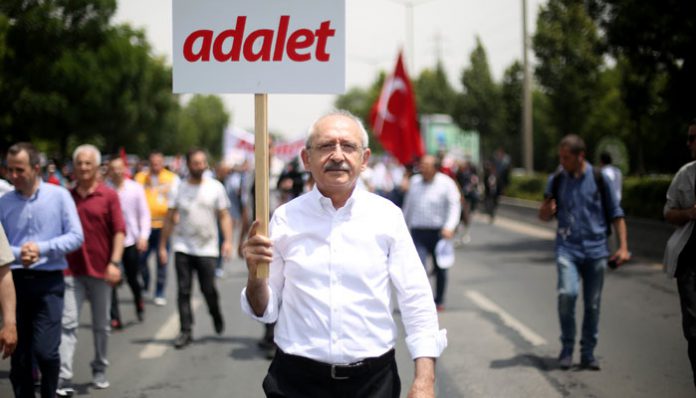
  • Turkey’s main opposition leader vows to reinstate all victims of post-coup purge

    Turkey’s main opposition leader vows to reinstate all victims of post-coup purge


    Main opposition Republican People’s Party (CHP) Chairman Kemal Kılıçdaroğlu has said his party will reinstate all civil servants who were fired from their jobs by government decrees in the aftermath of an abortive putsch in Turkey in July 2016 if the CHP comes to power in the 2023 elections, local media reported on Wednesday.

    Following the failed coup, President Recep Tayyip Erdoğan’s Justice and Development Party (AKP) government carried out a massive purge of state institutions under the pretext of an anti-coup fight, summarily dismissing some 130,000 public servants as well as military personnel for alleged membership in or relationships with “terrorist organizations” by emergency decree-laws subject to neither judicial nor parliamentary scrutiny.

    Kılıçdaroğlu’s remarks came on Wednesday when he went to the Black Sea province of Samsun to hold his party’s group meeting.

    When the CHP leader was asked by a former public servant what his party’s solution would be for those who were fired as part of the AKP government’s post-coup purge when they come to power, he said, “We will reinstate all those [dismissed by] KHKs [state of emergency decrees].”

    “All of them?” the purge victim asked once again, according to Turkish media reports, to which Kılıçdaroğlu replied, “All of them.”

    The CHP leader’s remarks indicated a change of tone in his party’s attitude regarding the purge victims, since Kılıçdaroğlu and others from his party previously stated that they would only reinstate those who were tried and acquitted of the charges against them.

    The AKP’s post-coup crackdown ruined the lives of tens of thousands in Turkey who have been targets of hate speech, hate crimes, unlawful prosecution, torture and abduction, among other serious human rights violations.

    Former public servants were not only fired from their jobs; they were also prohibited from working again in the public sector and getting a passport. The government also made it difficult for them to work formally in the private sector.

    Most dismissed civil servants are accused of links to the faith-based Gülen movement, inspired by Islamic preacher Fethullah Gülen, but there were many others who belonged to other opposition groups.

    The ruling AKP labels the movement as a terrorist organization and accuses them of masterminding the abortive putsch, although Gülen and his followers strongly deny involvement in the coup attempt or any terrorist activity.

  • Court blocks access to news stories on mob boss’ posts including footage of AKP MP


    An Ankara court has blocked access to three online news stories which covered recent social media posts by mafia boss Sedat Peker that included video footage of ruling Justice and Development Party (AKP) lawmaker Zehra Taşkesenlioğlu, the Freedom of Expression Association’s (İFÖD) EngelliWeb initiative reported on Monday.

    Over the weekend Peker, the head of one of Turkey’s most powerful mafia groups who has been making shocking revelations since early 2021 about state-mafia relations, drug trafficking and murders implicating state officials and their family members, unveiled a new series of allegations from his Twitter handle, revealing a network of bribery and corruption at Turkey’s stock exchange.

    Peker said AKP deputy Taşkesenlioğlu, her brother and former Capital Markets Board (SPK) chair Ali Fuat Taşkesenlioğlu; advisor to Turkish President Recep Tayyip Erdoğan Serkan Taranoğlu; and pro-government daily Hürriyet columnist Burak Taşçı were all involved in the operation of the bribery network extorting the owners of companies that are listed on the stock exchange.

    Peker claimed that Taranoğlu and Taşkesenlioğlu demanded a bribe of 12 million lira ($660,000 as of Aug. 29, 2022) from Mine Tozlu Sineren, the owner of Marka Investment Holding, for processing her company’s request to issue new shares through increasing capital. Sineren corroborated Peker’s allegations in a live broadcast and said no action has been taken by the authorities despite her complaints.

    The mafia boss also released video footage that he alleged was of Taşkesenlioğlu and was secretly shot by her husband Ünsal Ban, after she slightly injured him with a knife in their home.

    “I talked to him [Ban] over the phone a few times. He also thinks he will be killed. He sent me this footage … and I’m going to share it with you. … Mr. Ünsal, you asked me not to mention your name and not to publish the video. … [But] I’m doing this out of necessity to save your life,” Peker said in a series of tweets.

    “You two waste me so that you can make money. Damn you and the money you make. … I’m either going to kill myself or you [since] I can’t take this anymore,” Taşkesenlioğlu was heard saying in the video, while holding a fairly big kitchen knife in her hand.

    According to Peker’s allegations, in the video, the AKP deputy refers to her brother Ali Fuat Taşkesenlioğlu and husband Ban. The MP and Ban are currently in the process of divorcing, according to local media reports.

    The Ankara 1st Criminal Court of Peace on Monday made the decision to ban access to news pieces regarding the video footage released by the mafia boss on the grounds that they “violated the personal rights” of the ruling party lawmaker, EngelliWeb said.

    “My footage, which was shot secretly by Ünsal Ban with my head uncovered, in my own home, has been served to millions, disregarding my personal and family privacy,” Taşkesenlioğlu, who wears a headscarf, said on Monday in a written statement released on Twitter, claiming that she was “exposed to the most severe form of violence against women” with the footage in question.

    Turkey was shaken by two corruption investigations implicating then-prime minister and current president Erdoğan’s inner circle that became public Dec.17-25, 2013. Erdoğan’s AKP government subsequently suppressed the scandal by managing to control the judiciary by creating special criminal courts headed by a single judge, thanks to the AKP’s parliamentary majority.

    These judges then jailed all the police and prosecutors who had conducted the 2013 corruption investigations, while Erdoğan and his family members who were implicated have never appeared in court.

  • Erdoğan ally resigns after allegations from crime boss


    A top member of Turkish President Recep Tayyip Erdoğan’s ruling party has resigned following a string of corruption allegations levelled through social media by a fugitive crime boss, Agence France-Presse reported.

    Convicted felon Sedat Peker has gained a cult following in Turkey by using YouTube and Twitter to accuse top members of Erdoğan’s team of everything from graft to drug smuggling and even murder.

    Peker is believed to be hiding out in the United Arab Emirates and saw his lavish property in İstanbul confiscated last week.

    The 51-year-old openly admits to being a crime boss and claims to have incriminating evidence stacked away on his phone against top officials who allegedly deal with the Turkish underworld.

    Most of his videos rack up millions of views.

    His latest Twitter posts last weekend accused a string of officials of seeking bribes from companies trading on the stock exchange.

    One of them concerned Korkmaz Karaca — an executive in Erdoğan’s ruling Justice and Development Party (AKP) and a member of the Presidential Economic Policy Board.

    Karaca said on Twitter that the “ongoing immoral troll lynching campaign on social media” was damaging his health and ruining his family life.

    “This lynching, which has reached my beautiful daughter and wife, has become a threat to my health again. For these reasons, I am resigning from my post,” he said late Tuesday.

    He denied the allegations and argued that he never met the people mentioned by the crime boss.

    Another Erdoğan adviser implicated by Peker resigned last Sunday.

    Peker’s popularity stems in part from his oratory skills and his free admission that he is guilty of many of the same crimes he accuses the government of being involved in.

    His allegations also feed into a growing perception of government waste and corruption in the second decade of Erdoğan’s dominant rule.

    Erdoğan rose to power vowing to root out the graft that blemished successive secular governments in the 1980s and 1990s.

    But polls show the public accusing Erdoğan’s Islamic-rooted party of the same bad habits in the runup to next year’s general election.

    Turkey’s main opposition parties demanded a formal investigation into Peker’s latest allegations this week.

  • 21 detained in İstanbul over alleged Gülen links


    Turkish police on Friday detained 21 people in simultaneous operations in İstanbul due to their alleged links to the Gülen movement, the TR724 news website reported.

    The Turkish government accuses the Gülen movement of masterminding a coup attempt on July 15, 2016 and labels it a “terrorist organization,” although the movement strongly denies involvement in the coup attempt or any terrorist activity.

    The detentions took place based on an investigation overseen by the İstanbul Chief Public Prosecutor’s Office, which issued detention warrants for 25 people due to their alleged membership in the Gülen movement. The remaining four suspects could not be found at their homes, and the police are continuing their search to detain them.

    According to a statement from Justice Minister Bekir Bozdağ in July, 117,208 people have been convicted, with 1,366 sentenced to life in prison and 1,634 to aggravated life with no chance of parole following the coup attempt. While 87,519 people have been acquitted of charges specifically related to the Gülen movement since the coup attempt, according to Bozdağ, there are doubts about the number of people who have been acquitted of all charges by a court of law.

    Judicial experts voice skepticism about the figures announced by the minister, saying that 117,208 convictions are only those that have been upheld by an appeals court, since Justice Ministry data show that more than 265,000 people were sentenced on charges of terrorist organization membership between 2016 and 2020 due to their alleged Gülen links.

  • Prominent Swedes call on gov’t not to extradite Kurdish dissidents to Turkey

    A group of prominent Swedes, including authors, journalists and human rights activists, have called on their government in a written statement not to extradite Kurds in Sweden, both Swedish citizens and refugees, who are alleged by the Turkish government to be terrorists, local media reported on Thursday.

    NATO member Turkey is threatening to freeze Sweden’s attempts to join the Western defense alliance unless it extradites dozens of people Ankara accuses of “terrorism.”

    A non-binding deal Sweden and fellow NATO aspirant Finland signed with Turkey in June commits them to “expeditiously and thoroughly” examine Ankara’s requests for suspects linked to a 2016 coup attempt and the outlawed Kurdistan Workers’ Party (PKK), listed as a terrorist organization by Turkey and much of the international community.

    Turkish media reports on Thursday cited a translation of the Swedes’ statement.

    The signatories of the statement included Kurdo Baksi, Swedish-Kurdish writer, journalist and social commentator; journalist Selma Brodrej; Göran Greider, author, poet and editor-in-chief of the Dala-Demokraten newspaper; Thomas Hammarberg, writer and former Council of Europe commissioner for human rights; Keya Izol, former head of the Federation of Kurdish Associations in Sweden; and Dagens Arbete daily editor-in-chief Helle Klein.

    “A deep concern has gripped Kurds in both Sweden and Turkey as a result of the government’s negotiations with the regime in Ankara,” the group said, urging the government to promise not to deport the Kurds, and therefore, give Kurdish-Swedish voters a clear message before elections scheduled for Sept. 11.

    “For some reason, NATO’s leadership decided that Sweden and Finland themselves would negotiate with Turkey on the terms of being able to become members of the military alliance. The Turkish regime took advantage of that situation to demand measures that are outside of NATO’s formal mandate and that are also contrary to human rights principles,” they said.

    The group stated that even peaceful opposition was branded as terrorism in Turkey nowadays and that the extradition of Kurds would very likely result in arbitrary trials and long prison sentences for them as this was what happened to a large number of people in Turkey who had expressed criticism of President Recep Tayyip Erdoğan’s regime.

    “The Swedish response to the regime’s demands has been that those who are Swedish citizens cannot be extradited. It goes without saying, but as an answer it is completely inadequate. … Turkey has understood that Sweden may very well hand over Kurds to Turkish ‘justice’,” they noted.

    Saying that Ankara had also demanded that Sweden open up arms trade with the Turkish military, the group warned that Sweden must refrain from doing so “in light of the Turkish military’s ongoing warfare against Kurds in Iraq and advanced preparations for an invasion against Kurds in northern Syria.”

    Sweden and Finland ended decades of military neutrality and decided to join NATO in response to Russia’s February invasion of Ukraine.

    Their bids have already been ratified by the United States and more than half of the 30 members of NATO. Each application must win unanimous consent from member states.

  • Erdoğan’s luxury yacht spotted transiting Bosporus for the first time since refitting

    A Turkish presidential yacht, formerly known as the Turkish Navy’s auxiliary ship Yakamoz Y68, has been seen for the first time transiting the Bosporus since a refitting, the Cumhuriyet daily reported on Thursday, citing a Turkish geopolitical analyst.

    Yörük Işık, an independent geopolitical analyst based in İstanbul, where he runs the Bosphorus Observer blog, tweeted last week that a yacht “with no visible name but with the official seal of the president” transited the Bosporus, sharing photos showing a large group of people on it.

    Although Turkish President Recep Tayyip Erdoğan wasn’t seen in any of the photos he posted, Işık claimed on Aug. 22 that Erdoğan was “showing the sights of Bosphorus” to King of Malaysia Sultan Abdullah of Pahang.

  • 25,000 migrants reach Greece in August as gov’t plans to extend border wall

    The Greek government said on Thursday that some 25,000 migrants had tried to enter the country through its border with Turkey in August as it announced plans to drastically extend a wall between the two neighbors, Agence France-Presse reported.

    Athens will extend a 40-kilometer (25-mile) long wall built along the Greek-Turkish border at Evros by another 80 kilometers as part of efforts to control the flow of migrants.

    Greek government spokesman Giannis Oikonomou said the country was facing “increased migratory pressure” both at its land border in Evros and in the Aegean Sea.

    “In August alone, with the month not yet over, 25,000 migrants tried to enter illegally through the Greek-Turkish borders,” Oikonomou said at a press briefing.

    Greece has already said that there are more arrivals this year than in previous years.

    As well as extending the wall, Oikonomou said the government will install thermal cameras and deploy an additional 250 border guards.

    Greece is often the country of choice for people fleeing Africa and the Middle East to try to reach a better life in the European Union.

    Thousands come via Turkey over the narrow and perilous sea crossing separating the traditional enemies.

    Charity groups have accused Athens of illegally turning back migrants or forcing them over the border to Turkey — something Greece’s conservative government has denied.

    And Greece has similarly accused neighboring Turkey of not doing enough to stop human smugglers from sending migrants across the Mediterranean Sea.

    Earlier this month, Athens accused Turkey of forcibly pushing a group of stranded migrants onto a small Greek island and leaving behind the body of a 5-year-old child who died.