Category: World

  • Erdoğan pardons disabled bomb expert 20 months after his incarceration


    Turkish President Recep Tayyip Erdoğan has used his presidential power to pardon disabled former bomb disposal expert Bilal Konakçı nearly 20 months after he was put behind bars for conviction on bogus terrorism-related charges, the Kronos news website reported on Friday, citing the Official Gazette.

    Konakçı was a decorated police officer whose life was upended in 2009 after a bomb left in front of a school detonated while he was trying to defuse it. Besides losing his eyesight and right hand, he also lost some of the fingers on his left hand. He has difficulty walking as well as hearing loss.

    Konakçı was arrested after a coup attempt on July 15, 2016 for alleged links to the Gülen movement, a faith-based group inspired by Turkish cleric Fethullah Gülen.

    He was accused of terrorism for having an account at Bank Asya, a commercial bank founded by businessmen affiliated with the Gülen movement, and for using the ByLock messaging app. He was released and put under house arrest after remaining in police custody and jail for more than a month.

    He was re-arrested in February after Turkey’s Supreme Court of Appeals upheld a conviction and sentence handed down on the charge of membership in a terrorist organization.

    A decision concerning the pardon of the 45-year-old Konakçı based on a Council of Forensic Medicine (ATK) report on his “continuous illness and disability,” sent by the Ministry of Justice, was published in the Official Gazette on Friday, Kronos said. The decision by the president, who has the authority to pardon convicts due to advanced age or health problems according to the 104th article of the Turkish Constitution, lifted the remainder of a sentence of seven years, six months handed down to Konakçı.


    Journalist in exile Sevinç Özarlsan tweeted the first picture of Konakçı after his release from Menemen Prison in the western province of İzmir on Friday.

    “They kept a person in such a condition in prison for 20 months,” Özarlsan said, tagging the Twitter account of Turkey’s Justice Ministry.

    Konakçı previously said in a letter he wrote from prison that he feared for his life there and that life had become unbearable as he was unable to take care of himself due to his severe disabilities. “Prison conditions are endangering my life as I can’t walk, use the bathroom or eat on my own,” he said.

    Erdoğan also pardoned 54-year-old Hasan Şen, who was sentenced to 24 years, seven months in prison on charges of drug trafficking and threatening with a weapon and has been behind bars since 2018, due to a report on his “continuous illness,” according to Kronos.

    Opposition politicians and legal experts have criticized the Supreme Court of Appeals decision to uphold Konakçı’s conviction and sentence without even stopping to think about how he could have committed the crimes he was accused of as a person with such severe disabilities.

    Despite the fact that Ömer Faruk Gergerlioğlu, a lawmaker from the pro-Kurdish Peoples’ Democratic Party (HDP) and a prominent defender of human rights, and Democracy and Progress Party (DEVA) deputy Mustafa Yeneroğlu had previously condemned Konakçı’s imprisonment, and multiple campaigns were held on social media stating he shouldn’t have been arrested and calling for his immediate release, Erdoğan’s decision to pardon him came nearly 20 months after his imprisonment.

    Erdoğan has been targeting followers of the Gülen movement since the corruption investigations of December 17-25, 2013, which implicated then-prime minister Erdoğan, his family members and his inner circle.

    Dismissing the investigations as a Gülenist coup and conspiracy against his government, Erdoğan designated the movement as a terrorist organization and began to target its members. He intensified the crackdown on the movement following an abortive putsch on July 15, 2016 that he accused Gülen of masterminding. Gülen and the movement strongly deny involvement in the coup attempt or any terrorist activity.
  • More than 5,000 people mistreated or tortured in Turkey in 2021: report


    The “2021 Turkey Rights Violations Report” was released by the İHD on its website on Thursday.

    According to the report, 1414 people were subjected to mistreatment or torture in Turkish prisons in 2021, while 2,835 people faced mistreatment as a result of police intervention in protests and gatherings, in addition to 531 people – including 12 children – mistreated or tortured in detention and 704 people – 25 of them children – outside places of detention.

    At least 57 people died behind bars due to negligence, suicide, illness or violence, and 375 women died as a result of domestic violence last year, while 2,170 workers were killed in occupational accidents in Turkey.

    Sixty-nine security officers, 275 militants and eight civilians died in armed conflict inside and outside the borders of Turkey in 2021, and security forces killed 16 and injured 27 people in raids and by firing into a crowd on the pretext that the people did not obey orders, the report also said.

    Turkish police intervened in at least 409 demonstrations, public press statements and gatherings last year, the report said, adding that investigations were launched into 7,704 people for “contravening Law No. 2911 on assemblies and demonstrations” in the same period, citing data from the Justice Ministry.

    According to the report, the number of inmates in Turkish prisons, which have the capacity to safely hold 288,798 people, reached a record high of 326,243 in 2021.

    The human rights report also pointed out the disappearance of Yusuf Bilge Tunç in broad daylight on August 8, 2019, saying he has not been heard from since.

    Tunç’s family has consistently complained about the lack of cooperation from officials to find him after his wife unearthed details indicating that Tunç had been abducted.

    Hüseyin Galip Küçüközyiğit, a former Turkish bureaucrat who had been missing since December 2020 and was found in Ankara’s Sincan Prison in September 2021, is still behind bars, the İHD said in the report, adding that there are three more people missing who they think haven’t been found due to the negligence of the security forces.

    İHD chair Öztürk Türkdoğan said during a press briefing on Thursday where they announced the report that “a new political power and an increased social struggle” is needed to change the permanent effects of the state of emergency on the country.

    Turkey’s Justice and Development Party (AKP) government declared a state of emergency in the aftermath of a failed coup on July 15, 2016 that remained in effect until July 19, 2018, during which the AKP increased the pressure on human rights by issuing a number of government decrees, known as KHKs.

    Human rights violations culminated in Turkey after the abortive putsch in 2016, when the government launched a crackdown on non-loyalist citizens under the pretext of an anti-coup fight. Ill-treatment and torture became widespread and systematic in Turkish prisons and detention centers, with a lack of condemnation from higher officials and a readiness to cover up allegations rather than investigate them, resulting in widespread impunity for the security forces.

  • Alevis claim Erdoğan’s plan to support cemevis is attempt to control their faith

    Alevi leaders and politicians have condemned Turkish President Recep Tayyip Erdoğan’s recent push to establish a new government institution to provide financial support to Alevi houses of worship (cemevis) and hire spiritual leaders, saying the policy aims to bring their faith under state control, Turkish media reported on Friday.

    Alevis are historically the largest religious minority group in Turkey, and they fulfill religious obligations and hold ceremonies not in mosques but in cemevis. Alevis make up as much as 20 percent of Turkey’s 85 million population.

    Erdoğan attended the opening ceremony of a cemevi on Friday.

    Turkey is a majority Sunni country, and millions of the religious, conservative masses view Alevis as apostates. Turkey’s religious authority the Diyanet does not recognize cemevis as places of worship. As a result, mosques have civil servant imams and enjoy government subsidies for their electricity and water bills, but cemevis struggle to pay high utility bills as they fall under the status of “commercial users” and don’t have government-paid clerics like Sunnis do.

    During the ceremony, Erdoğan announced that a new institution was to be established under the Ministry of Culture and Tourism, named the Directorate of Alevi Bektaşi Culture and Cemevis.

    According to Erdoğan, the institution will take care of cemevis’ financial obligations such as utility bills and maintenance costs.

    “The people who run cemevis will be given a staff by the state if they want one,” Erdoğan said.

    The new policy was denounced by some leaders of the Alevi community and other prominent Alevis.

    Ali Kenanoğlu, founder of the Federation of Alevi Foundations, said, “This is not an AKP [Justice and Development Party] project, but a state project,” implying that a deeper bureaucratic plot to put Alevism under state control is at play.

    Kenanoğlu added that the government wants to take Alevism under control through the Ministry of Culture in a way that the Sunni public and Sunni Islam have been taken under control by the state through the Diyanet.

    “A faith under government control should be out of the question,” said Reha Çamuroğlu, who was an AKP deputy between 2007 and 2011.

    Çamuroğlu said the policy is an attempt to appropriate Alevism. “Will the ministry coordinate worship? Will they allocate a budget to the Alevi community’s houses of worship? Who is going to use that budget? It would be enough if they provided the privileges that mosques enjoy. Beliefs must be independent of the state. Believers themselves must pay for their religious activities,” he said.

    There are long-standing tensions between the Alevi and Sunni communities in Turkey. Hundreds of Alevis were killed in pogroms, which many now believe were masterminded by groups inside the state, in the cities of Çorum, Yozgat and Kahramanmaraş in the 1970s.

  • Albanian court approves decision to close Gülen-linked school

    Albanian court approves decision to close Gülen-linked school

    An Albanian court on Friday ruled in favor of a government decision to close a school with links to the Gülen movement, a faith-based group accused by Ankara of orchestrating a coup in Turkey in 2016 although it denies any involvement, Turkey’s state-run Anadolu news agency reported.

    Albania’s government was accused of caving in to Turkey’s authoritarian President Recep Tayyip Erdoğan after it abruptly closed a Gülen-linked school on Sept. 22.

    After public criticism of the decision, Education Minister Evis Kushi said the school, Mehmet Akif Ersoy College, had its license revoked because the location of the building had been changed without permission and that it no longer met the legal criteria to operate as a school.

    Mehmet Akif Ersoy College said it only learned about the closure order from the media and that it would challenge it in court.

    It added that on Sept. 14, an inspection was carried out by the Ministry of Education and on Sept. 22 the school was notified by mail that the school does not meet the criteria to continue operations.

    Anadolu also reported that a kindergarten that had ties to the Gülen group-affiliated college was also ordered to close.

    Many criticized the decision and connected it with Erdoğan’s repeated calls for Albania to close institutions connected with his arch-foe Fethullah Gülen, the inspiration of the movement who has lived in self-imposed exile in the US since 1999.

    At its peak, the Gülen movement, a worldwide civic initiative renowned for its educational activities, operated schools in 160 countries, from Afghanistan to the United States. In Turkey, the network had run thousands of educational facilities, including schools, prep schools, universities and dormitories.

  • Turkey outraged over musician’s murder at Ankara nightclub


    Turkey was shocked by the murder of a musician at a nightclub in Ankara on Sunday in which some employees from a state ministry and a public agency were allegedly involved, according to Turkish media reports.

    Musician Onur Şener, 45, was seriously injured, allegedly by a group of customers, at a nightclub in Ankara’s Çankaya district following a row that erupted over a song request. He later succumbed to his injuries at a hospital.

    The dispute reportedly erupted when Şener told the customers that he didn’t know the song they requested him to sing.

    Haluk Levent, a Turkish rock star and human rights activist, on Monday revealed in a series of tweets that the people who killed Şener, a father of two, were bureaucrats from the Ministry of Labor and Social Security whom he identified as ALİ G. and İLKER K. in addition to Semih S., an engineer at Turkish Aerospace Industries (TAI).

    “I’m even more shocked [now that I found out] they smashed Onur’s face with [broken] glass,” Levent added. Five people were detained in connection to the musician’s murder. Three of the suspects, two bureaucrats and an engineer at TAI, were arrested, while two other suspects were released under judicial supervision on Monday.

    The development sparked outrage among celebrities and social media users in Turkey, who criticized the ruling Justice and Development Party (AKP) for its policy of impunity for public servants.

    “The killers beat and killed Onur Şener because he didn’t know the song they requested! At the end of the night, they waited for him to come out of the bar and ambushed him. It doesn’t matter what we write or say. We should be ashamed at where this country has come to,” Turkish actor Mert Fırat said.

  • Jailed Kurdish politician faces 43 years in prison on propaganda charges

    Jailed Kurdish politician faces 43 years in prison on propaganda charges

    A new indictment seeks a prison sentence of up to 43 years for a Kurdish politician who was already convicted of terrorism-related charges and has been behind bars since late 2020, the Mezopotamya news agency reported.

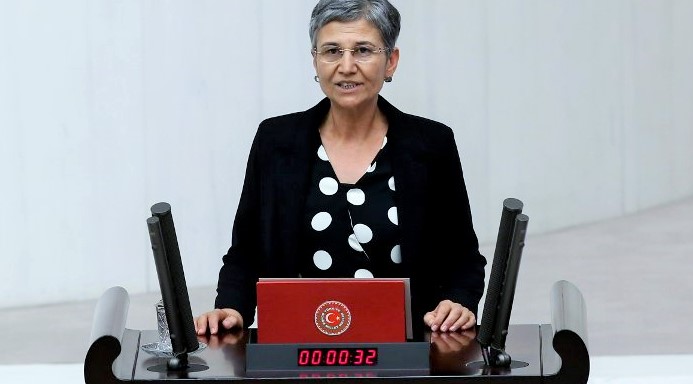
    Leyla Güven, a former lawmaker from the pro-Kurdish Peoples’ Democratic Party (HDP) who was ousted from the Turkish Parliament in June 2020 and was co-chairperson of the Democratic Society Congress (DTK), is facing the lengthy prison sentence on charges of disseminating terrorist propaganda in her social media posts and four speeches for the outlawed Kurdistan Workers’ Party (PKK).

    The PKK, recognized as a terrorist organization by Turkey and much of the international community, has been waging a bloody campaign in Turkey’s Southeast since 1984.

    The first hearing in Güven’s trial was held at the Diyarbakır 9th High Criminal Court on Wednesday where she attended via IT Voice and Image System (SEGBİS) from the Elazığ Prison for Women.

    Güven is accused of praising the PKK, its jailed leader Abdullah Öcalan and its armed violence in her speeches and social media posts.

    However, Güven said her speeches were incorrectlly translated from Kurdish into Turkish and asked for an expert opinion and additional time to present her defense.

    The politician is already serving a prison sentence of 22 years, three months and an additional five years as a result of two separate convictions on terrorism-related charges.

    The ruling Justice and Development Party (AKP) increased its crackdown on Kurds, especially after the collapse of Ankara’s reconciliation process with the outlawed PKK in 2015.

  • Hundreds protest in Turkey in support of Iranian women


    Hundreds of protesters took to the streets in Turkey on Sunday to condemn Iran’s crackdown on women-led demonstrations sparked by a young woman’s death after her arrest by the country’s notorious morality police, Agence France-Presse reported.

    In İstanbul, many Iranians were among the hundreds of people who chanted slogans against the Tehran regime and in support of Iranian women.

    Women held red roses, Iranian flags and signs bearing the words “women, life, freedom”, the battle cry of the protest movement that has rocked Iran and was triggered last month by the death of Mahsa Amini, a 22-year-old Iranian Kurd.

    In Diyarbakır, a southeastern city with a majority Kurdish population, around 200 people gathered brandishing photographs of Iranian women killed in the crackdown and a large banner with the slogan “women, life, freedom” in Kurdish, an AFP correspondent reported.

    A demonstration in solidarity with Iranian women attended by hundreds of people was also held in the western city of İzmir on Saturday evening, according to images published on social media and verified by AFP.

    At least 92 people have been killed in Iran since the start of the protests two weeks ago, Norway-based NGO Iran Human Rights said on Sunday.

  • Turkish filmmakers express solidarity with ‘Iranian sisters’ demanding freedom

    Female filmmakers in Turkey have released a video in which they express solidarity with Iranian women rising up to demand freedom as they protest the death of 22-year-old Mahsa Amini in the custody of Iran’s “morality police,” local media reported on Thursday.

    Arrested by the morality police, who enforce strict rules in the Islamic Republic requiring women to cover their hair and wear loose-fitting clothes in public, for allegedly wearing the hijab improperly, Amini suffered a heart attack, fell into a coma and died on Sept. 16 while in custody, state-affiliated media claimed.

    Her family insists she had no previous health problems, and activists claim she may have been beaten by police.

    The death of Amini, a Kurdish woman from western Iran, has sparked outrage over the government’s increasingly strict enforcement of an ultraconservative dress code for women, compulsory since Iran’s 1979 revolution, with Iranian women demanding an end to gender-based injustice and state-sanctioned violence by cutting their hair and removing and even burning their hijabs in public.

    In response, the Iranian government has shut down the internet and used excessive force. Iranian authorities have beaten people with batons, fired live ammunition at protesters from close range and wrongfully employed tear gas and water cannons, killing at least 76 protestors and arresting hundreds more, according to Amnesty International.

    A number of female filmmakers in Turkey who created Instagram and Twitter accounts named “Stand with Women of Iran – Turkey,” on Thursday posted a video in which they voiced their support for protesters in Iran, saying, “For freedom, for our sisters, at all costs, revolt! We are together in this resistance for freedom, we are with you.”

    The group also invited all women in Turkey, regardless of profession, to shoot and post similar videos to express solidarity with Iranian women so they can tell “our friends who are resisting on the streets of Iran” that they are not alone and contribute to the voices being heard all over the world.

    The Turkish women’s video came after Iranian filmmakers Bahman Ghobadi and Asghar Farhadi called for the support and participation of the creative community, including artists, filmmakers, writers and civil rights activists from all over the world, in the protests of Iranian women by making videos, in writing or some other way.

    Turkish filmmakers also signed a petition written in Turkish, Kurdish and English and titled “Open call from filmmakers” in which they said, “We bow respectfully before the honorable stance of the [Iranian] people who risk death while resisting for their rights. … We are with you.”

    Turkey’s pop music diva, Sezen Aksu, also released a written message on her website to voice her support for the protestors, according to Turkish media reports.

    “How many deaths does freedom require? How many women, how many children, how many fights, how many wars, how many tortures, how many hells? … Your pain is my pain, your struggle is my struggle,” she said.

    Since the death of Amini, Iranian women in Turkey have staged numerous protests outside Tehran’s İstanbul consulate. Another such demonstration was held on Thursday, with Iranian women holding photos of Amini and shouting “Death to the dictator” and “Damn the Iranian government.” They also burned black hijabs during the protest.

    Members from Turkey’s women’s rights organization the We Will Stop Femicide Platform (Kadın Cinayetlerini Durduracağız Platformu) also marched from the İstanbul Governor’s Office to the consulate in support of the Iranian protestors and made a statement to the press.

    “Don’t think that Iran is too far from us. We will [also] fight, we will stop this course of events. …We will resist until the end,” they said.

  • Turkey seeks extradition of journalist in exile reporting on gov’t corruption


    Turkey’s Justice Ministry is seeking the extradition of an investigative journalist living in exile in Germany from where he reports extensively on the Turkish government’s corruption and murky relations with mafia and crime groups, according to a Friday report in the pro-government Sabah daily.

    Journalist Cevheri Güven, who makes scandalous revelations about President Recep Tayyip Erdoğan and his close circle as well as some journalists and opposition figures in his YouTube videos, recently came to public attention after the Sabah daily on its Sept. 22 front page published secretly taken photos of him while walking on the street and revealed his address in a German city.

    Sabah reported on Friday that Turkey’s National Intelligence Organization (MİT) and the Security Directorate General jointly found out Güven’s location in Germany and that the Justice Ministry sent a request in August to the German authorities seeking the journalist’s extradition based on arrest warrant issued by the İstanbul 14th High Criminal Court.

    Sabah’s Friday story contradicted its earlier report, which said the daily’s news coordinator Abdurrahman Şimşek secretly followed Güven for several months in Germany until he found out his address and took the photos of him and his house.

    Güven told Turkish Minute at the time he believed MİT was behind the search for him and that it was due to one of his videos in early September in which he questioned MİT’s role in a failed coup in Turkey in July 2016 following which Erdoğan’s government launched a massive crackdown on outspoken journalists and non-loyalist citizens under the pretext of an anti-coup fight.

    German media outlets also earlier reported that there were thousands of MİT agents operating in the country spying on Turkish dissidents who fled Turkey and took refuge in Germany in the aftermath of the coup attempt.

    According to Sabah, Turkey is seeking Güven’s extradition on charges of membership in a terrorist organization, namely the Gülen movement.

    The Gülen movement, inspired by the views of Islamic cleric Fethullah Gülen, a resident of the US, is accused by the Turkish government and President Erdoğan of masterminding the failed coup on July 15, 2016 and is labeled a “terrorist organization,” although the movement denies involvement in the coup attempt or any terrorist activity.

    Güven is also accused of having downloaded the ByLock and Tango smart phone applications, which are considered by Turkish authorities to be secret tools of communication among Gülen followers, in addition to depositing money in Islamic lender Bank Asya, which was closed down by the government following the coup attempt due to its affiliation with the Gülen movement, according to Sabah.

    The European Court of Human Rights ruled in July 2021 in the case of a former police officer that use of the ByLock application is not an offense in itself and does not constitute sufficient evidence for an arrest.

    Turkish authorities also consider acts such as subscribing to a Gülen-linked newspaper, having sent children to a Gülen-affiliated school or having worked at an organization associated with Gülen to be evidence of terrorist organization membership.

    Güven has recently been facing growing pressure and threats from pro-government circles in Turkey as his videos continue to reach a large audience, even attracting more viewers than some mainstream news outlets in Turkey.

    He fled Turkey following the coup attempt like thousands of other people to avoid the government’s post-coup crackdown as a part of which thousands of people have been sent to jail on bogus terrorism or coup charges.

    Journalists who fled Turkey following the coup attempt such as Güven have established their own news outlets and have become the major source of news for some Turks in a country where 90 percent of the national media is owned by pro-government businessmen who toe the official line, according to Reporters Without Borders (RSF).

    Güven, a former editor of the now-defunct Nokta magazine, along with the magazine’s managing editor, Murat Çapan, was handed down a prison sentence of 22 years, six months in 2017 on charges of “inciting people to armed revolt against the Turkish government.”

    The journalists were sentenced to prison due to two cover stories in Nokta that criticized Erdoğan for “capitalizing” on the death of soldiers in Turkey’s fight against terrorism.

    Meanwhile, Turkey is also seeking the extradition of journalists and political dissidents who are living in exile in Sweden and Finland. Turkey is threatening to torpedo Sweden and Finland’s attempts to join Western defense alliance NATO unless these countries extradite dozens of people Ankara accuses of “terrorism.”

  • Purged police officer dies in workplace accident at quarry in NE Turkey


    Kani Enön, a former police officer who was fired by an emergency decree as part of Turkey’s post-coup purge of state institutions, died last week while working at a quarry in Turkey’s northeastern province of Gümüşhane, the Kronos news website reported on Wednesday.

    Following the failed coup, the Turkish government declared a state of emergency and carried out a massive purge of state institutions under the pretext of an anti-coup fight.

    More than 130,000 public servants, including 4,156 judges and prosecutors, as well as 29,444 members of the armed forces were summarily removed from their jobs for alleged membership in or relationships with “terrorist organizations” by emergency decree-laws subject to neither judicial nor parliamentary scrutiny.

    According to Turkish media reports, Enön, 32, died on Sept. 20 when part of construction equipment he was repairing fell on him at a quarry belonging to Karatoprak Mining in Gümüşhane.

    Enön’s lawyer, Mesut Can Tarım, on Wednesday commented on the incident in a series of tweets, saying that Interior Minister Süleyman Soylu and Turkey’s Security Directorate General, which is affiliated with the ministry, failed to reinstate Enön to his police job although an administrative court ordered them to do so.