Category: Politics

  • EP Turkey rapporteur says he can’t forget post-mortem photos of Kabakçıoğlu, who was found dead in his cell

    Nacho Sánchez Amor, an MEP from the Progressive Alliance of Socialists and Democrats (S&D) and EP standing rapporteur on the annual report on Turkey, on Thursday discussed ongoing human rights violations in Turkey with Peoples’ Democratic Party (HDP) deputies Ömer Faruk Gergerlioğlu and Züleyha Gülüm.

    Gergerlioğlu disclosed the details of the discussion from his Twitter account. “We discussed the increasing pressure on the HDP,” said Gergerlioğlu. “We also talked about the persecution of government critics and the situation of political prisoners.”

    Gergerlioğlu said he explained the extent of human rights violations in Turkey, including torture and mistreatment in prisons, and the situation of critically ill inmates. He said he highlighted the cases of Ayşe Özdoğan, an imprisoned woman suffering from a rare form of cancer, and Mehmet Emin Özkan, an 83-year-old man who remains in prison despite severe health problems.

    Human rights activists and opposition politicians have frequently criticized authorities for not releasing critically ill prisoners so they can seek proper treatment.

    According to the most recent statistics published by the Human Rights Association (İHD), the number of sick prisoners is in the thousands, more than 600 of whom are critically ill. Although most of the seriously ill patients have forensic and medical reports deeming them unfit to remain in prison, they are not released. Authorities refuse to free them on the grounds that they pose a potential danger to society.

    A number of critically ill prisoners passed away in 2020 because they were not released in time to receive proper medical treatment.

    “Amor said he followed my social media posts about ongoing human rights violations in Turkey,” said Gergerlioğlu. ” He said he was very aware of the situation in Turkey and supported me.”

    Amor told Gergerlioğlu and Gülüm he could not forget the post-mortem photographs of Mustafa Kabakçıoğlu, a decorated police inspector who was found dead in a quarantine cell in August 2020.

    Kabakçıoğlu was arrested in July 2016 for alleged membership to the Gülen movement. He was sentenced to seven years, six months in prison.

    The Turkish government accuses the Gülen movement, a faith-based group inspired by Muslim cleric Fethullah Gülen, of masterminding a coup attempt in July 2016 and labels it a terrorist organization. The movement strongly denies involvement in the coup attempt or any terrorist activity.

    Kabakçıoğlu struggled with multiple health problems during his time in prison. He started coughing on August 20 and was put in a solitary cell on suspicion of having contracted COVID-19. He was alone for the next nine days, and it was claimed that he died in his cell after heavy coughing that continued until morning.

    A post-mortem COVID-19 test came back negative, which raised doubts about the conditions of his death.

    Post-mortem photographs Kabakçıoğlu’s lifeless body revealed he was in a chair in a sitting position, his head drooping back and his nails turned blue. The conditions of his prison cell were also photographed, revealing damp and filthy quarters and dirt on his T-shirt. It was obvious he used the trash bin as a dinner table and did not eat his last meal, seen in the photos untouched on top of the bin.

    Thinking that his death was not due to the coronavirus, Kabakçıoğlu’s family filed a criminal complaint with the Gümüşhane Chief Public Prosecutor’s Office demanding that the parties responsible for the imprisoned police officer’s death be found and punished.

    However, the prosecutor’s office said there were no grounds for legal action in April. SCF
  • Boğaziçi University rector files complaint with police about students protesting his appointment

    Boğaziçi University Rector Naci İnci, appointed to his position by the Turkish president, has filed a complaint with the police about students who took part in protests against his appointment, Turkish media reported.

    İnci complained the students had threatened, insulted and prevented him from doing his job. They had also damaged property and violated the law on demonstrations and protests, he claimed. According to İnci the students insulted him by carrying banners that called him a government-appointed trustee and by stopping his car on the university campus.

    Seven of the students who were on İnci’s list were questioned on Thursday about taking part in the protests, while three of them appeared in court, where the prosecutor demanded their arrest.

    A prolonged series of protests broke out at the university after President Recep Tayyip Erdoğan appointed Melih Bulu a founding member of the ruling Justice and Development Party’s (AKP) Sarıyer district branch and former deputy chairman of the AKP’s İstanbul provincial chapter, as rector in early January.

    Bulu was dismissed in July, and İnci, a former deputy to Bulu, was appointed despite a 95 percent disapproval rating he received in polls held among the university community to determine possible rector candidates.

    Seventeen candidates emerged with high rates of approval; however, President Erdoğan appointed İnci, prompting outrage among academics and students.

    Political pressure on students of different age groups has been increasing. A high school student in Kocaeli was officially warned about handing out tea in the classroom. According to the school administration the student had insulted Erdoğan by impersonating him handing out tea to citizens during rallies.

    An official report was written up about the student that said he had “mocked the president” and would be subject to disciplinary action if it were repeated.

    Insulting the president is a crime in Turkey, according to the controversial Article 299 of the Turkish Penal Code (TCK). Whoever insults the president can face up to four years in prison, a sentence that can be increased if the crime was committed through the mass media.

    According to the Justice Ministry, a total of 160,169 investigations and 35,507 cases have been launched on charges of insulting the president over the past seven years, beginning with the election of Erdoğan to the presidency in 2014 to the end of 2020. SCF

  • Turkish far-right party drafts bill to keep media outlets with foreign funding in check

    Turkey’s far-right Nationalist Movement Party (MHP), an ally of the ruling Justice and Development Party (AKP), has introduced a bill designed to restrict the functioning of media outlets and reporters receiving direct or indirect funding from abroad, Turkish Minute reported on Wednesday, citing the Gerçek Gündem news website.

    The bill makes it compulsory for media institutions and reporters receiving direct or indirect funds from abroad and earning income based on such funds to register a “foreign center representative” with the Interior Ministry.

    According to the bill, the representative will submit all documents required by the ministry, and all activities of media outlets and reporters will be recorded and monitored.

    All written or digital records of media outlets must be kept ready for inspection by the ministry, the bill says.

    Media outlets and reporters will have to provide details about activities conducted using the foreign funds, according to the bill.

    The bill also stipulates penalties for failure to comply with its provisions, and media outlets or reporters receiving foreign funds may be sentenced to between two and five years in prison or fined from TL 100,000 ($11,210) to TL 1 million ($112,100) if they fail to register their foreign center representative with the Interior Ministry.

    Failure to share information with the ministry can result in a prison sentence of one to three years.

    The bill will be debated by a parliamentary committee before submission to the General Assembly for a vote.

    Director of Communications Fahrettin Altun had hinted in July that a new regulation would be enacted for media outlets that receive financial support from overseas.

    “The government is closely following claims that a foundation headquartered in the United States is funding some media outlets in Turkey,” Altun told the state-run Anadolu news agency. “Obviously there is need for a regulation for the media organizations operating in our country with funds provided by foreign governments or organizations.”

    Altun was referring to the US-headquartered Chrest Foundation, which, based on publicly available information, provided funds to Medyascope, Serbestiyet, 140 Journos and the Platform for Independent Journalism (P24).

    Medyascope has received the most funding with $476,720 to date, followed by P24 with $124,015. The outlets publicly declare their sponsors, including the Chrest Foundation, on their websites.

    Independent news outlets have increased in popularity in Turkey since the government muzzled the press by imprisoning journalists, shutting down media outlets, overseeing the purchase of media brands by pro-government conglomerates and using regulatory authorities to exert financial pressure.

    The popularity of the Turkish versions of news outlets owned by foreign governments, such as Deutsche Welle, BBC and Voice of America, has also grown.

    Turkey is one of the world’s biggest jailers of professional journalists and ranked 153rd among 180 countries in terms of press freedom, according to Reporters Without Borders (RSF).

    According to the Stockholm Center for Freedom’s “Jailed and Wanted Journalists in Turkey” database, 174 journalists are behind bars in Turkey and 167 are wanted and either in exile or at large. SCF

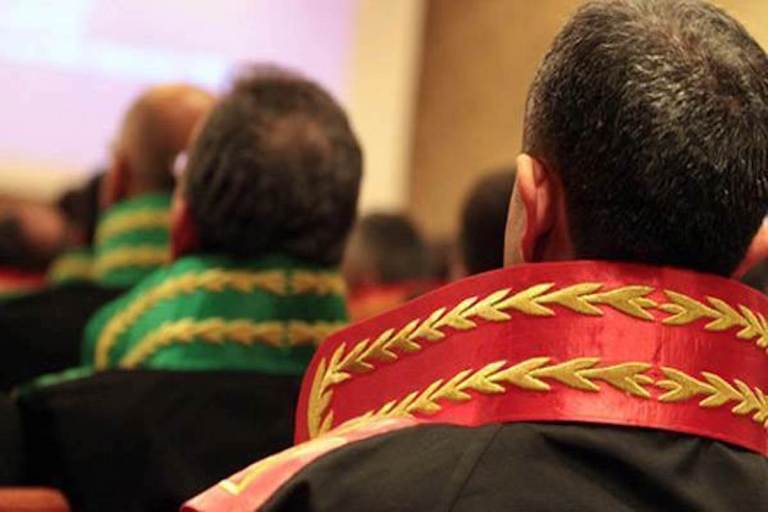
  • Turkey’s top judicial body disbars 13 judges, prosecutors over Gülen links

    Turkey’s top judicial body disbars 13 judges, prosecutors over Gülen links

    Turkey’s Board of Judges and Prosecutors (HSK) has disbarred 10 prosecutors and three judges due to their alleged links to the Gülen movement, Turkish Minute reported, citing Turkey’s Official Gazette.

    “Now that they have been found to be linked to, or affiliated with, the FETÖ/PDY Armed Terrorist Organization, it has been unanimously decided that the persons in question are not fit to remain in the profession and therefore, should be disbarred under Article 26 of Law no. 7145 and Provisional Article 35(A) of Law-Decree no. 375,” the state-run Anadolu news agency quoted the HSK’s decision as saying.

    FETÖ is a derogatory term used by the Turkish government to refer to the Gülen movement.

    The Turkish government accuses the Gülen movement of masterminding a failed coup on July 15, 2016 and labels it a “terrorist organization,” although the movement strongly denies involvement in the coup attempt or any terrorist activity.

    More than 4,500 judges and prosecutors have been disbarred since the failed coup on the grounds of ties to the Gülen movement.

    Since the coup attempt, followers of the Gülen movement have been subjected to a massive crackdown, with the Turkish government and pro-government media outlets demonizing its members.

    Following the coup attempt the Turkish government also removed more than 130,000 civil servants from their jobs due to alleged Gülen links.

    According to a statement from Turkish Interior Minister Süleyman Soylu in February 2021, a total of 622,646 people have been the subject of investigation and 301,932 have been detained, while 96,000 others have been jailed due to alleged links to the Gülen movement since the failed coup. The minister said there are currently 25,467 people in Turkey’s prisons who were jailed on alleged links to the movement.

    In addition to the thousands who were jailed, scores of other Gülen movement followers had to flee Turkey to avoid the government crackdown.

    The HSK, Turkey’s top judicial administrative body, was set up to ensure an independent judiciary, but over time it has become a political instrument for putting the judiciary under government control.

    The Stockholm Center for Freedom’s comprehensive report about the HSK, “Turkey’s Judicial Council: Guarantor or Annihilator of Judicial Independence,” can be reached here. SCF

  • Documents show Turkish diplomats spied on Erdoğan critics in the United Kingdom: report

    The Turkish Embassy in London spied on Turkish citizens in the UK and forwarded the illegal profiling list to Ankara, which led to the launch of groundless judicial procedures against them, Nordic Monitor reported, citing official documents.

    According to a December 11, 2018 decision by prosecutor Birol Tufan, the Ankara Chief Public Prosecutor’s Office launched a separate investigation (file no.2018/27284 ) into 70 Turkish nationals who were listed by Turkish diplomats in London without any concrete evidence of wrongdoing. They were charged with “membership in a terrorist group” by Tufan.

    Nordic Monitor previously reported that even death from COVID-19 does not prevent Turkish nationals from being profiled by Turkish diplomats in London, with a deceased Turkish national and his family members listed in parallel with an ongoing witch-hunt in Turkey. According to a Turkish Foreign Ministry document obtained by Nordic Monitor, a Turkish national informed Turkey’s consulate general in London about the death from COVID-19 of his father, a prominent businessman believed to be affiliated with the Gülen movement, and submitted a medical certificate to Vice Consul Hakan Etkin. However, Etkin asked for not only the address and contact details of the deceased businessman’s son, who was applying for a death certificate, but also for information about the Turkish businessman’s spouse and daughter. The consulate general then dispatched a file including their address in the United Kingdom and contact details including phone numbers and email addresses to the foreign ministry in Ankara.

    Critics of the Erdoğan government abroad, especially members of the Gülen movement, have been facing surveillance, harassment, death threats and abduction since President Recep Tayyip Erdoğan decided to scapegoat the group for his own legal troubles. They have often been denied consular services such as power of attorney and birth registry, as well as having their passports revoked. Their assets in Turkey are seized and their family members at home risk criminal charges.

    Most recently educator Orhan İnandı, who was included in documents previously published by Nordic Monitor, was kidnapped in Kyrgyzstan on May 31 and illegally brought to Turkey by Turkish intelligence agency MIT. İnandı, who had lived in Kyrgyzstan for nearly 30 years, was arrested July 12 on charges of membership in a terrorist organization.

    Turkish embassies are also spying on citizens who have registered for consular services. In June Nordic Monitor published a Turkish foreign ministry communiqué, stamped secret, showing that the Turkish Embassy in Kosovo profiled 78 people who had listed their professions as teachers when they made applications with the consulate for various citizen services. Similar work has apparently been done in other Turkish diplomatic missions at the request of the Turkish National Police, which was politicized with a mass purge of some 30,000 officers from the police force.

    As previously disclosed by Nordic Monitor, the foreign ministry sent lists of profiled Turkish nationals in two CDs to the Ankara Chief Public Prosecutor’s Office, the national police and Turkey’s intelligence agency MIT on February 19, 2018 via an official document for further administrative or legal action, the punishment of their relatives back in Turkey and the seizure of their assets. Public prosecutor Adem Akıncı, who received the foreign ministry document on February 23, 2018, forwarded the classified CDs including information on 4,386 Erdoğan critics to the Organized Crimes Unit of the Ankara Police Department for further action. The police conveyed the results of its investigations to the public prosecutor.

    According to judicial documents released by the Ankara 4th High Criminal Court on January 16, 2019, the foreign ministry compiled a long list of foreign entities that were owned and/or operated by people who were seen as close to the movement.

    Moreover, Nordic Monitor revealed how MIT infiltrated refugee camps in Greece in order to spy on opponents who were forced to flee to Greece to escape an unprecedented crackdown in neighboring Turkey.

     Foreign Minister Mevlüt Çavuşoğlu confirmed systematic spying on Turkish government critics on foreign soil as by Turkish diplomatic missions in February, 2020. Çavuşoğlu said Turkish diplomats assigned to embassies and consulates have officially been instructed by the government to conduct such activities abroad. “If you look at the definition of a diplomat, it is clear. … Intelligence gathering is the duty of diplomats,” Çavuşoğlu told Turkish journalists on February 16, 2020 following the Munich Security Conference, adding, “Intelligence gathering and information collection are a fact.” SCF

  • “With this outbreak, and Delta, the return to zero is incredibly difficult,” New Zeland PM Ardern said.

    New Zealand has abandoned its strategy of eliminating COVID-19 and will instead look to live with coronavirus and control its spread as vaccinations rise.

    Prime Minister Jacinda Ardern signalled the change of strategy on Monday as she announced a lockdown affecting Auckland would be scaled back in phases, starting on Wednesday.

    The Pacific nation was among just a handful of countries to bring COVID-19 cases down to zero until an outbreak of the highly infectious Delta variant in mid-August frustrated efforts to stamp out transmission.

    “With this outbreak, and Delta, the return to zero is incredibly difficult,” Ardern told a news conference.

    “This is a change in approach we were always going to make over time. Our Delta outbreak has accelerated this transition. Vaccines will support it,” she said.

    The country recorded 29 new cases of COVID-19 on Monday, taking the total number in the current outbreak to 1,357.

    Most of the infections are in Auckland, which has been in lockdown for almost 50 days.

    Under mounting pressure, Ms Ardern said her strategy was never to have zero cases, but to aggressively stamp out the virus.

    She added that strict lockdowns would end once 90 per cent of the eligible population was vaccinated.

    About 2 million New Zealanders have so far been fully vaccinated, or about 48 per cent of the eligible population.

    Ms Ardern said the Delta variant felt like “a tentacle that has been incredibly hard to shake”.

    “It’s clear that a long period of heavy restrictions has not got us to zero cases,” she said.

    “But it’s OK … elimination was important because we didn’t have vaccinations. Now we do, so we can begin to change the way we do things.”

    Auckland residents will be able to leave their homes to connect with loved ones outdoors from Wednesday, with a limit of 10 people.

    Early childhood education will also return, but retail and hospitality outlets and offices will still remain shut.

    Ms Ardern said the remaining restrictions for the city of 1.7 million would be eased in phases. ABC

  • Pregnant woman unlawfully arrested in Antalya for aiding families of post-coup victims

    A pregnant woman was unlawfully arrested on September 30 in Turkey’s southern Antalya province for helping the families of individuals targeted by a post-coup crackdown in Turkey, Bold Medya reported.

    The woman, whose name was not disclosed, is two months pregnant and has two more children ages four and six. The Law on the Execution of Sentences and Security Measures stipulates that even if a pregnant woman is convicted, her sentence must be postponed. The law also states that “execution of the prison sentence is delayed for women who are pregnant or have given birth within the last year and a half.”  The law also applies to inmates kept in pre-trial detention.

    Yet, according to a report by Solidarity with OTHERS, a nongovernmental organization comprising mainly political exiles from Turkey, a total of 219 pregnant women and women with children under 6 years of age have been arbitrarily detained or arrested over their suspected links to the Gülen movement.

    The woman was among 23 others who were arrested after being detained on September 17, when police raided multiple locations in seven cities. The suspects were accused of providing food and financial assistance to the families of people who were arrested in the post-coup crackdown or removed from their state jobs and hence deprived of the means to make a living.

    Turkish authorities have over the past week ordered the detention of 104 people for helping those families.

    In Antalya, several women were charged with attending the funeral of Adem Sazlık, who recently died after being imprisoned for 18 months for links to the movement. Sazlık’s wife, Nurgül Sazlık, was also among those who were arrested.

    Firdevs Taşkın, a 46-year old mother of four who suffers from heart disease, was also arrested. Taşkın was first detained in 2016 with her husband Ahmet Taşkın. She was later released but was handed a six year, three month prison sentence. Taşkın’s case is pending with the Supreme Court of Appeals. Her husband, a former teacher, is still in prison.

    Turkish President Recep Tayyip Erdoğan has been targeting followers of the Gülen movement, a faith-based movement inspired by Turkish cleric Fethullah Gülen, since the corruption investigations of December 17-25, 2013, which implicated then-Prime Minister Erdoğan, his family members and his inner circle.

    Dismissing the investigations as a Gülenist coup and conspiracy against his government, Erdoğan designated the movement as a terrorist organization and began to target its members. He intensified the crackdown on the movement following a coup attempt on July 15, 2016 that he accused Gülen of masterminding. Gülen and the movement strongly deny involvement in the abortive putsch or any terrorist activity.

    Such daily activities as having an account at or depositing money in a Gülen movement-affiliated bank, working at any institutions linked to the movement or subscribing to certain newspapers and magazines were accepted as benchmarks for identifying and arresting alleged members of the movement.

    Turkish authorities have arrested thousands of people regardless of whether they may be critically and chronically sick, pregnant or have infants.

    According to a statement from Turkish Interior Minister Süleyman Soylu in February 2021, a total of 622,646 people have been the subject of investigation and 301,932 have been detained, while 96,000 others have been jailed due to alleged links to the Gülen movement since the failed coup. The minister said there are currently 25,467 people in Turkey’s prisons who were jailed on alleged links to the movement. SCF

  • 9 Palestinians go missing in Turkey in one month: report

    Nine Palestinians have gone missing in Turkey in the space of one month, Turkish Minute reported on Monday, citing the Paltoday news website, which published the names of the missing Palestinians.

    Mahmud Abu Navah, the brother of Abdel Rahman Abu Navah, one of the missing Palestinians, told Palestinian media that his brother went missing as he was about to meet with a real estate agent in Beylikdüzü, İstanbul.

    Noting that his brother has been providing consultancy services on real estate in Turkey to Palestinians and people from other Arab countries for eight years, Abu Navah indicated that no information could be obtained about his whereabouts despite efforts by INTERPOL and the Palestinian Embassy in Ankara.

    The first Palestinian to go missing was Muhammed Salhab, a student at a medical faculty in Konya who has not been heard from since Sept. 3. Salhab’s father Emad and brother Wajeeh had gone to Konya to search for him.

    His friends told the Serbestiyet news website that eyewitnesses had observed a black minibus approach Salhab and push him inside the vehicle when he was on his way to Friday prayer.

    The Palestinian Embassy in Ankara announced that some of the missing Palestinians –Alaeddin Abdul Latif, Muhammed Hamada, Abdul Rahman Abu Nawah, Nahed Saber Al Kafarna, Ahmed Al-Qishawi and Fatima Getawi — were living in İstanbul and that their families had been unable to contact them.

    Palestinian authorities have floated the possibility that Israeli intelligence agency MOSSAD might be behind the disappearances.

    Upon complaints by the parents of the Palestinians who went missing in İstanbul, the İstanbul Police Department’s Missing Persons Bureau has started to screen recordings from security cameras across the city.

    Turkey’s consul general in Jerusalem, Ahmet Demirer, on Wednesday said Turkish authorities were doing all they could to locate the Palestinians who went missing in Turkey, the official Palestinian news agency WAFA reported.

    Demirer, who met in Ramallah with Ahmad al-Deek, a director at the Palestinian Foreign Ministry, to discuss the missing Palestinians, said what was definite was that they were not detained by Turkish authorities nor were they in hospitals or government facilities, stressing that Turkey would provide any information it obtained about the disappearances, WAFA said.

    Al-Deek urged the Turkish authorities to do whatever they can to find out what happened to the missing Palestinians, most of whom disappeared while in Istanbul.

    Palestine’s ambassador to Turkey, Fayed Mustafa, told Voice of Palestine that contacts are continuing with Turkish authorities on the missing Palestinians, expressing hope that there might be some information in the next few hours.

    He said he was in contact with the Turkish president’s office and was going to meet with officials from the Ministry of Interior and the police to see what they have.

    “There is no specific information yet about their fate,” he said, adding that the Turkish parties did not provide them with any information other than saying that they are continuing with their efforts in checking street cameras and gathering information about them. SCF

  • Teacher convicted on Gülen links dies in Greece while fleeing persecution in Turkey

    Erkan Akıllı, 47, a teacher who was convicted on terrorism charges due to his links to the Gülen movement, died on Wednesday, a few hours after crossing into Greece via the Evros River, the Bold Medya news website reported.

    After walking for two hours, Akıllı told the group he was travelling with that he was tired and wanted to rest. “You go, I’ll catch up,” he reportedly said. His family learned about Akıllı’s death after Turkish gendarmes asked them to identify his remains prior to an autopsy.

    The cause of his death is still unknown.

    Since 2016 Turkey has arrested tens of thousands of people suspected to have links to the Gülen movement, a faith-based group inspired by Turkish cleric Fethullah Gülen. In order to avoid the government-led crackdown, thousands of Gülen followers have fled Turkey and taken refuge in European and other countries.

    Akıllı was the director of an exam prep center affiliated with the Gülen movement. He was sentenced to six years, three months in prison for membership in a terrorist organization. He was released from prison due to health problems and was scheduled to go back to serve his sentence after the Supreme Court of Appeals upheld his conviction.

    Turkish President Recep Tayyip Erdoğan has been targeting followers of the Gülen movement since the corruption investigations of December 17-25, 2013, which implicated then-Prime Minister Erdoğan, his family members and his inner circle.

    Dismissing the investigations as a Gülenist coup and conspiracy against his government, Erdoğan designated the movement as a terrorist organization and began to target its members. He intensified the crackdown on the movement following a coup attempt on July 15, 2016 that he accused Gülen of masterminding. Gülen and the movement strongly deny involvement in the abortive putsch or any terrorist activity.

    Such daily activities as having an account at or depositing money in a Gülen movement-affiliated bank, working at any institutions linked to the movement or subscribing to certain newspapers and magazines were accepted as benchmarks for identifying and arresting alleged members of the movement.

    According to a statement from Turkish Interior Minister Süleyman Soylu in February 2021, a total of 622,646 people have been the subject of investigation and 301,932 have been detained, while 96,000 others have been jailed due to alleged links to the Gülen movement since the failed coup. The minister said there are currently 25,467 people in Turkey’s prisons who were jailed on alleged links to the movement. SCF

  • Famous Turkish actress convicted of ‘insulting’ former soldier accused of rape

    Ezgi Mola, a popular Turkish actress, was convicted on insult charges after she protested in a tweet in August 2020 the release of a former soldier accused of raping an 18-year-old Kurdish woman, Turkish media reported.

    An Ankara court convicted Mola of insult and ordered her to pay a fine of TL 5,200 ($587). The court then deferred the announcement of the verdict, meaning if Mola does not commit a similar offense during the probation period the conviction will not appear on her record.

    “Drown in the conscience that let you release this rapist low-life,” Mola had said in a tweet referring to Musa Orhan, who was released pending trial after six days behind bars by a Siirt court on August 26, 2020, despite a forensics report confirming that he raped İpek Er.

    In its ruling the court said Orhan is a suspect and not yet convicted. By calling the suspect a “rapist” Mola accused him of a crime, and by saying “low-life” she insulted Orhan, according to the court.

    The 18-year-old Kurdish woman, who died in a hospital on August 18, 2020, 33 days after she tried to take her own life, had left a suicide note accusing Orhan of keeping her at a house for 20 days during which time she was regularly raped by him.

    Lawyer Mehmet Erkan Akkuş, who represents Orhan, had filed a criminal complaint against Mola.

    Thousands on Twitter had reacted angrily to the case against Mola, using the hashtag #YalnızDeğilsinEzgiMola (You’re not alone, Ezgi Mola).

    “Ezgi Mola referred to a rapist low-life by calling him a ‘rapist low-life,’ what’s wrong with that? Musa Orhan is, at the same time, a murderer who caused a person to die and he’s free. Nobody can guarantee that he won’t take another woman’s life,” well-known Turkish actress Hazal Kaya said.

    Femicides and violence against women are serious problems in Turkey, where women are killed, raped or beaten every day. The Justice and Development Party (AKP) government’s policies that protect men by granting them impunity is the main cause of the situation, critics say.

    In late May Minister of Family and Social Services Derya Yanık attracted widespread criticism due to remarks suggesting that the country has experienced “tolerable levels” of domestic violence during the coronavirus pandemic while speaking to members of a committee investigating violence against women. SCF