Category: Politics

  • Architect posts images of Erdoğan’s summer mansion on his website

    An architect has released photos of a presidential state guesthouse in western Turkey, known to the public as Turkish President Recep Tayyip Erdoğan’s “summer palace,” local media outlets reported on Monday.

    The photos were posted by Şefik Birkiye, a Turkish-Belgian architect. The construction of the Okluk State Guesthouse in the popular holiday resort of Marmaris was completed in 2019, but no photos were shared with the public at the time.

    The guesthouse campus was built near Okluk Cove at a cost of TL 640 million between 2018 and 2021 to replace the summer residence that had been constructed during the term in office of the late President Turgut Özal in the 1980s.

    Encompassing some 85,000 square meters, the campus has five buildings as well as three blocks of residential buildings for staff.

    A beach has been created with a 10,966-square-meter landfill, featuring bungalows and docks.

    The construction of the summer mansion was undertaken by Rönesans Holding, which had constructed the presidential complex in Ankara, and was completed in secrecy.

    The mansion is rumored to have 300 rooms.

    A number of guests have stayed at the complex, including Albanian Prime Minister Edi Rama and Azerbaijani President Ilham Aliyev.

    Architect Birkiye was the architect of Erdoğan’s presidential complex in Ankara. He has designed seven mosques, including a mosque built in İstanbul’s Taksim Square as well as the Bizim Mahalle (Our Neighborhood) project funded by the Emlak Konut Real Estate Investment Company in Halkalı and the central bank building in the İstanbul Finance Center.

  • Erdoğan attends iftar dinner hosted by Turkish family in violation of COVID-19 rules

    Turkish President Recep Tayyip Erdoğan and his wife Emine Erdoğan attended a fast-breaking dinner hosted by a Turkish family in violation of newly tightened coronavirus restrictions recently announced by the president himself for the holy month of Ramadan.

    The president and his wife on Wednesday were guests at a traditional iftar dinner hosted by a family living in Ankara’s Mamak district, according to a report by the state-run Anadolu news agency.

    Photos of the event posted on the official Twitter account of the Turkish Presidency on Wednesday showed three traditional floor tables with Erdoğan and his wife seated around one of them and four members of the family hosting the dinner sharing the other two.

    Cumhurbaşkanı @RTErdogan, eşi Emine Erdoğan ile iftarda bir vatandaşın evine konuk oldu. pic.twitter.com/zVqejSs4ql

    — T.C. Cumhurbaşkanlığı (@tcbestepe) April 14, 2021

  • Turkish Parliament receives proceedings against 10 opposition lawmakers

    Turkish Parliament receives proceedings against 10 opposition lawmakers

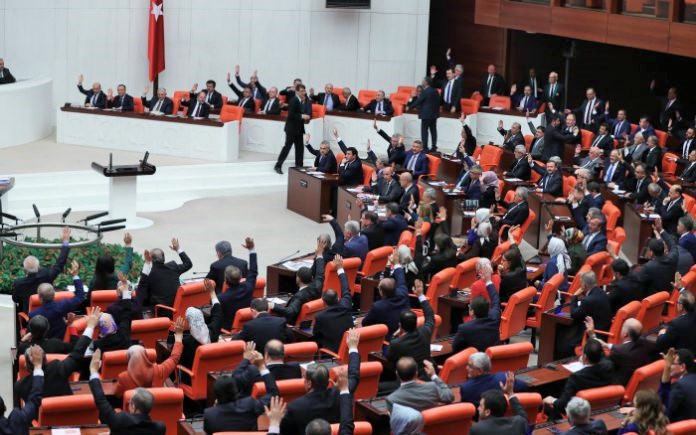
    The Turkish Parliament on Wednesday received summaries of proceedings to remove the parliamentary immunity of 10 opposition lawmakers including the leader of Turkey’s main opposition party, Kemal Kılıçdaroğlu, Turkish media outlets reported.

    In addition to Republican People’s Party (CHP) Chairman Kılıçdaroğlu, CHP lawmakers Oğuz Kaan Salıcı, Muharrem Erkek, Yunus Emre, Veli Ağbaba, Fethi Açıkel and Faik Öztrak as weak as pro-Kurdish Peoples’ Democratic Party (HDP) lawmakers Ayşe Acar Başaran and Kemal Bülbül face removal of their immunity from prosecution.

    The proceedings against the CHP lawmakers are reportedly related to a CHP report about the relationship between Turkey’s ruling Justice and Development Party (AKP) and the Gülen movement, accused by the Turkish government of masterminding a failed coup in Turkey in 2016. The movement strongly denies any involvement in the abortive putsch.

    The HDP politicians face the proceedings on terror charges as the party is accused by the Turkish government of being the political wing of the outlawed Kurdistan Workers’ Party (PKK), listed as a terrorist organization by Turkey, the EU and the US.

    If parliament votes to strip the deputies of their immunity from prosecution, they will be tried by Turkish courts.

    The prosecution of members of parliament has been possible since the CHP and the Nationalist Movement Party (MHP) lent support to a 2016 proposal submitted by the ruling AKP on removing deputies’ immunity from prosecution.

  • Jailed Kurdish leader denounces killing of PKK hostages, blames gov’t for botched rescue attempt

    Jailed Kurdish politician Selahattin Demirtaş has denounced the killing of 13 Turkish nationals held hostage by the outlawed Kurdistan Workers’ Party (PKK), blaming the government for using military methods instead of diplomacy to retrieve the hostages.

    Demirtaş, former co-chair of the pro-Kurdish Peoples’ Democratic Party (HDP), has been imprisoned on terror charges since November 2016. His statement was posted on Twitter.

    “I denounce the massacring of 13 of our people who were in the hands of the PKK. I share the pain of their families and extend my condolences. I am very saddened by what happened,” Demirtaş tweeted.

    On Sunday the Turkish government accused the PKK of executing 13 Turkish nationals — mainly members of the security forces — whom they had held captive in northern Iraq.

    The bodies of the 13 hostages were discovered by Turkish soldiers in a cave in the Gara region of northern Iraq, where Ankara had launched an operation against PKK militants on Feb. 10, Turkish Defense Minister Hulusi Akar said.

    “It is irresponsible to put the blame on the HDP or the opposition for a tragedy that came out of an operation aimed at [creating] a political parade rather than using diplomacy. It is the government that must account for [the killings] to the public,” Demirtaş said.

    A video shared on the HDP’s official Twitter account on Monday shows seven different times when the party’s lawmakers had brought the issue of Turks held captive by PKK militants to the public agenda through parliamentary inquiry requests, parliamentary questions, and press conferences and speeches in parliament since December 2015.

    “Our party and MPs have repeatedly voiced the demands of the families of the hostages in parliament and at press conferences, calling [on the AKP government] to ensure their safe return. If the ruling party is looking for someone to hold responsible [for the death of the 13 hostages], the answer is in the video below,” the HDP said in the tweet.

    “What really matters is opposing violence and war in all circumstances and making peace,” Demirtaş said.

    In December 2020 the European Court of Human Rights (ECtHR) called for the immediate release of Demirtaş, finding Turkey guilty of violating his rights on five counts.

    Despite a decision from the ECtHR in November 2018 that ruled Demirtaş’s pre-trial detention was a political act and ordering his release, Turkish courts refused to implement the European court’s ruling, and a regional appeals court subsequently upheld a prison sentence given to Demirtaş for disseminating terrorist propaganda.

    Demirtaş was an outspoken critic of Turkey’s ruling Justice and Development Party (AKP) and its leader, President Recep Tayyip Erdoğan, before he was jailed. He ran in the presidential elections of 2014 and 2018 as a rival to Erdoğan. Demirtaş conducted his election campaign from jail for the 2018 election.

  • Top court decision to uphold sentence of rights advocate MP draws global outrage

    The Supreme Court of Appeals on Friday upheld a prison sentence of two years, six months given to the rights advocate lawmaker on charges of disseminating terrorist propaganda, a move that has sparked outrage in Turkey and beyond, with thousands of Twitter users posting messages under the hashtag #GergerlioğlununYanındayız (We stand by Gergerlioğlu).

    According to the court’s reasoning, the accusation against Gergerlioğlu is based on a social media post shared by him on Aug. 20, 2016 that included a link to a statement by the outlawed Kurdistan Workers’ Party (PKK) — an armed Kurdish group listed as a terrorist organization by Turkey, the US and the EU.

    Milena Büyüm, Amnesty International’s Turkey campaigner, said the 21-page decision upholding the MP’s conviction and sentence included 16 pages of the dissenting judge’s opinion, which argued that Gergerlioğlu’s prosecution should have been halted when he entered parliament.

    “The law under which he was convicted does not apply; if it was considered a crime has been committed, he should have been prosecuted under a different article. Thus, the conviction should be overturned,” Büyüm tweeted, adding that the lawmaker’s conviction had “the hallmarks of attempting to silence him.”

    “As an MP, Gergerlioğlu consistently speaks out against rights violations. He must be free to continue to do so without judicial harassment and intimidation,” she said.

    Rebecca Harms, a former Green member of the European Parliament, said the MP would lose his freedom and his mandate because he loves the people and defends the truth.

    “He is one of strongest defenders of human rights in Turkey. Jailing him is another severe violation of human rights,” she added.

    Kati Piri, the European Parliament (EP) rapporteur for Turkey, said Gergerlioğlu’s sentence was upheld because he was principled and outspoken on human rights.

    “[President Recep Tayyip] Erdoğan’s Turkey uses the judiciary as an instrument of oppression,” she said.

    Human Rights Watch (HRW) Turkey director Emma Sinclair-Webb referred to Gergerlioğlu in a tweet as one of Turkey’s bravest and most principled rights defenders who consistently demands justice for the most marginalized victims without regard for their political identity.

    “The [Turkish] government has targeted him, he faces a bogus conviction,” she tweeted.

    Sergey Lagodinsky, a member of the European Parliament, said he was repulsed by the court decision to impose a prison sentence on Gergerlioğlu for merely sharing a news article. “This is another step away from democratic standards,” Lagodinsky added.

    “Gergerlioğlu has always been someone who defends justice, exposes injustice and tries to prevent torture [in Turkish prisons]. The Erdoğan regime was disturbed by this and therefore wanted to punish him,” Lawyers in Exile, a platform founded by lawyers from Turkey to monitor human rights violations, tweeted.

    Journalist Can Dündar commented that the deputy’s imprisonment would trigger “a riot of conscience” since he defended the rights of so many people with very different backgrounds and ideologies.

    “We often use the saying, ‘This attack targeted us all.’ I think Gergerlioğlu’s situation is where this saying fits exactly right. He unrelentingly defended people’s rights without questioning who they were. Now it’s our turn. We’ve got your back, Mr. Gergerlioğlu, no ifs, ands or buts,” prominent human rights jurist Kerem Altıparmak tweeted.

  • European rights court requests Turkey’s defense for imprisonment of Kurdish leader over Kobani protests

    The European Court of Human Rights (ECtHR) has asked Turkey to provide its defense for the pre-trial detention of Kurdish politician Selahattin Demirtaş in connection to street protests in the country’s Southeast in 2014 that claimed the lives of 37 people, Turkish Minute reported, citing Demirtaş’s lawyers.

    On Jan. 7, a Turkish court accepted an indictment naming 108 people including jailed politicians Demirtaş and Figen Yüksekdağ, both former co-chairs of the pro-Kurdish Peoples’ Democratic Party (HDP), in relation to the Kobani protests of 2014, seeking punishment for the suspects on various charges including 37 cases of homicide and disrupting the unity and territorial integrity of the state.

    Demirtaş had called for street protests in support of Kurdish fighters in the Syrian town of Kobani while accusing Ankara of failing to provide adequate help to Kobani and of supporting the Islamic State in Iraq and the Levant (ISIL), which had laid siege to the town.

    Demirtaş’s lawyers Ramazan Demir and Benan Molu tweeted about a court document on Monday in which the Strasbourg court directed questions to the Turkish government regarding Demirtaş’s imprisonment in relation to the Kobani protests.

    Turkey has kept Demirtaş, who has been behind bars since November 2016, in prison despite rulings from the ECtHR that called for his immediate release in 2018 and December 2020 as part of another case.

    The seven questions directed to Turkey about Demirtaş’s pre-trial detention include whether Demirtaş has exhausted domestic legal remedies and whether Turkey’s Constitutional Court constitutes an effective legal remedy, considering that Demirtaş has had an application at the court pending since November 2019.

    Following a decision from a Turkish court in September 2019 ordering Demirtaş’s release pending trial, another court blocked his release the same month after prosecutors demanded his rearrest over a fresh investigation on “terrorism” charges.

    The ECtHR asked whether Demirtaş’s second arrest was in compliance with Article 5 of the European Convention on Human Rights concerning the the right to liberty and security of person.

    In other questions, the rights court asked Turkey whether the restrictions imposed on Demirtaş’s legal dossier violated the rights of Demirtaş and his lawyers to have access to the investigation files, whether his freedom of expression was violated, whether his arrest was politically motivated and whether Article 18 of the European Convention of Human Rights was violated through his arrest. Article 18 of the convention states, “The restrictions permitted under this Convention to the said rights and freedoms shall not be applied for any purpose other than those for which they have been prescribed.”

    Demirtaş was an outspoken critic of Turkish President Recep Tayyip Erdoğan before he was jailed. He ran against Erdoğan in the presidential elections of 2014 and 2018. Demirtaş conducted his election campaign from jail for the 2018 election.

    Erdoğan and his government have accused of Demirtaş of being a “terrorist” due to his alleged links to the outlawed Kurdistan Workers’ Party (PKK), listed as a terrorist organization by Turkey, the EU and the US.

    Demirtaş denies the claim.

  • Anger and confusion in Myanmar as coup sweeps away democratic hopes

    Myanmar’s military has seized power in a coup against the democratically-elected government of Nobel laureate Aung San Suu Kyi.

    There was panic-buying of food, military roadblocks in the capital Naypyidaw and a triumphant pro-army rally in Yangon in the hours after a coup in Myanmar.

    But there was also quiet anger simmering among those whose hopes for the country’s democratic future have been stolen.

    “It’s extremely upsetting – I don’t want the coup,” said a 64-year-old Burmese man in Hlaing township, standing with a crowd outside a grocery stall.

    “I have seen many transitions in this country and I was looking forward to a better future,” he added, declining to provide a name for fear of repercussions.

    A putsch had been expected for days, yet when it came it left Myanmar stunned – with roads to its main international airport blocked and communications cut – a country once more isolated from a world it only rejoined a decade ago.

    The military detained 75-year-old de facto leader Aung San Suu Kyi along with President Win Myint and other party figures and activists early on Monday – hours before a newly elected parliament dominated by her National League for Democracy (NLD) party was expected to take its seats for the first time since November polls.

    The military then declared it had taken control of Myanmar for one year under a state of emergency.

    Former general Myint Swe was appointed acting president – sinking the country back into direct military rule after barely a decade-long experiment with democracy.

    Myanmar’s November vote was only the second democratic election the country had seen since it emerged from the 49-year grip of military rule in 2011.

    Fear spread as internet and mobile services were pulled by authorities across the country.

    In Yangon, Myanmar’s commercial capital, people rushed to their neighbourhood grocery stores to stock up on rice, oil and instant noodles as banks were temporarily closed by the communications freeze.

    But aside from police, uniformed men were few and far between in the city, and no blood was shed.

    The guns, tanks and helicopters were further north around Naypyidaw, where armoured vehicles blocked off major roads leading to parliament.

    Suu Kyi remains an immensely popular figure in Myanmar despite her international reputation being deeply tarnished over a crackdown on the country’s stateless Rohingya minority in 2017.

    Her NLD party won over 80 per cent of parliamentary seats available – a seemingly unacceptable number to a military that still held key government posts, retained power over all defence and security decisions, and had 25 per cent of seats ring-fenced for them.

    Yangon filmmaker Lamin Oo said he was “shocked” but unsurprised after a week of coup rumblings.

    “I take my chance to vote very seriously because this can happen in this country,” the 35-year-old told AFP, adding that his neighbourhood is Yankin Township is trying to stay calm.

    “I think we need to be prepared for the worst.”

    Truckloads of pro-military supporters were spotted driving through Yangon’s main roads, waving the country’s flag while blaring the national anthem in an apparent resounding approval for the putsch.

    A small group gathered near the Martyrs’ Mausoleum in downtown Yangon dancing to music booming from loudspeakers blaring the lyrics “We have bravely shown Myanmar’s blood”.

    Another pro-military protest near Sule pagoda saw local and foreign reporters beaten up, according to videos posted on Facebook.

    “This is too much… and an act of injustice,” an NLD MP told AFP requesting anonymity and explaining she was restricted in her official compound in Naypyidaw with scores of other lawmakers.

    For weeks the military has raised allegations of voter irregularities, demanding the election committee release the voters’ list while army head Min Aung Hlaing made menacing statements about repealing the country’s constitution.

    By Monday, the military had announced a year-long state of emergency, promising to hold new “free and fair general elections” and handover power at the end.

    But the country – where pro-democracy protest movements have been crushed with army violence in the past – is on “a knife’s edge,” said independent analyst David Mathieson.

    For the millions who voted for Suu Kyi’s party, they will be “enraged and fearful at a power grab that threatens to squander the gains of the past ten years.”

    The NLD said the statement, which was uploaded on a Facebook page used by the party during its election campaign, was written before Monday’s coup had taken place. Reuters could not immediately reach NLD party officials for comment.

    The actions of the military are actions to put the country back under a dictatorship,” said the statement, which carried leader Suu Kyi’s name but not her signature.

    “I urge people not to accept this, to respond and wholeheartedly to protest against the coup by the military.”

    The statement was issued by the party chairman Win Htein, who in a handwritten note at the bottom stressed it was authentic and reflected Suu Kyi’s wishes.

    “On my life I swear, that this request to the people is Aung San Suu Kyi’s genuine statement,” wrote Win Htein, who could not be reached by Reuters.

    Countries around the world condemned the overnight raids, called for Suu Kyi’s release and urged the military to respect the norms of democracy.

    Prime Minister Scott Morrison described the developments as “disappointing” and said Australia had, alongside other nations including Canada, the UK, the US, New Zealand and some EU countries, issued a statement on Friday opposing efforts to to alter the election outcome and urging the military and all parties to adhere to democratic norms.

    The country continued to face many challenges as it attempted to shape its future, he added.

    “We all hope for Myanmar. We all hope for what I know the Myanmar people want to achieve. I found them the most beautiful of people when I was there, so peaceful in nature but having suffered such terrible violence over the course of their nation’s history.”

    US Secretary of State Antony Blinken called on Myanmar military leaders to immediately release Suu Kyi and other detained officials and civil society leaders.

    “We call on Burmese military leaders to release all government officials and civil society leaders and respect the will of the people of Burma as expressed in democratic elections on November 8,” Mr Blinken said.

    “The United States stands with the people of Burma in their aspirations for democracy, freedom, peace, and development. The military must reverse these actions immediately.”

    Japanese Chief Cabinet Secretary Katsunobu Kato called on the parties concerned “to resolve the issue peacefully through dialogue in accordance with the democratic process”.

    Myanmar is a vital piece of China’s Belt and Road Initiative – Chinese President Xi Jinping’s $US1 trillion ($A1.3 trillion) vision for maritime, rail and road projects across Asia, Africa and Europe – including a proposed $8.9 billion ($A11.6 billion) high-speed rail link from southern Yunnan province to Myanmar’s west coast.

    The country’s northwestern neighbour India said it was watching developments with “deep concern”.

    “India has always been steadfast in its support to the process of democratic transition in Myanmar. We believe that the rule of law and the democratic process must be upheld,” India’s Ministry of External Affairs said in a statement.

    A former UN rights investigator said Myanmar’s people would be forced to make “huge sacrifices” as a result of the military coup.

    “It’s an assault to democracy, the fragile democracy that Myanmar already had,” said Yanghee Lee, a university professor in Seoul who previously served as the United Nations Special Rapporteur on human rights in Myanmar.

    A coup in Myanmar six decades ago followed by over 50 years of military rule had “greatly regressed” the country’s democracy and civilian life, she added, and warned of a similar effect this time.

    “It seems the citizens of Myanmar will once again make huge sacrifices through the coup.” sbs
  • Erdoğan aide used forged high school diploma to get into university, court documents reveal

    Former Olympic wrestler Hamza Yerlikaya, now a chief advisor to Turkish President Recep Tayyip Erdoğan as well as the youth and sports deputy minister, used a forged high school diploma to get into university, according to court documents, the Cumhuriyet daily reported.

    Yerlikaya, a former ruling Justice and Development Party (AKP) deputy who is also an executive board member of Turkey’s state-run Vakıfbank, stood trial on charges of forgery of documents at the Ankara 7th High Criminal Court. According to the court’s reasoned decision dated 2011, Yerlikaya intentionally used the forged high school diploma based on evidence examined by the court.

    According to the Turkish Parliament website, Yerlikaya has a degree from Süleyman Demirel University’s physical education and sports department. He served in parliament between 2007 and 2011. He was appointed as a senior advisor to Erdoğan in 2015.

    Yerlikaya’s appointment to the Vakıfbank board as an independent member in June led to jokes and ridicule among Turkey’s social media users who pointed to the wrestler’s lack of knowledge and experience in banking.

    The AKP and its leader Erdoğan have been harshly criticized for filling state posts with their cronies and eschewing merit-based appointments.

    In the meantime, the People’s Liberation Party, left-wing populist and anti-imperialist political party, filed a criminal complaint against Yerlikaya with the Ankara Chief Public Prosecutor’s Office on charges of forgery of official documents, violation of the Banking Law, wrongful conduct and fraud.

    Turkish President Erdoğan is also at the center of a controversy regarding his university degree.There has been an ongoing debate in Turkey since Erdoğan’s 2014 election as president as to his completion or not of university since the Office of the President has provided no satisfactory documentation of his graduation.

    Despite several calls for Erdoğan to produce an original copy of his four-year college degree to prove that he is eligible to be president, no evidence has been forthcoming proving the completion of his studies.

  • Turkey feared to be turning into surveillance state under Erdoğan rule

    Claims by two opposition political parties of the illegal wiretapping of their phones and the discovery of four bugs at the İstanbul headquarters of another opposition party as well as the Turkish government granting broader authority to the country’s intelligence agency have all raised concerns about the country turning into a surveillance state under the rule of President Recep Tayyip Erdoğan.

    Two Turkish opposition politicians have claimed that their phones are wiretapped and that they are being surveilled. While Interior Minister Süleyman Soylu has denied the allegations, the phone monitoring authorizations granted to Turkey’s state institutions have expanded in recent years.

    Kemal Kılıçdaroğlu, leader of the main opposition Republican People’s Party (CHP), and Felicity Party (SP) leader Temel Karamollaoğlu recently claimed their phones were being illegally wiretapped and that they were being monitored.

    Kılıçdaroğlu’s name recently came up in connection to alleged plots to assassinate him when pro-government columnists Fuat Uğur and Fuat Bol brought up the claims in their newspapers.

    When asked about the allegations, the CHP chairman said he has confidence in his security detail. However, he also claimed his phone conversations are being monitored and that he is under surveillance.

    “I know very well that my phones are being tapped,” Kılıçdaroğlu said.

    The CHP leader’s allegation was followed by Karamollaoğlu saying that he, too, was sure he was being wiretapped.

    “I think our phones and the locations we frequent are being monitored. Yet we are not upset by this since we have nothing to hide. They can listen all they want, it is not a problem for us,” Karamollaoğlu said.

    Interior Minister Soylu spoke out against the allegations on social media. In response to the Habertürk newspaper’s Kübra Par, who raised the issue in her column, Soylu slammed the journalist.

    “Nobody can be wiretapped unless authorized. It’s a felony,” Soylu tweeted. “You have given in to the designs of the West, which tries to take advantage of the concerns of the public.”

    “Admiring the West while looking down on one’s own state…” Soylu went on to say. “I put myself out there, but what about the fabricators of this slander? Wiretapping the main opposition leader is a perversity. Alleging this is a horrible slander!”

    In a similar development on Tuesday, the pro-Kurdish Peoples’ Democratic Party (HDP) announced that four listening devices were found in the party building in İstanbul. Deputy Chairman Saruhan Oluç displayed the devices at a news conference and said the party would file a criminal complaint.

    “We have not been involved in any crime that we’re trying to hide. We don’t have criminal partnerships like you do that we’re covering up,” said Oluç in remarks aimed at the Justice and Development Party (AKP) government.

    Expansion of wiretapping authority

    The allegations raised by the opposition are arguably linked to the vast powers granted to Turkey’s National Intelligence Organization (MİT) in recent years. The government of President Recep Tayyip Erdoğan first passed legislation making it difficult to prosecute MİT employees. Under the new laws, they can only be tried with Erdoğan’s approval and in a special court set up in Ankara. The 34th Ankara High Criminal Court was established to oversee the trials of MİT staff. No intelligence operative has thus far stood trial before it.

    Until 2014 legal wiretapping in Turkey was only possible with a court decision delivered by a panel of three judges. In 2014 new legislation made it possible for a single judge to make the call. In 2016 prosecutors were authorized to directly order the police to carry out phone monitoring if they deemed a situation to be an emergency.

    Monitoring room at the presidential palace

    The surveillance allegations raised by Kılıçdaroğlu and Karamollaoğlu are linked to a new center set up in Erdoğan’s presidential complex in the capital city.

    In September Interior Minister Soylu announced that the government was about to perfect a system connecting all public security cameras across the country to the presidency.

    The opposition believes Erdoğan’s government is monitoring their every move.

    Turkey wants to purchase spyware to penetrate mobile communications

    After the enactment of legislation to facilitate wiretapping, WhatsApp became Turkey’s most popular mobile messaging app. However, several reports have said that Turkey is trying to acquire spyware that would allow it to penetrate WhatsApp communications.

    An ongoing investigation in Germany involves allegations that a software company named FinFisher has sold the Turkish government spyware to wiretap the phone conversations of opponents.

    In the investigation conducted by Munich prosecutors, the company is charged with unlawfully exporting technical surveillance software and hardware to Turkey. The spyware in question, Finspy, is believed to have been sold to Turkey in 2017 to allow the Turkish government access to the phones of participants in protests against the government’s mass detentions and purges under a post-coup state of emergency declared in the aftermath of an abortive putsch in July 2016.

    Reuters reported that through Finspy, it is possible to get hold of the contacts, photos and videos on the phones.

    The hacking of Zehra Türkmen’s phone

    The first allegation about MİT’s use of Finspy came in February 2020 when a teacher by the name of Zehra Türkmen saw her personal information and photos published on the Internet.

    What made Zehra Türkmen significant was her struggle to find her husband Gökhan Türkmen, a former public sector worker sacked by an emergency decree-law who went missing in 2019 for six months. Zehra Türkmen as well as the wives of five other people who disappeared under suspicious circumstances waged an intensive public campaign for months. After six months Gökhan Türkmen turned up in police custody, showing visible signs of torture and ill-treatment. At his first court hearing months later, Türkmen said he had been abducted by MİT and interrogated under torture for four months in an unknown location.

    Zehra Türkmen’s campaign made her a target. The educational institution where she worked was repeatedly audited by inspectors and fined. She lost her job as a result of the pressure. Her phone was hacked, her personal photos were published and her social media passwords stolen.

    After the incident, two journalists critical of the government also had their phones hacked, and their social media accounts published pro-Erdoğan posts.

    Turkey is one of the biggest clients of the Pegasus spyware

    A report released in 2018 by the Citizen Lab at the University of Toronto found that Turkey was one of the biggest clients of spyware named Pegasus, developed by the Israeli-based NSO Group.

    The state clients of the company can access all the information on a phone on which they use the spyware, including passwords, contact lists, calendars, messages and calls made through messaging apps. The spyware also allows the remote use of the phones’ cameras and microphones. It can be used on both iPhones and phones with an Android operating system.

    Citizen Lab had previously revealed that the spyware was used to tap Ahmed Mansoor, an Emirati human rights activist. The phone of Jamal Khashoggi, a Washington Post columnist who was murdered at the Saudi Consulate General in İstanbul, was also surveilled through Pegasus spyware.

  • 55 million lira spent in 10 months to maintain gardens of Erdoğan’s palaces

    The Turkish government had spent 55 million lira as of November to maintain the gardens of presidential palaces around the country, a columnist from the Sözcü daily said on Monday, citing finance ministry records.

    Columnist Çiğdem Toker said expenditures reported under the “purchase of tools, construction and maintenance expenses” item have increased by more than 12 million lira from 42 million lira in the same period last year.

    Toker criticized the extravagance of the presidency, which will be using 11 palaces all around the country after the completion of Okluk Palace near the Aegean coast and a mansion near Lake Van, in addition to the 1,150-room behemoth in the capital.

    Vice President Fuat Oktay has not answered a parliamentary question directed by an opposition deputy about the cost of Okluk Palace, which is under construction on 65 hectares of expropriated land in the coastal Marmaris district, Toker mentioned in her column.

    Known to the public as a “summer palace,” with 300 rooms and four-meter-high walls, the complex is being constructed near the pristine Okluk Bay, where 20 plots of privately owned land were expropriated by the state.

    While Erdoğan’s palace in Ankara has been at the center of debate for five years due to questions about the legality of its construction and the overall cost of the palace, the construction of the presidential complex in Ahlat near Lake Van is moving forward despite a ruling by the Constitutional Court.

    The top court on July 25 annulled an article in an omnibus law that allowed the construction of the palace, saying the shoreline should be under the protection of the state, that it cannot be the venue for a private residence and that it should be open to public use.

    The main presidential complex in Ankara was also at the center of criticism when it was constructed due to its large budget, expensive interiors, more than a thousand rooms and luxurious design as well as the felling of trees in its neighborhood.

    When Erdoğan moved into the palace in November 2014, more than TL 1.7 billion had been spent on it, twice the original estimate.