Blog

  • Mother with special needs child detained over alleged Gülen links

    Zeybegül Yılmaz, who has a 5-year-old special needs child, was detained yesterday evening in İzmir for alleged links to the Gülen movement, the Stockholm Center for Freedom reported citing Bold Medya.

    Yılmaz’s son, Salih, suffers from developmental problems and needs constant care. Salih’s father, Fatih Yılmaz, was arrested in 2016 and is currently serving a seven year, six month sentence in Eskişehir Prison.

    Turkish President Recep Tayyip Erdoğan has been targeting followers of the Gülen movement since the corruption investigations of December 17-25, 2013, which implicated then-Prime Minister Erdoğan, his family members and his inner circle.

    Dismissing the investigations as a Gülenist coup and conspiracy against his government, Erdoğan designated the movement as a terrorist organization and began to target its members. Erdoğan intensified the crackdown on the movement following a coup attempt on July 15, 2016 that he accused Gülen of masterminding. Gülen and the movement strongly deny involvement in the abortive putsch or any terrorist activity.

    Critics have slammed Turkish authorities for detaining and arresting mothers with young or sick children.

    According to a report by Solidarity with Others, a Brussels-based nongovernmental organization that mainly consists of political exiles from Turkey, a total of 219 pregnant women and women with children under 6 years of age have been arbitrarily detained or arrested over their suspected links to the Gülen movement.

    According to a statement from Turkish Interior Minister Süleyman Soylu on February 20, a total of 622,646 people have been the subject of investigation and 301,932 have been detained, while 96,000 others have been jailed due to alleged links to the Gülen movement since the failed coup. The minister said there are currently 25,467 people in Turkey’s prisons who were jailed on alleged links to the movement.
  • Turkey sets clock back 10 years on women’s rights, says Amnesty

    Turkey has set the clock back 10 years on women’s rights by withdrawing from the Istanbul Convention and has also set a “terrifying precedent,” Amnesty International said in a press release on Thursday, the Stockholm Center for Freedom reported.

    Agnes Callamard, secretary-general of Amnesty International, said the withdrawal, “sends a reckless and dangerous message to perpetrators who abuse, maim and kill that they can carry on doing so with impunity.” Callamard added that the “deplorable decision,” which becomes effective today, had become a rallying point for women’s rights all over the world.

    On March 20 President Recep Tayyip Erdoğan issued a decree withdrawing Turkey from the Council of Europe (CoE) Convention on preventing and combating violence against women and domestic violence, better known as the Istanbul Convention, an international accord designed to protect women’s rights and prevent domestic violence in societies, sparking outrage in Turkey and the international community.

    The Council of State, Turkey’s highest administrative court, rejected an appeal demanding cancellation of the presidential decree that pulled out of the international treaty.

    The Istanbul Convention was opened for signature during the CoE Ministers Committee meeting hosted by Turkey in 2011.A survey conducted by Metropoll has revealed that 52.3 percent of Turks are against the government’s decision to withdraw from the convention.

    Prominent women in Turkey have campaigned against the decision to withdraw from the convention and thousands of women took to the streets to protest.

    Gender-based violence is serious problem in Turkey. According to a report published earlier by Sezgin Tanrıkulu,  a human rights defender and Republican People’s Party (CHP) lawmaker, nearly 7,000 women have been victims of femicide during the 18 years that the Justice and Development Party (AKP) has been in power.

    Despite alarming data, Turkey withdrew from the convention instead of working for its better implementation because Turkish conservatives claimed the charter damaged family unity, encouraged divorce and that its references to equality were being used by the LGBT community to gain broader acceptance in society.

    World leaders, including US President Joe Biden and European Commission President Ursula von der Leyen, international and regional organizations and rights groups have reacted negatively to Turkey’s decision to withdraw from the Istanbul Convention.

  • Turkey’s top court says imprisoned lawmaker’s right to liberty and security “violated”

    Turkey’s Constitutional Court has ruled that Ömer Faruk Gergerlioğlu’s rights to be elected and engage in political activities as well as his right to liberty and security were violated through his imprisonment, the Turkish media reported.

    Gergerlioğlu is a former pro-Kurdish Peoples’ Democratic Party (HDP) lawmaker and a prominent human rights activist. He was stripped of his parliamentary status in March and was subsequently jailed.

    In a series of tweets he posted on Wednesday, Gergerlioğlu’s son, Salih Gergerlioğlu said he believes that his father will be a free man soon. “My father is being released from prison. He is being released!” he said

    Gergerlioğlu was stripped of his status in parliament on March 17 after conviction of disseminating “terrorist propaganda” in a 2016 social media post, where he commented on a story that reported on outlawed Kurdish militants calling on the Turkish state to take a step towards peace.

  • 28-year-old relative of Fethullah Gulen in police custory in İzmir

    Munise Gülen, a relative of Turkish cleric Fethullah Gulen, has been detained by the police in İzmir over links to the Gulen group, accused by the government of masterminding a coup attempt on July 15, 2016.

    The group denies any involvement.

    According to the Cumhuriyet daily, the 28-year old woman is the grandchild of Fethullah Gulen’s uncle, Seyfeddin Gulen.Munise is accused of having ByLock, an encrypted mobile app that Turkish government sees as a communication tool among followers of the Gulen group.

  • EU working to locate educator feared to have been abducted in Bishkek

    EU working to locate educator feared to have been abducted in Bishkek

    An official from the European Union has announced that they are working closely with the Office of the United Nations High Commissioner for Human Rights to locate a Turkish-Kyrgyz educator who has been missing in Kyrgyzstan for a month and is allegedly being held against his will at the Turkish Embassy in Bishkek, local media reported.

    Orhan İnandı, the founder and president of the Turkish-Kyrgyz Sapat school network operating in Kyrgyzstan, went missing in Bishkek on the evening of May 31 and is feared to have been abducted by Turkey’s National Intelligence Organization due to his alleged links to the Gülen movement, a faith-based group inspired by Muslim cleric Fethullah Gülen.

    Boris Iarochevitch, head of the Central Asia Division of the European External Action Service, recently answered questions from Brussels-based human rights associations, stating that the EU delegation in Kyrgyzstan had been closely monitoring developments regarding the situation of İnandı.

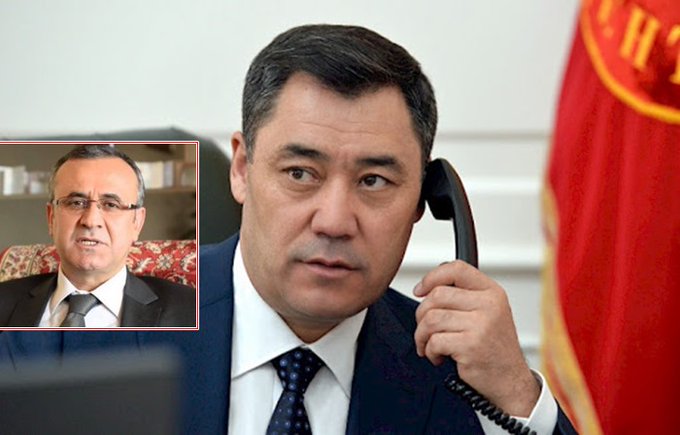
    Iarochevitch added that Kyrgyz President Sadyr Japarov convened law enforcement officers for an emergency meeting and reiterated his order to prioritize locating İnandı, upon a request by the EU.

    Underlining that they noted Japarov’s quick response and instructions, the EU official said they have also conveyed similar requests to other Kyrgyz authorities in Bishkek and Brussels.

    Iarochevich indicated that it was regrettable not to have obtained a result from the investigation to find İnandı, adding that they would remind Kyrgyz Foreign Minister Ruslan Kazakbaev of his international obligations regarding human rights and reiterate their request to locate İnandı at a meeting next week.

    Meanwhile the missing educator’s wife Reyhan İnandı on Thursday called on Japarov to help find İnandı, reminding that her husband has been missing for a month, in a video she released on Twitter.

    “Today it has been a month since Orhan went missing. So far, there is no information about his whereabouts, those who have him or his health. My four children and I can’t sleep and are waiting night and day,” she said.

    She added that she was waiting hopefully for Japarov to make sure that an effective investigation is being carried out to locate her husband.

    Over the past five years scores of men alleged by Turkish authorities to have links to the Gülen movement, living in countries around the world, have been arbitrarily detained and forcibly returned to Turkey. There they are incarcerated on bogus terrorism charges in violation of due process rights and protections.

    Turkish President Recep Tayyip Erdoğan has been targeting followers of the Gülen movement since the corruption investigations of December 17-25, 2013, which implicated then-Prime Minister Erdoğan, his family members and his inner circle.

    Dismissing the investigations as a Gülenist coup and conspiracy against his government, Erdoğan designated the movement as a terrorist organization and began to target its members. He intensified the crackdown on the movement following a coup attempt on July 15, 2016 that he accused Gülen of masterminding, an allegation both Gülen and his followers strongly deny.

  • Twitter users call on Turkish authorities to postpone cancer patient’s prison sentence

    Turkish Twitter users conducted a hashtag campaign on Friday calling on authorities to postpone the execution of the prison sentence of Ayşe Özdoğan, 34, who suffers from a rare form of cancer.

    An appeals court on June 11 upheld a nine year, six month prison sentence for former teacher Özdoğan. She currently faces years in prison despite severe health problems.

    The hashtags #AyşeÖzdoğanTutuklanmasın (Don’t arrest Ayşe Özdoğan) and #AyşeÖzdoğanİçinSesOl (Be a voice for Ayşe Özdoğan) were shared widely by Turkish social media users to appeal the Turkish government.

    Özdoğan and her husband were detained on April 8, 2019 for alleged links to the Gülen movement. She was released due to her son’s heart condition, but her husband was sent to prison in southern Antalya province.

    Özdoğan developed cancer seven months later and underwent an operation on November 12, 2019. However, she was arrested shortly after, convicted and sentenced to nine years, six months in prison.

    Özdoğan’s arrest sparked outrage, and thanks to an online campaign started by Ömer Faruk Gergerlioğlu, a human rights activist and former deputy from the Peoples’ Democratic Party (HDP), she was released on appeal on December 27, 2019.

    It was already too late for her second surgery, however, as the cancer had spread. Özdoğan’s tooth, palate, zygomatic bone and lymph nodes were removed in an emergency operation. Özdoğan lost her ability to see and hear after the operation due to the trauma her facial bones suffered.

    Turkish President Recep Tayyip Erdoğan has been targeting followers of the Gülen movement since the corruption investigations of December 17-25, 2013, which implicated inmatethen-Prime Minister Erdoğan, his family members and his inner circle.

    Dismissing the investigations as a Gülenist coup and conspiracy against his government, Erdoğan designated the movement as a terrorist organization and began to target its members. Erdoğan intensified the crackdown on the movement following a coup attempt on July 15, 2016 that he accused Gülen of masterminding. Gülen and the movement strongly deny involvement in the abortive putsch or any terrorist activity.

    Critics have slammed Turkish authorities for refusing to release critically ill prisoners.

    Gergerlioğlu said critically ill political prisoners were not released from prison “until it reaches the point of no return.” He depicted the deaths of seriously ill prisoners in Turkey who are not released in time to receive proper medical treatment as acts of “murder” committed by the state.

    According to the Human Rights Association (İHD), there are more than 1,605 sick prisoners in Turkish prisons, approximately 604 of whom are critically ill. Although most of the seriously ill patients have forensic and medical reports deeming them unfit to remain in prison, they are not released. Authorities refuse to release them on the grounds that they pose a potential danger to society. In the first eight months of 2020, five critically ill prisoners passed away because they were not released in time to receive proper medical treatment.

  • Victims commemorated on 28th anniversary of Sivas massacre

    Families of the victims of a 1993 fire at the Madımak Hotel in Sivas commemorated their loved ones in the city on the 28th anniversary of the massacre, Turkish media reported.

    The families were accompanied by delegations from the Republican People’s Party (CHP) and Peoples’ Democratic Party (HDP) as well as representatives from Alevi organizations and CSOs during the ceremony held in front of the hotel.

    The victims’ families and attendees called on the government to turn the hotel into a “museum of shame,” saying they were still waiting for justice.

    Some 5,000 people marched to the Madımak Hotel, where they laid carnations and photos of the victims.

    Speaking on behalf of his party during the ceremony, CHP deputy group chairman Özgür Özel said no statutory limitation applies to crimes against humanity, adding, “The [massacre at the] Madımak Hotel was a crime against humanity.”

    Noting that the party’s deputy group chairman, the head of women branches, party assembly members and 15 deputies were in attendance,  CHP Deputy Chairman Veli Ağbaba said: “Unfortunately, we have witnessed one of the gravest massacres in human history. [Therefore] we say that the Madımak Hotel should be declared a museum of shame.”

    HDP spokesperson and Mardin deputy Ebru Günay said justice had not been served since the ruling party protected the assailants, claiming that the “massacre mentality” was still alive today. “We all know the perpetrators very well. We are faced with a massacre mindset. That mentality is still working with the deep state,” she added.

    Federation of Alevi Bektaşi Associations Chairman Hüseyin Güzelgül stated they continue to be a voice for those who died in the Sivas massacre and vowed to keep the memory of the massacre alive.

    Pir Sultan Abdal Culture Foundation (PSAKD) Chairman Gani Kaplan said, “It is the state itself that was behind the Sivas massacre.”

    Nilgün Karababa, the elder sister of Gülsüm Karababa, who died in the fire, expressed regret for not being able to take the case to the European Court of Human Rights (ECtHR). “We commemorate our lost ones and are engaged a legal battle. Yet our main regret is that we were not able to take such a serious case to the ECtHR,” she said.

    The ceremony ended with a semah, an Alevi religious rite.

    Meanwhile, İYİ (Good) Party leader Meral Akşener posted a message on Twitter commemorating the massacre. “Twenty-eight years ago a fire was set at the Madımak Hotel with a torch that never died away in the deepest part of our hearts. Commemorating those who lost their lives and wishing God’s mercy on them,” she tweeted.

    On July 2, 1993 an angry mob torched the Madımak Hotel, killing 37 people, mostly Alevi artists and scholars who were there to attend a conference hosted by the PSAKD.

    In attendance was Aziz Nesin, a left-wing Turkish short story writer, hated among religious Sunnis in Turkey, who had become the target of attacks for attempting to translate Salman Rushdie’s controversial novel “The Satanic Verses” into Turkish.

    A group of radical Islamists, having been provoked by several local political leaders, gathered in front of the hotel following Friday prayer and accused conference participants of being infidels.

    Thirty-three attendees, two hotel staff members and two protesters died in the fire. Nesin was able to escape because the attackers initially failed to recognize him.

    In a controversial move President Recep Tayyip Erdoğan in 2020 used his presidential power to pardon a man who was given an aggravated life sentence for his role in the Sivas massacre.

    A number of lawyers who defended the suspects in the massacre later became politicians in Erdoğan’s ruling party.turkishminute

  • Thousands protest as Erdoğan defends Turkey’s withdrawal from Istanbul Convention

    Turkish President Recep Tayyip Erdoğan on Thursday defended Turkey’s withdrawal from an international treaty to combat violence against women, a move that has drawn condemnation from many Turks and rights groups, prompting protests across the country.

    The Istanbul Convention, negotiated in Turkey’s biggest city and opened for signature in 2011, had as of 2019 been signed by 45 countries and the European Union, committing its signatories to preventing and prosecuting domestic violence and promoting equality.

    Erdoğan sparked outrage in March by pulling out from the treaty, a decision that formally came into force today.

    “Some circles are trying to portray our withdrawal from the Istanbul Convention as a step backwards in our battle with violence against women,” Erdoğan said during a speech in Ankara to present an alternative action plan.

    “Our battle did not start with the Istanbul Convention, and it will not end with our withdrawal from the treaty,” he said.

    Turkey’s highest administrative court on Tuesday rejected an attempt to annul the withdrawal, saying that Erdoğan had the “authority” to make the decision.

    On Thursday thousands protested the decision across Turkey, where femicide has surged in recent years.

    On Thursday thousands protested the decision across Turkey, where femicide has surged in recent years.

    One monitoring group has logged roughly one femicide per day in Turkey since a sharp rise five years ago.

    Rights organizations say Erdoğan’s decision will put women at greater risk of violence when femicide is already prevalent in Turkey.

    Ankara’s withdrawal triggered condemnation from both the United States and the European Union, and critics say it puts Turkey even further out of step with the bloc that it applied to join in 1987.

    Three opposition parties also pulled out of a parliamentary commission on Thursday to protest the decision.

    Women’s rights groups accuse Ankara of withdrawing from the treaty to appease conservatives at a time when Erdoğan’s ruling Justice and Development Party (AKP) is recording lower levels of support.

    “We will continue our struggle,” Canan Güllü, president of the Federation of Turkish Women’s Associations, said on Wednesday. “Turkey is shooting itself in the foot with this decision.”

    She said that since March, women and other vulnerable groups had been more reluctant to ask for help and less likely to receive it, with COVID-19-fuelled economic difficulties causing a dramatic increase in violence against them.

    Proponents of the convention and related legislation say more stringent implementation is needed.

    The Turkish Industrialists and Businessmen’s Association (TÜSİAD) said in a written statement on Thursday that Turkey should turn back from the decision to withdraw from the convention.

    However, many conservatives in Turkey and people supporting Erdoğan’s Islamist-rooted Justice and Development Party (AKP) say the pact undermines the family structures that protect society.

    This month, Council of Europe Commissioner for Human Rights Dunja Mijatovic sent a letter to Turkey’s interior and justice ministers expressing concern about a rise in homophobic narratives by some officials, some of which targeted the convention.

    “All the measures provided for by the Istanbul Convention reinforce family foundations and links by preventing and combating the main cause of destruction of families, that is, violence,” she said.

    “The withdrawal sends a reckless and dangerous message to perpetrators who abuse, maim and kill: that they can carry on doing so with impunity,” said Amnesty International’s secretary-general, Agnes Callamard.

  • Appeals court upholds Azeri-Turkish businessman’s sentence on conviction of Gülen links

    A regional appeals court in İstanbul has upheld a prison sentence handed down to Azeri-Turkish shipping magnate Mubariz Mansimov Gurbanoğlu on conviction of aiding a terrorist organization due to his alleged links to the Gülen movement, the Birgün daily reported on Wednesday.

    Considering the objection to the sentence filed by Mansimov’s lawyers, the court said the five-year sentence handed down to Mansimov by a local court on charges of aiding a terrorist organization was lawful.

    The Turkish government accuses the Gülen movement of orchestrating a failed coup on July 15, 2016 and labels it a “terrorist organization,” although the movement strongly denies involvement in the coup attempt or any terrorist activity.

    The court, however, found the house arrest imposed on him to be a restriction of his liberty, ordering instead that Mansimov remain within the İstanbul city limits.

    Mansimov was arrested in March 2020 and shortly afterwards released into house arrest with an electronic bracelet on his ankle.

    Mansimov had come to the agenda again in recent weeks when crime boss Sedat Peker argued that former shady police chief and former interior minister Mehmet Ağar unlawfully seized the Yalıkavak Marina in the popular holiday resort of Bodrum in western Turkey, which belonged to Mansimov.

    Ağar had defended himself saying the mafia would “unlawfully seize” the marina had he not been chairman of its board of directors but that he had to resign upon criticism from Interior Minister Süleyman Soylu.

  • “My husband is forced to renounce Kyrgyz citizenship,” says İnandı’s wife

    Turkish authorities are forcing Orhan İnandı to renounce his Kyrgyz citizenship in order to be able to deport him to Turkey to prosecute on alleged links to the Gulen group, İnandı’s wife, Reyhan İnandı tweeted.

    Orhan İnandı, a Kyrgyz citizen of Turkish origin, is feared to have been abducted by the Turkish Intelligence in early June. While his whereabouts are still unknown, his family members say he is being held in a building housing the Turkish Embassy in Bishkek.

    “Today marks the 29th day of my husband’s abduction. I believe he is still being held at the Turkish Embassy in Bishkek and is being forced to renounce his Kyrgyz citizenship. I’m worried about his health,” Reyhan İnanlı tweeted on Tuesday.

    İnandı is accused by the Turkish authorities of having membership in the Gulen group, accused of masterminding a coup attempt in July 15, 2016. The group denies any involvement in the attempt.

    According to Kyrgyz media outlets, İnandı has been living in Kyrgyzstan for over 20 years and had worked as a teacher at several elementary schools established by the Gulen members across the country.

    Since 2016, tens of Turkish nationals were abducted and rendered to Turkey by the Turkish intelligence over alleged links to the Gülen group.