Category: World

  • Expelled pro-Kurdish MP‘s ‘justice watch’ at parliament in third day

    Ömer Faruk Gergerlioğlu, a former MP from the pro-Kurdish Peoples’ Democratic Party (HDP) who was stripped of his parliamentary status on Wednesday and has refused to leave the parliament building in protest ever since, told the Artı Gerçek news website on Friday that he would continue to resist until justice was restored.

    Gergerlioğlu, a medical doctor by profession and member of the parliament’s human rights commission, on Wednesday refused to leave the chamber after hearing the decision against him and spent the night on a sofa in the HDP’s parliament meeting room, declaring that he will have to be forcibly removed.

    A rare and prolific critic of President Recep Tayyip Erdoğan and his government who has filed thousands of petitions calling on government ministries to investigate widespread human rights violations in Turkey, the 55-year-old stated that he would remain in the building until the Constitutional Court ruled on his appeal against his conviction on terrorism offenses.

    Gergerlioğlu was stripped of his parliamentary membership after a Supreme Court of Appeals decision upholding a prison sentence of two years, six months given to him for sharing a news report on Twitter and on charges of disseminating terrorist propaganda was read out in the General Assembly.

    “I’ve been here for three days so that the Constitutional Court can give the right decision and the people’s will can be manifested,” Gergerlioğlu said, adding that several other HDP lawmakers were taking turns staying with him every night.

    Referring to the “justice watch,” which he previously said was “ever-growing with the support of the public,” he added: “This is resistance for democracy, justice and the rule of law. I’ll continue to resist despite the unfavorable conditions. It’s not easy being away from my family. But I’m a fighter; I have struggled all my life. The people made me a lawmaker, and I will never stop fighting for that.”

    “Although the mainstream media choose to turn a blind eye to this, what’s happening here is crucial,” he argued, indicating that he was doing everything he could to announce his watch to the world through social media, motivated by the public support he received.

    A video shared on Twitter on Thursday night also showed Gergerlioğlu in the HDP’s meeting room in his pajamas. He was telling and showing the audience that he now had a mattress on the floor to sleep on and that he wouldn’t be sleeping on a sofa as he did before.

    Standing trial on terrorism charges for sharing a news report on Twitter, Gergerlioğlu was given the jail sentence at the end of his trial on Feb. 21, 2018 on charges of disseminating terrorist propaganda, and the conviction was upheld by the Supreme Court of Appeals on Feb. 19.

    The revocation of his status reduced the HDP’s seats in the 600-member assembly to 55. The parliamentary status of two other HDP lawmakers was removed last year due to convictions against them.

    On the same day of his expulsion, a top Turkish prosecutor asked the Constitutional Court to shut down the HDP, which is accused by the Justice and Development Party (AKP) government of having links to the outlawed Kurdistan Workers’ Party (PKK). The party denies links to the militants and says it is coming under attack because of its strong opposition to Erdoğan’s 18-year rule.

    Hundreds of HDP politicians, including the party’s former co-chairs, are behind bars on terrorism charges.
  • Human Rights Watch calls on Turkish Parliament not to expel opposition deputy Gergerlioğlu

    Any move by Turkey’s parliament to use opposition lawmaker Ömer Faruk Gergerlioğlu’s wrongful conviction for a social media post as a pretext to strip him of his parliamentary seat and jail him would compound the serious violation of his right to freedom of expression and violate the voters’ right to choose their representatives, Human Rights Watch said in a statement today.

    The statement comes one day before a court decision is read in parliament that will strip Gergerlioğlu of his membership in the legislature.

    Gergerlioğlu is a prominent human rights activist and a member of parliament since 2018 for the Peoples’ Democratic Party (HDP), a left-wing party with majority Kurdish support. One of the most outspoken critics of President Recep Tayyip Erdogan’s government’s appalling record on human rights, Gergerlioğlu was found guilty in February 2018 of “spreading terrorist propaganda” on the basis of a 2016 social media post that did not advocate violence.

    “Any move to strip Ömer Faruk Gergerlioğlu of his parliamentary seat as a prelude to jailing him would look like a reprisal by the Erdogan government for his brave and vocal stance in support of thousands of victims of human rights violations,” said Hugh Williamson, Europe and Central Asia director at Human Rights Watch. “Gergerlioğlu’s conviction is a blatant violation of his right to free speech and using it as a pretext to expel him from parliament would show deep disdain for democratic norms and the right to political association.”

    On August 20, 2016 Gergerlioğlu tweeted and commented on a news story briefly reporting that the leadership of the outlawed Kurdistan Workers’ Party (PKK), an armed secessionist group listed as a terrorist organization by Turkey, the European Union and the US, had called on the Turkish state to take a step towards peace. The news story also carried a lengthy response to the PKK’s call by Bülent Arınç, the then-speaker of parliament and former deputy prime minister.

    Gergerlioğlu said, “This [the PKK’s] call should be properly considered, there’s no end to the issue, they are saying yes if Öcalan gets involved,” making the argument that imprisoned PKK leader Abdullah Öcalan should be involved in a renewed peace process to end the decades-long armed conflict between the Turkish state and the PKK. Gergerlioğlu was convicted for this tweet sharing the news article and its accompanying photograph of PKK fighters. But no one from the news website that published the article was prosecuted, and the news article itself with the photograph is still accessible online and has never been the subject of any court order blocking it or requiring its removal.

    “Gergerlioğlu’s 2016 tweet falls squarely within the boundaries of protected speech and there are no grounds on which to argue that it could be either necessary or proportionate to prosecute him for words which state an opinion and do not incite violence,” Human Rights Watch said. “His prosecution and conviction are a serious violation of his rights to freedom of opinion and expression and take place in the context of widespread and systematic violations of free speech by the Turkish government that have accelerated following the coup attempt in 2016.”

    Before he was elected to parliament in the 2018 general election, Gergerlioğlu was well known for his engagement over many years in human rights activism alongside his professional work as a doctor. After he was arbitrarily dismissed by emergency decree from working in the public health sector, he served briefly at a private hospital and continued his human rights work.

    After he entered parliament, Gergerlioğlu made human rights his main focus and has been a voice for tens of thousands of people arbitrarily dismissed and jailed in the aftermath of a 2016 coup attempt.

    “At a time when few members of parliament or activists have been speaking up for the rights of people unjustly targeted for their links with the Fethullah Gülen movement, which Turkey regards as a terrorist organization responsible for the coup attempt, Gergerlioğlu has not shied away from his principled and impartial stance in defending their rights,” Human Rights Watch said. “He has made a huge contribution by telling the stories of ordinary people subject to deep injustice and by championing them in their struggle for dignity and recognition regardless of their political and social affiliations.”

    Turkish President Recep Tayyip Erdoğan has been targeting followers of the Gülen movement, a faith-based group inspired by Turkish cleric Fethullah Gülen, since the corruption investigations of December 17-25, 2013, which implicated then-Prime Minister Erdoğan, his family members and his inner circle.

    Dismissing the investigations as a Gülenist coup and conspiracy against his government, Erdoğan designated the movement as a terrorist organization and began to target its members. He intensified the crackdown on the movement following the coup attempt on July 15, 2016 that he accused Gülen of masterminding. The crackdown also targeted political opponents of the government, Kurdish activists and human rights defenders, among others. Gülen and the movement strongly deny involvement in the abortive putsch or any terrorist activity.

    In recent weeks Gergerlioğlu has raised the issue of routinely reported strip-searches of women taken into custody as a cruel and degrading practice. His work to highlight the issue has received wide coverage in the Turkish media but has been met with full or partial denials by the prison authorities and members of parliament from the ruling party.

    “The deeply flawed conviction of Gergerlioğlu for a social media posting should not become the pretext to expel him from parliament and into jail,” Williamson said. “A decision of the Constitutional Court is pending on his case and in the meantime the government would do better to seriously address the human rights concerns raised by Gergerlioğlu and let him carry on his legitimate parliamentary work as an elected deputy.”

  • Turkey, Cambodia called on to implement UN body decision on expelled educator

    The New York-based Journalists and Writers Foundation (JWF) has called on the governments of Turkey and Cambodia to implement a decision against the Kingdom of Cambodia and the Republic of Turkey made by the United Nations Working Group on Arbitrary Detention (WGAD) in the case of an expelled educator. 

    During its 88th session, on November 26, 2020, WGAD concluded that the arrest, detention and forcible transfer of Turkish-Mexican national Osman Karaca in Cambodia on October 14, 2019 was arbitrary and in violation of international human rights norms and standards. The working group found serious human rights violations perpetrated by agents acting on behalf of the governments of Cambodia and Turkey. 

    WGAD said it had noted a significant increase in the number of cases brought to it concerning arbitrary detention in Turkey. The working group expressed its concern “over the pattern that all these cases follow,” recalling that “under certain circumstances, widespread or systematic imprisonment or other severe deprivation of liberty in violation of the rules of international law may constitute crimes against humanity.” 

    The working group requested that “the Governments of Cambodia and Turkey … take the steps necessary to remedy the situation of Mr. Karaca without delay and bring it into conformity with the relevant international norms, including those set out in the Universal Declaration of Human Rights and the International Covenant on Civil and Political Rights.” 

    WGAD called on “the Government of Turkey to release Mr. Karaca immediately” and “the Government of Turkey and the Government of Cambodia to accord him an enforceable right to compensation and other reparations, in accordance with international law.”

    The working group urged “both Governments to ensure a full and independent investigation of the circumstances surrounding the arbitrary deprivation of liberty of Mr. Karaca and to take appropriate measures against those responsible for the violation of his rights.”

    Karaca, the Turkish-Mexican former director of a school run by the movement of US-based Turkish cleric Fethullah Gülen, who Ankara accuses of orchestrating a failed 2016 coup, was arrested by eight policemen while he was at a bank on Oct. 14 in the capital city of Phnom Penh.

    Turkish President Recep Tayyip Erdoğan has demanded the extradition of various people tied to the movement — including staff at schools it funded worldwide. Gülen denies any connection to the abortive putsch.

    At its peak the Gülen movement operated schools in 160 countries, from Afghanistan to the United States. Since the coup attempt, Turkey has pressured allies to shut down Gülen-run establishments.

    Karaca, a former director of the Zaman International School, was arrested “at the request and at the behest of the Turkish authorities,” WGAD said.

    Karaca was not informed of his rights at the time of arrest or about the charges against him and “was held until October 18, 2019, in a secret detention facility operated by the Government of Cambodia and by denying or concealing Mr. Karaca’s whereabouts or fate, the Cambodian authorities placed him outside the protection of the law, excluding the possibility of review of his situation by the domestic courts,” WGAD noted.

    On October 18, 2019 Karaca was handed over to the Turkish authorities, which enabled his illegal transfer to Turkey on a special flight, landing in Turkey the following day, on October 19, 2019. Since October 25, 2019 Karaca has been held in solitary confinement, despite severe and life-threatening disabilities.

    Turkey’s transnational repression policy

    Previously, the Turkish government was accused by UN rapporteurs of engaging in the systematic practice of state-sponsored extraterritorial abductions and forcible returns to Turkey, with at least 100 Turkish nationals from multiple states including Afghanistan, Albania, Azerbaijan, Afghanistan, Cambodia, Gabon, Kosovo, Kazakhstan, Lebanon and Pakistan removed to Turkey.

    In different cases, WGAD has concluded that the arrest, detention and forced transfer to Turkey of Turkish nationals were arbitrary and in violation of international human rights norms and standards.

  • NATO chief expresses ‘serious concerns’ over Turkey’s actions

    The NATO secretary general on Monday said he maintained “serious concerns” over actions by member state Turkey, but added the alliance was an important platform for resolving disputes involving Ankara.

    “I have expressed my serious concerns and we all know there are serious differences and some issues, ranging from the eastern Mediterranean, the Turkish decision to buy the Russian air defence system S-400 or related to democratic rights in Turkey,” Agence France-Press, cited Jens Stoltenberg as telling lawmakers from the European Parliament.

    But the NATO Secretary general added he believed the alliance can “at least can provide an important platform for discussing these issues, raising these issues and having serious debates and discussions about different concerns.”

    Though it has been a NATO member since 1952, Turkey has angered members of the alliance over the last few years in a string of moves.

    The country pushed ahead with the Russian S-400 missile deal despite repeated warnings the missiles risked breaching NATO operational security if used alongside the Western alliance’s own hardware. It went further by conducting a test launch in October. The U.S put off sanctioning Turkey in July 2019 over the S-400, but the missile test ended any delay in issuing them as required under American law.

    It is also accused of destabilising the eastern Mediterranean in its competition with Greece and Cyprus over access to recently discovered hydrocarbons. Ankara’s involvement in the conflicts Libya, Nagorno-Karabakh and Syria have also drawn the ire of other alliance members as well.

    Last week, Stoltenberg said Turkey was an extremely important ally, given the country’s strategic geography.

    Stoltenberg also said the country played an important role in the alliance’s fight against the Islamic State (ISIS). Turkish President Recep Tayyip Erdoğan thanked the NATO official for his remarks.

  • From the coup to the Caucasus: the UK’s curious love affair with Turkey’s Erdoğan

    Before taking up residence at 10 Downing Street, Boris Johnson once famously won £1,000 prize for a poem he wrote about Recep Tayyip Erdoğan in which he referred to the Turkish president as a “wankerer” and implied that he had sex with a goat.

    A lot has happened since then, and Johnson now holds the reins of the Western government with arguably the closest ties to Erdoğan, which do not seem at all to be soured by his past accomplishment in poetry, despite the Turkish strongman’s well-established reputation as a thin-skinned and vindictive autocrat.

    In fairness, London is not the only Western capital criticized for ignoring Erdoğan’s boundless contempt for human rights and his unending crackdown on civil society, media and the Kurdish political movement. Germany also received its share of criticism for being overly lenient with Erdoğan, a policy that persisted into the unprecedented collapse of the human rights situation after a failed military coup in July 2016.

    While Berlin’s rationale for appeasing Erdoğan is fairly self-evident in view of its keenness on sticking to a delicate 2016 migrant deal that purchased Ankara’s services as a gatekeeper for the EU in exchange for financial aid and Turkey’s significance as a customs-free market within the context of Frau Merkel’s trademark commerce-driven foreign policy, the British government’s dealings with the Turkish president’s one-man regime, particularly in the aftermath of the attempted putsch of 2016, have remained rather unexplored and often overshadowed by wider UK-related concerns against the backdrop of Brexit or Erdoğan’s spats with other European capitals.

    In the aftermath of the coup attempt, London stood out in the free world for its feverish support for the Turkish government while other countries were keeping their distance, arguably due to Erdoğan’s use of the abortive putsch as a pretext for carrying out what appeared to be his premeditated assault on the rule of law. Alan Duncan, then-British minister of state for Europe and the Americas who paid a visit to Turkey just a week after the attempted coup, even went so far as to accuse the rest of Europe of “being very slow to react.”

    The UK also frenetically embraced the Turkish government’s narrative on the coup, specifically the claim that it was orchestrated by US-based cleric Fethullah Gülen, in stark contrast to not only other prominent Western security and intelligence officials but also a report later drafted by the UK’s very own parliament which would find that the allegation was lacking an evidential basis. The parliamentary report also slammed the Foreign Commonwealth Office (FCO) for its downplaying of the severity of the human rights crisis caused by the Turkish government’s widespread crackdown on dissent.

    Central to any effort to shed light on this notable alignment is the role played by Richard Moore, a British diplomat who at the time of the coup was the ambassador in Ankara.

    Known in Turkey for his quick-witted Twitter personality and flamboyant football fandom, the go-to shtick for any diplomat seeking to appeal to the Turkish public, Moore also made unusually frequent appearances in government-controlled mainstream media, including his coup anniversary article published in the Sabah newspaper, which is owned by the brother of Erdoğan’s son-in-law, and a peculiar piece in Yeni Şafak, an Islamist version of Breitbart known for its peddling of anti-Western and anti-Semitic conspiracy theories, in which he tried to deflate Turkish conservatives’ traditionally conspiratorial views on the UK by explaining that the old British Empire was a thing of the past. While the publications by Moore and Duncan in pro-Erdoğan mouthpieces never failed to flatter the Turkish people for standing up to the coup and to praise the highly “strategic” relationship the two countries enjoyed, they strictly avoided referring to human rights issues, even generically. The FCO also drew criticism for not designating Turkey among its “Human rights priority countries.”

    In December 2017 Moore returned to his capital as a political director. In mid-2020 he was appointed as the new head of MI6, the UK’s intelligence agency. His name would reappear with a conspicuous visit he paid to Ankara as intelligence chief in November 2020 on the heels of a military escalation in Nagorno-Karabakh between Armenia and Azerbaijan in which Turkey’s military was actively involved on the side of the Azeris. Instead of meeting with his Turkish counterpart, Hakan Fidan, Moore chose to hold talks with Erdoğan’s spokesperson İbrahim Kalın, and the two discussed, among other topics, developments in the South Caucasus.

    The Strategic Culture Foundation, a Russian journal, released an analysis in which it described Moore as the architect of an alleged UK strategy to use Turkey as a battering ram to advance British foreign policy interests. Yet, this claim should be taken with a grain of salt as it came from an establishment closely affiliated with the Russian foreign ministry and flagged by the US State Department for spreading propaganda on behalf of the Kremlin.

    Nevertheless, Moore’s visit remains worthy of interest since it came at a point when Erdoğan had grown isolated in the international community due to his standalone warmongering during the conflict, reminiscent of the role he played as ambassador when the Turkish autocrat was widely criticized in Western capitals over his disproportionately brutal response to the failed coup.

    The UK under Moore’s watch seems to have filled a vacuum created in recent years by Erdoğan’s break with Turkey’s traditional Western alliances as well as a certain disinterest that prevailed in Washington. What remains to be seen is whether this will change during the presidency of Joe Biden, who famously ran on a campaign promise to adopt a more values-based stance vis-à-vis autocratic regimes and whose term has already kicked off with a cold shoulder to Erdoğan.

  • Prosecutor drops negligence charges in case of critically ill inmate released 2 weeks before death

    The Silivri Public Prosecutor’s Office said there were no grounds for legal action in the case of Deniz Hakan Şen, an inmate who died of cancer after being denied timely treatment and released only two weeks before his death, claiming “he would have died even if he had received treatment.”

    According to the Bold Medya news website, the prosecutor determined that Şen was not taken to a hospital despite losing nine kilos in 10 days and suffering from intense abdominal pain. However, the prosecutor also said that even if Şen had received the correct treatment in a timely fashion, his cancer was far too advanced to respond to treatment.

    According to prison records, Şen petitioned the prison administration, saying he was very sick and he could not eat because of his condition. He begged for medical care because he could not function due to the intolerable pain.

    In his petitions Şen said he worked as the sales representative of a medical company for 10 years and based on his experience he suspected he had cancer. However, the prison doctor dismissed Şen’s suspicions and did not refer him to a specialist.

    One morning Şen collapsed in his cell and was taken to a hospital, where he was indeed diagnosed with late-stage stomach cancer.

    Şen was detained in October 2017 for alleged links to the Gülen movement, a faith-based group inspired by Turkish cleric Fethullah Gülen. He was arrested three days later and sent to İstanbul’s Silivri Prison, notorious for its large number of political prisoners.

    Turkish President Recep Tayyip Erdoğan has been targeting followers of the Gülen movement, since the corruption investigations of December 17-25, 2013, which implicated then-Prime Minister Erdoğan, his family members, and his inner circle.

    Dismissing the investigations as a Gülenist coup and conspiracy against his government, Erdoğan designated the movement as a terrorist organization and began to target its members. He intensified the crackdown on the movement following an abortive putsch on July 15, 2016 that he accused Gülen of masterminding. Gülen and the movement strongly deny involvement in the coup attempt or any terrorist activity.

    Şen’s wife, Hüsna Şen, said she would continue to seek justice for her husband who she believes was a victim of gross negligence. “The prosecutor’s decision is full of contradictions. On the one hand there is an admission that there was negligence; on the other hand the prosecutor refuses to allow a full investigation,” she said.

    Hüsna Şen said she pressed charges against the prison administration because she believed her husband had been deprived of his right to medical treatment. “Although my husband will never come back, I am pressing charges as a precedent for other cases where inmates have been deprived of their right to treatment,” she added.

    Hüsna Şen said she visited the warden of Silivri Prison after her husband’s death. “I asked him why they would not allow my husband to get treated,” she said. “He told me the prison doctor was responsible and that my husband was a victim of malpractice.”

    Hüsna Şen said she did not accept this explanation because as an institution, the prison administration was responsible for the conduct of its staff.

    Ömer Faruk Gergerlioğlu, a human rights activist and deputy from the Peoples’ Democratic Party (HDP), a left-wing party with majority-Kurdish support, criticized authorities for not releasing critically ill prisoners until it is too late for them to receive effective treatment.

    “They refuse to release the prisoners until it comes to the point of no return. They only release the prisoners when they realize they will die soon, not wanting them to die in prison,” he said.

    He claimed that prisoners did not have access to proper healthcare facilities such as hospitals or infirmaries.

  • Daniel Andrews is still in hospital after a bad fall — here’s what we know about his condition

    A decision on whether Victorian Premier Daniel Andrews will need spinal surgery after falling over while getting ready for work is expected to be made today.What happened to Daniel Andrews?
    The Premier had been staying in holiday accommodation on the Mornington Peninsula for a weekend break when the accident happened yesterday.

    “Early [Tuesday] morning, I was admitted to hospital after slipping and falling on wet and slippery stairs,” he said in a statement.

    “A CT scan has revealed several broken ribs and vertebrae damage, and subsequent medical advice has recommended I remain in intensive care for the next few days.”

    The fall happened as he was preparing for work in the morning.

    How serious is it?
    The ABC understands the Premier has fractured his T7 vertebra in his mid back.

    A decision will be made on whether he needs to have spinal surgery today.

    However the ABC understands the Premier does not have any punctured lungs, which was a concern yesterday with his broken ribs.

    The Victorian Government is expected to provide an update later.

    The ABC understands it will take Mr Andrews weeks to recover from the serious injury.

    Mr Andrews’s colleague, Environment Minister Lily D’Ambrosio, said he was in good spirits and getting the best care possible.

  • Court finds Interior Ministry culpable in killing of Kurdish girl in SE Turkey

    A Turkish court has found the country’s Interior Ministry culpable in the killing of a 12-year-old Kurdish girl in southeastern Diyarbakır province in 2009 by unexploded military ammunition and ordered that a fine of TL 283,000 ($37,000) be paid to the family by the ministry, the Mezopotamya news agency reported.

    The ruling was made by the Diyarbakır 2nd Administrative Court.

    Ceylan Önkol was killed in the Hambaz neighborhood of Lice while she was tending sheep on Sept. 28, 2009. No state official has stood trial in relation to the death of the Kurdish girl, and the family as well as human rights groups in the region said the incident was not thoroughly investigated.

    After the Önkol family filed a lawsuit against the state for the pecuniary and non-pecuniary damages they sustained over their daughter’s death, the court ruled in 2015 that TL 28,208 lira ($12,000 at the time) be paid to the family in pecuniary damages but did not give a decision for the non-pecuniary damages. The family then appealed the decision.

    Following a new proceeding, the court found the Interior Ministry 90 percent at fault for not taking the necessary measures to ensure the security of an area that was frequently used by villagers to tend to their animals and by children as a playground. The court said the existence of an unexploded ammunition in an area close to a residential neighborhood shows that the ministry was at fault and did not carry out its duties properly.

    Ceylan’s death at the time prompted national outrage, putting the impunity of the state under the spotlight, particularly in the country’s predominantly Kurdish southeastern regions. The young girl’s mother had said they had to endure giving over three hours of testimony with the body of her daughter beside them at a gendarmerie post near the scene of her death.

    Önkol’s body was left at the scene for six hours because a Lice prosecutor refused to go to the area out of security concerns. The prosecutor went to the area where Önkol was killed three days after the tragedy.

    The Turkish military refused to acknowledge any responsibility in the death of Önkol, and a brigadier general from the General Staff at the time pointed the finger at the outlawed Kurdistan Workers’ Party (PKK), which is also active in the region, as being responsible for the girl’s death.

    The brigadier general also described the efforts to link Önkol’s death with the Turkish military as part of “concerted, asymmetric, comprehensive propaganda warfare” against the Turkish Armed Forces (TSK).

  • Turkey marks Women’s Day amid increasing domestic violence, political imprisonment of women

    Thousands of women from all walks of life who were jailed on politically motivated charges in the aftermath of a failed coup in Turkey marked International Women’s Day in jail at a time when the country is shaken every day by news of the death of a woman at the hands of a man.

    According to a report from main opposition Republican People’s Party (CHP) lawmaker Sezgin Tanrıkulu, there are currently 17,000 women in Turkey’s jails, 11,000 of whom are believed to have been arrested in mass detentions following the failed coup. Some 3,000 children, 800 of them aged 3 or below, are accompanying their mothers in prison.

    Following the coup attempt, the Turkish government, which accuses the faith-based Gülen movement of masterminding the failed coup, launched a massive crackdown on the movement’s alleged followers under the pretext of an anti-coup fight. Thousands of women including pregnant women and women who had just given birth were sent to jail on trumped-up terrorism charges as part of the ongoing crackdown.

    Dozens of Kurdish female politicians such as former co-chairperson of the pro-Kurdish Peoples’ Democratic Party (HDP) Figen Yüksekdağ and former Diyarbakır co-mayor Gültan Kışanak also marked Women’s Day in jail as they were arrested as part of a crackdown on the Kurdish political movement.

    Tanrıkulu’s report showed an upward trend in cases of domestic violence in Turkey during the 18-year rule of the Justice and Development Party (AKP), which has witnessed the killing of 6,732 women by men so far.

    The latest example of domestic violence, which became public thanks to a video on social media, showing a man beating his ex-wife, led to outrage in Turkey over the weekend.

    The video, which went viral, shows the man violently punching and kicking his 24-year-old ex-wife in front of their 5-year-old child as neighbors called on him to stop.

    The assault — which came shortly before International Women’s Day — sparked condemnation on social media, with users calling on the authorities not to let him go unpunished. The man was subsequently detained.

    Angry over the rising number of women killed by men, women often take to the streets in İstanbul and other cities to demand that the government adhere to a landmark treaty on preventing domestic violence.

    The so-called İstanbul Convention is the world’s first binding instrument to prevent and combat violence against women, from marital rape to female genital mutilation.

    A ruling AKP official said last year that the convention was “wrong” and speculated about a possible withdrawal.

    Turkish President Recep Tayyip Erdoğan, who frequently attracts criticism from women’s rights groups due to controversial statements about gender roles and gender equality, said on Sunday he considered violence against women a “crime against humanity.”

    “I condemn once more in the strongest terms any kind of physical or mental violence against women as well as discrimination,” he said in a message for Women’s Day on Monday.

    However, Erdoğan and his statements targeting women are believed by many to be responsible for the increasing violence against women in the country.  During his 18 years in power, Erdoğan as well as some members of his AKP government has been criticized for using rhetoric considered discriminatory against women.

    CHP leader Kemal Kılıçdaroğlu said, “We grieve because of what we see instead of celebrating March 8,” in a video message on Twitter where he appeared alongside his wife.

    “You have my word. We will end the violence,” he promised.

    Women were expected to gather in İstanbul on Monday for the annual “Feminist Night March.”

    At last year’s event, police blocked all roads to the city’s central Taksim Square and fired tear gas at the protesters.

  • 70 detained across Turkey due to alleged Gülen links

    70 detained across Turkey due to alleged Gülen links

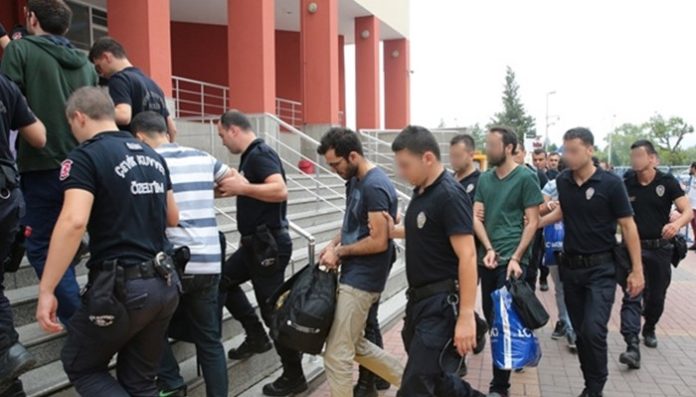
    Turkish police on Monday detained 70 people including former military officers in three separate operations targeting alleged members of the Gülen movement, the state-run Anadolu news agency reported.

    The faith-based movement is accused by the Turkish government and President Recep Tayyip Erdoğan of masterminding a coup attempt on July 15, 2016 and is labeled a “terrorist organization,” although the movement denies involvement in the coup attempt or any terrorist activity.

    The suspects, who were detained as part of operations in the western province of İzmir, central province of Konya and southeastern province of Şanlıurfa, are accused of continuing involvement in the movement’s activities, having contact with Gülen-linked military officers and using the ByLock messaging app. ByLock, once widely available online, has been considered by the Turkish government to be a tool of secret communication among supporters of the movement since the failed coup in 2016 despite the lack of any evidence that ByLock messages were related to the abortive putsch.

    Since the coup attempt, followers of the Gülen movement have been subjected to a massive crackdown, with the Turkish government and pro-government media outlets demonizing its members.

    According to a statement from Interior Minister Süleyman Soylu last month, a total of 622,646 people have been the subject of investigation and 301,932 have been detained, while 96,000 others have been jailed due to alleged links to the Gülen movement since the failed coup. The minister said there are currently 25,467 people in Turkey’s prisons who were jailed on alleged links to the Gülen movement.