Blog

  • Scott Morrison announces withdrawal of Australian troops from Afghanistan

    Prime Minister Scott Morrison became emotional as he read out a list of Australians killed in the war in Afghanistan and announced Australian troops would leave the country by September.

    Mr Morrison said the 80 remaining troops would be withdrawn in line with the withdrawal of US troops as announced by President Joe Biden.

    More than 39,000 Australians were deployed and 41 of them were killed during the decades-long conflict.

    “The loss is great, the sacrifice immense ,the bravery and courage things we can speak of, but not know of personally,” Mr Morrison said.

    “Many more were wounded, some physically, others mentally and we’ll be dealing with the scars, both mental and physical, of their service, for many, many years.”

    Australian forces first entered Afghanistan in October 2001 in support of US troops who were deployed in the wake of the terrorist attacks on September 11, 2001.

    The Prime Minister said it was “an emotional day” but that despite the toll the conflict took, it was worthwhile.

    “Freedom is always worth it,” Mr Morrison said.

    “Australians have always believed that.

    “That is why Australians who have served in our defence forces have always pulled on that uniform.”

    When asked about the allegations some Australian troops committed war crimes while in Afghanistan, Mr Morrison said: “There will be time to talk about those things. Today is not that time.”

    Mr Morrison said the government would continue to support Afghanistan once the troops had left.

    “Once again, we stand with them and the complex task of making peace that lies ahead for those people,” he said.

    “Australia continues to support the negotiations between the Afghan government and the Taliban.

    “We encourage both parties to commit to the peace process that so many Australians have died to provide for.”

  • Retrial of 4 Zaman journalists begins at İstanbul court after top court ruling

    An İstanbul court on Tuesday began the retrial of four journalists from the now-closed Zaman daily after the Supreme Court of Appeals in December annulled the local court’s rulings against the four journalists.

    The Zaman daily, which was Turkey’s best-selling newspaper, was closed down along with dozens of other media outlets due to their links to the Gülen movement, which is accused by Turkey’s Justice and Development Party (AKP) government of masterminding a coup attempt on July 15, 2016 although it strongly denies any involvement.

    Former Zaman daily columnists Şahin Alpay, Mümtaz’er Türköne and Ali Bulaç attended the first hearing of the trial at the İstanbul 13th High Criminal Court, while former Zaman editor Mehmet Öztürk was absent.

    The journalists had been arrested in the aftermath of the coup attempt as part of a crackdown on journalists critical of the government and journalists who used to work at Gülen-affiliated media organizations. Eleven journalists were tried on charges of violating the constitution, membership in a terrorist organization, disseminating the propaganda of a terrorist organization and aiding a terrorist organization.

    In December the Supreme Court of Appeals ruled to uphold the lower court’s decision for the acquittal of the four defendants as well as sentences given to the three of the defendants in the trial. The top court also ruled that sentences given to Türköne, Bulaç and Alpay as well as an acquittal decision for Öztürk were flawed.

    The journalists, who were all in pretrial detention for several years following the coup attempt, demanded that the court comply with the top appeals’ court ruling and rule for their acquittal. Alpay reminded the court of two rulings from Turkey’s Constitutional Court and one ruling from the European Court of Human Rights concerning the violation of his rights during his imprisonment and pretrial detention.

    The journalists denied all the charges against them, saying their activities at the Zaman daily were merely journalistic and that they had nothing to do with the coup attempt.

    The court adjourned the trial to a later date.

  • | Zaman Australia

    | Zaman Australia

    Chinese authorities have blacklisted Australian Uyghur community leaders and activists as “suspected terrorists” for monitoring and harassment in a trove of police records obtained by the ABC.

    The Australian citizens, who have lived in Australia for between 7 and 20 years, are among thousands of Uyghurs in China and abroad who are singled out in an official Chinese blacklist for surveillance and interrogation.

    The leaked blacklist contains the records of 10,000 “suspected terrorists”, including children and more than 7,600 ethnic minority Uyghurs, who face a campaign of repression and detention which Beijing claims is aimed at stamping out Muslim extremism.

    The files are among more than 1 million police and surveillance records from Shanghai contained in a database named “uyghur terrorist” that was hacked late last year, as revealed by the ABC earlier this month.

    An ABC investigation has now identified at least three Australian-based ethnic minority Uyghurs blacklisted in the database as “suspected terrorists” — evidence of a far-reaching campaign to monitor and stamp out foreign influence and dissent.

    They include two Australian citizens — prominent Canberra-based community leader Nurgul Sawut and Melbourne Uyghur elder Maimaitiaji Kasimu — who both appeared in an explosive ABC Four Corners program in 2019 about human rights abuses in the province of Xinjiang.

    The third Australian Uyghur, whose identity the ABC is withholding for his family’s safety, is a permanent resident whose mother was threatened with detention in Xinjiang months after he attended a major protest in Canberra.

    Each of the three have family members or relatives who have been detained in a network of “re-education” camps in the province.

    “I take being on this list as a badge of honour,” said Ms Sawut, a director of the US-based Campaign for Uyghurs organisation, who has spent years gathering data on the detention of Australian residents and their families.

    “But some of the family members [of blacklisted Uyghurs] took it hard. They interpret it as they’re still being watched, even though they live in Australia.

    “When I saw my name on the Chinese terrorist list, I was shocked but not surprised because I have been outspoken about the Uyghur cause and the crisis in our region since 2017.”

    Ms Sawut says dozens of her family members in Xinjiang have been locked up in retaliation against her activism, and she has received attacks and warnings online which she believes were sent by Chinese authorities.

    Hayrullah Maimaitiaji, whose blacklisted father Maimaitiaji Kasimu is revered as a devoutly religious leader in Melbourne’s Uyghur community, told the ABC he feared the discovery would further discourage others from speaking out.

    “We are telling the truth, and now the Chinese government put my father with more than 7,000 people [Uyghurs] on that list,” said Mr Maimaitiaji, who was detained in Xinjiang in 2017 and is from a prominent Muslim family repeatedly targeted by authorities in China.

    “If we are suddenly on the list, our relatives in China or us ourselves are in a very hard position.

    “You [already] can’t go to China anymore or we can’t leave China anymore. It’s going to affect our safety as well.” ABC news

  • Boy struggling with leukemia needs jailed parents’ support, grandfather says

    Chinese authorities have blacklisted Australian Uyghur community leaders and activists as “suspected terrorists” for monitoring and harassment in a trove of police records obtained by the ABC.

    The grandfather of Hakan Dağdeviren, an 11-year-old boy diagnosed with leukemia in January whose parents are imprisoned as part of a crackdown in Turkey targeting followers of the faith-based Gülen movement, has told Deutsche Welle Turkish service that Hakan needs his parents to be able to battle his disease.

    “He is just a kid. He’s in a hospital, he’s ill. This is a period when he needs his parents the most,” 70-year-old Ali Dağdeviren told DW about Hakan, whose cancer metastasized to his liver, abdomen, neck and armpits, according to his doctors.

    Sabriye and Gökhan Dağdeviren, Hakan’s mother and father, were arrested in 2018 for alleged links to the Gülen movement, a faith-based group inspired by Muslim cleric Fethullah Gülen and critical of Turkish President Recep Tayyip Erdoğan and his ruling Justice and Development Party (AKP).

    The Erdoğan administration accuses Gülen and his followers of masterminding an abortive putsch on July 15, 2016 and labels the movement a terrorist organization. Both the preacher and members of his movement, however, strongly deny involvement in the coup or any terrorist activity.

    Hakan’s mother was sentenced to six years, 10 months in prison and his father to 19 years. Both are serving their time in Eskişehir Prison, while Hakan and his sister Halenur, are under the care of their grandparents.

    “According to his psychologist, Hakan, once an active child, withdrew into himself following the latest developments because he tries to carry his own burden as well as that of his sister and parents, and he can’t do it,” the grandfather said.

    He added that Hakan has undergone three rounds of chemotherapy since January and that the second was especially hard for him. “By then, he had scars in his mouth and throat. He needed respiratory support and his hair started to fall out,” he said.

    Hakan to have bone marrow transplant between May and June

    The grandfather also revealed some good news, saying that Hakan had a match for a bone marrow transplant with his sister and that the operation was scheduled to take place between May and June, DW said. Hakan is also expected to be allowed to go home next week.

    The hashtag #DirenBeHakan (Be strong, Hakan) was shared widely last week by Turkish social media users appealing to the Turkish government to postpone the execution of the jail sentence of Hakan’s mother.

    Referring to the campaign, the grandfather said: “It’s not just Hakan. There are many people, babies who are really ill and cannot have the company of either one or both of their parents. It’s not supposed to be like this. Be that as it may, I believe that they [the AKP government] will not release those parents. They won’t do it because they don’t want to do it.”

    Erdoğan has been targeting followers of the Gülen movement since the corruption investigations of December 17-25, 2013, which implicated then-Prime Minister Erdoğan, his family members and his inner circle.

    He intensified the crackdown on the movement following a coup attempt in 2016 and launched a massive post-coup purge that has taken a huge toll on human life, making no exceptions for children. Several children such as Ahmet Burhan Ataç, Mehmet Fatih Dedeoğlu, Selman Çalışkan, Eymen Küçükaydoğan, Ali İhsan Başer and Furkan Dizdar were diagnosed with cancer after their fathers were arrested. Some of these children were unable to cling to life and succumbed to their illnesses.

    According to a statement from Interior Minister Süleyman Soylu on February 20, a total of 622,646 people have been the subject of investigation and 301,932 have been detained, while 96,000 others have been jailed due to alleged links to the Gülen movement since the failed coup. The minister said there are currently 25,467 people in Turkey’s prisons who were jailed on alleged links to the Gülen movement.

  • Saving food to save the planet: European initiatives take on food waste

    Almost a third of the food produced worldwide goes to waste. That’s equivalent to around 1.3 billion tonnes. This waste is a global issue that has a negative impact on waste management systems, food insecurity, biodiversity and pollution. If food waste were a country, it would be the third biggest source of greenhouse gas emissions in the world.

    In the EU alone, 88 million tonnes of food waste is generated each year. Costs associated with this are estimated to be around 143 billion euros.

    The European Commission is committed to meeting its Sustainable Development Goals and halving food waste per capita, at the retail and consumer level, by 2030. At the heart of the European Green Deal is the Farm to Fork Strategy. This strategy is looking to make food systems fairer, healthier and more environmentally friendly. That’s why the commission is proposing legally binding targets to reduce food waste across the EU by the end of 2023. It is also looking to revise EU rules on date-marking food by the end of 2022.Food waste affects many different areas, so there also are many ways to fight it.

    Sirplus supermarkets in Berlin have found one effective way to reduce food waste and turn a profit at the same time. The company sells food that can be visually unappealing, mislabeled, or close to the best-before date.All their products are inspected to ensure that they are safe to eat before being sold in their shops or online. It also sells this food to charities, such as refugee centres and soup kitchens that need cheap food. Food sold at Sirplus can be up to 70% cheaper than conventional supermarkets.

    Susanne Zander, the outreach manager at Sirplus, tells us that in 2020 they were able “to save 3.5 million products”. She says that ensuring that this food is not thrown away, means that they’re doing their “bit for sustainability and fighting greenhouse gas emissions”.

    Creative cooking with surplus food

    Hanna and Theresa work for Restlos Glücklich, a German non-profit organisation campaigning for more sustainable food consumption. They regularly rescue surplus food, which is close to expiring, or visually unattractive for educational projects.At their headquarters in Berlin, they teach people how to cook good and healthy meals using the food they recover. Showing how to make these under-appreciated ingredients into tasty dishes is also a way of reducing food waste. Hanna tells us that “across Germany 18 million tonnes of food are thrown away every year”. To her “that is totally absurd”. That’s why her association campaigns for food destined to be thrown away “to be reused, for it to be returned to the food cycle and for people to understand what it’s all about, what effects it has on the climate”.

    Hanna’s online cooking classes for the association’s followers are also part of the #planetaryhealthchallenge, an international initiative looking to raise awareness about the best diet for people and planet.

    Foodsharing initiatives

    Getting people involved in saving food is at the heart of the foodsharing.de initiative, an online platform active in Germany and Austria. It coordinates the pick-up of excess food that is still edible, but would otherwise be thrown away, from people, retailers and producers. It is then taken free of charge by volunteers to public distribution centres. Katja Scheel is the communication manager for this platform. She says that “it’s a completely open movement, anyone can join in, anyone can get involved”. To this platform, it’s important that it’s a “participatory movement”. They currently have over 10,000 active members in Berlin.

    One such member is Lena. She joined this ‘foodsharing’ initiative to do something about all the food that is being thrown away and to teach her son about sustainable food handling.

    There are ways and means to decrease food waste which, in turn, will lower CO2 emissions and protect the planet. Making food that would otherwise be thrown out into a tasty dish is one of the simplest solutions. It requires little effort, a bit of imagination and as Hanna from Restlos Glucklich says: “saving the planet can taste so delicious”.

  • ‘Time to end forever war’: US troops to be withdrawn from Afghanistan

    US President Joe Biden has announced he will withdraw remaining US troops from Afghanistan on 11 September.

    “It’s time to end the forever war,” Biden said in remarks from the White House’s Treaty Room.

    His plan is to pull out all US forces – numbering 2,500 now – one the 20th anniversary of the 2001 terror attack that was coordinated from Afghanistan.

    The US cannot continue to pour resources into an intractable war and expect different results, Biden said.

    After his televised remarks, Biden went to Section 60 of Arlington National Cemetery to visit the graves of US troops killed in Afghanistan.

    “There’s no comforting distance in history in Section 60, the grief is raw.” he said. “It’s a visceral reminder of the living cost of war.”

    The troop drawdown would begin rather than conclude by May 1, which has been the deadline for full withdrawal under a peace agreement the Trump administration reached with the Taliban last year.

    The decision marks perhaps the most significant foreign policy decision for Biden so far in his presidency.

    The president will then visit Section 60 of Arlington National Cemetery to honour the sacrifice of those who died in recent American conflicts.

    The US administration had originally planned to withdraw troops by May 1 as part of a peace agreement the Trump administration reached with the Taliban last year.

    His plan sets a firm end to two decades of war that killed more than 2,200 US troops, wounded 20,000, and cost as much as €835bn ($1 trillion).

    The conflict largely crippled al-Qaeda and led to the death of Osama bin Laden, the architect of the September 11 attacks.

    It recently became clear that an orderly withdrawal of the remaining troops would be difficult and was unlikely by May 1.

    Defence officials and commanders had argued against the May 1 deadline, saying the US troop withdrawal should be based on security conditions in Afghanistan, including Taliban attacks and violence.

    Officials have quietly acknowledged that there are hundreds more in Afghanistan than the official 2,500 number.

    The president’s decision risks retaliation by the Taliban on US and Afghan forces, possibly escalating the 20-yea conflict.

    It will also reignite political division over America’s involvement in what many have called the endless war.

    The German Defence Minister also said NATO soldiers engaged in Afghanistan are likely to withdraw by September.

    Speaking ahead of a meeting of defence and foreign ministers of NATO members on Wednesday, Annegret Kramp-Karrenbauer said: “I am for an orderly withdrawal, which is why I suppose we will decide this today.”

    During a videoconference the Alliance is expected to make a decision on whether the time is right to end the “Resolute Support” mission in Afghanistan which includes 9,600 troops from 36 countries.

    An intelligence community report issued on Tuesday about global challenges for the next year said prospects for a peace deal in Afghanistan are “low” and warned that “the Taliban is likely to make gains on the battlefield.

    If the coalition withdraws support the Afghan government will struggle to control the Taliban, the report says.

    Reaction to the new deadline has been mixed.

    “Precipitously withdrawing US forces from Afghanistan is a grave mistake,” said Senate Republican leader Mitch McConnell, R-Ky. “It is retreat in the face of an enemy that has not yet been vanquished and abdication of American leadership.”

    Sen. Jim Inhofe of Oklahoma, the ranking Republican on the Senate Armed Services Committee, slammed the move as a “reckless and dangerous decision.”

    He said any withdrawal should be conditions-based, adding that arbitrary deadlines could put troops in danger, create a breeding ground for terrorists and lead to civil war in Afghanistan.

    Democrat, Sen. Jack Reed, D-R.I., chairman of the Armed Services Committee, said President Donald Trump’s May 1 deadline limited Biden’s options.

    “We still have vital interests in protecting against terrorist attacks that could be emanating from that part of the world, but there are other areas, too, we have to be conscious of,” Reed said.

    But at least one senior Democrat expressed disappointment; Sen. Jeanne Shaheen of New Hampshire said in a tweet that the US “has sacrificed too much to bring stability to Afghanistan to leave without verifiable assurances of a secure future.”

    Taliban spokesman Zabihullah Mujahed told the AP that the religious militia is waiting for a formal announcement to issue its reaction. The Taliban previously warned the US of “consequences” if it reneged on the May 1 deadline.

    In a February 2020 agreement with the Trump administration, the Taliban agreed to halt attacks and hold peace talks with the Afghan government, in exchange for a U.S. commitment to a complete withdrawal by May 2021.

    When Biden entered the White House in January, he began a review of the February 2020 agreement and has been consulting at length with his defence advisers and allies.

    In recent weeks, it became increasingly clear that he was leaning toward defying the deadline.

    “It’s going to be hard to meet the May 1 deadline,” Biden said in March. “Just in terms of tactical reasons, it’s hard to get those troops out.” He added, “And if we leave, we’re going to do so in a safe and orderly way.” euronews
  • Turkish Parliament receives proceedings against 10 opposition lawmakers

    Turkish Parliament receives proceedings against 10 opposition lawmakers

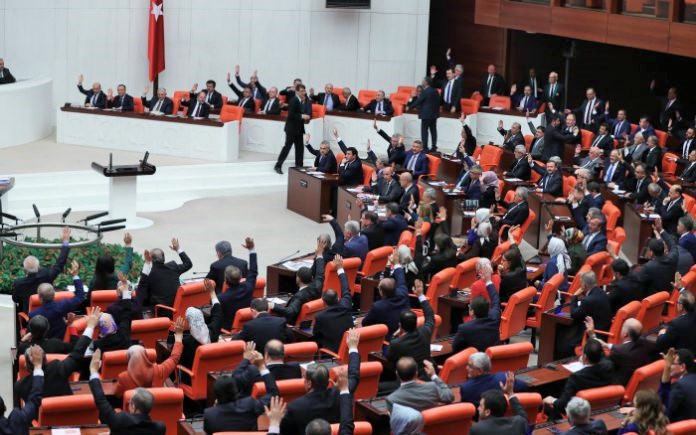
    The Turkish Parliament on Wednesday received summaries of proceedings to remove the parliamentary immunity of 10 opposition lawmakers including the leader of Turkey’s main opposition party, Kemal Kılıçdaroğlu, Turkish media outlets reported.

    In addition to Republican People’s Party (CHP) Chairman Kılıçdaroğlu, CHP lawmakers Oğuz Kaan Salıcı, Muharrem Erkek, Yunus Emre, Veli Ağbaba, Fethi Açıkel and Faik Öztrak as weak as pro-Kurdish Peoples’ Democratic Party (HDP) lawmakers Ayşe Acar Başaran and Kemal Bülbül face removal of their immunity from prosecution.

    The proceedings against the CHP lawmakers are reportedly related to a CHP report about the relationship between Turkey’s ruling Justice and Development Party (AKP) and the Gülen movement, accused by the Turkish government of masterminding a failed coup in Turkey in 2016. The movement strongly denies any involvement in the abortive putsch.

    The HDP politicians face the proceedings on terror charges as the party is accused by the Turkish government of being the political wing of the outlawed Kurdistan Workers’ Party (PKK), listed as a terrorist organization by Turkey, the EU and the US.

    If parliament votes to strip the deputies of their immunity from prosecution, they will be tried by Turkish courts.

    The prosecution of members of parliament has been possible since the CHP and the Nationalist Movement Party (MHP) lent support to a 2016 proposal submitted by the ruling AKP on removing deputies’ immunity from prosecution.

  • Turkey freezes assets of 377 people, organizations on terror charges

    Turkey has frozen the assets of 377 individuals and institutions, including the US-based Muslim cleric Fethullah Gülen and people with links to the worldwide civic initiative inspired by his ideas and activism, under Law No. 6415 on the Prevention of the Financing of Terrorism, local media reported on Wednesday.

    The decision published in the Official Gazette on Wednesday was made by Treasury and Finance Minister Lütfi Elvan and also signed by Interior Minister Süleyman Soylu.

    “It is decided that the assets in Turkey of the individuals, institutions and organizations included on the list will be frozen based on the fact that they engaged in acts mentioned in Articles 3 and 4 of Law No. 6415, in accordance with subsection 3 of Article 7 of the same law,” the decision said, in reference to “providing or collecting funds” for terror-related acts.

    Among the 365 individuals whose assets have been frozen by way of the 12-page decision are 77 members of the outlawed Kurdistan Workers’ Party’s (PKK), nine members of the Revolutionary People’s Liberation Party/Front (DHKP/C), 86 Islamic State in Iraq and the Levant (ISIL) members and 205 followers of the faith-based Gülen movement, which is regarded as a terrorist organization by Turkey.

    Murat Karayılan, Cemil Bayık, Duran Kalkan, Ali Haydar Kaytan, Remzi Kartal, Sabri Ok, Rıza Altun and Zübeyir Aydar are among those added to the list due to their links to the PKK, a Kurdish group designated as a terrorist organization by Turkey, the United States and the European Union that has waged a separatist insurgency against the Turkish state since 1984.

    Among those who made their way onto the list over links to the Gülen movement in addition to Fethullah Gülen are Ekrem Dumanlı, editor-in-chief of Zaman – Turkey’s best selling national daily before its seizure by the government in 2016; former Koza Ipek Holding Chairman Hamdi Akin Ipek and Hidayet Karaca, former chief executive of the Samanyolu Media Group.

    Turkey’s Justice and Development Party (AKP) government accuses the Gülen movement of orchestrating a coup attempt that claimed the lives of 251 civilians in Turkey on July 15, 2016.

    Although Gülen and the movement strongly deny involvement in the abortive putsch or any terrorist activity, President Recep Tayyip Erdoğan’s AKP has jailed some 96,000 people while investigating more than 622,000 over alleged links to the movement as part of a massive purge launched under the pretext of an anti-coup fight.

    Releasing a statement about the development on Twitter on Wednesday, Akın İpek condemned ministers Soylu and Elvan among others who drew up the list, saying “[It] even targets young people who have been living a simple life abroad for seven years,” in reference to young members of the İpek family whose names were also included on the list.

    İpek underlined that the funds and assets of the İpek family were examined and cleared of blame by the institutions of more 50 countries that investigate financial crimes, following a request in 2016 by Turkey’s cabinet to freeze the family’s assets abroad.

    “The basis of this decision cannot be lawful. I can only think that it is a way of oppressing and harassing me due to my continuous efforts to seek my rights abroad. I would like to remind you that the only difference between a government and a gang is [the adherence to the] law,” he added.

  • Turkish Twitter users call on authorities to release mother of boy struggling with leukemia

    Turkish Twitter users conducted a hashtag campaign yesterday calling on authorities to release Sabriye Dağdeviren, the mother of 11-year-old leukemia patient Hakan, who is battling the cancer alone in a hospital, the Stockholm Center for Freedom reported.

    Hakan was diagnosed with advanced stage leukemia in January. According to his doctors the cancer metastasized to his liver, abdomen, neck and armpits. He is expected to stay in the hospital for almost a year.

    Both of his parents were arrested in 2018 for alleged links to the Gülen movement, a faith-based group inspired by Muslim cleric Fethullah Gülen.

    The hashtag #DirenBeHakan (Be strong, Hakan) was shared widely by Turkish social media users appealing to the Turkish government to postpone the execution of the jail sentence of Hakan’s mother.

    Hakan’s mother was sentenced to six years, 10 months in prison and his father, Gökhan Dağdeviren, to 19 years. Both are serving their time in Eskişehir Prison, while Hakan and his sister Halenur, are under the care of their grandparents.

    In a letter to Elif Çakır of the Karar daily, his mother Sabriye said Hakan is at times cared for by their neighbors during his treatment at the hospital because his grandmother also needs to tend to her 90-year-old mother,

    “How painful it is for a mother to know that her son is cared by someone other than his family during chemotherapy,” Sabriye Dağdeviren said in her letter. “I can’t do anything other than wait to hear from my son once a week.”

    Turkish President Recep Tayyip Erdoğan has been targeting followers of the Gülen movement since the corruption investigations of December 17-25, 2013, which implicated then-Prime Minister Erdoğan, his family members and his inner circle.

    Dismissing the investigations as a Gülenist coup and conspiracy against his government, Erdoğan designated the movement as a terrorist organization and began to target its members. He intensified the crackdown on the movement following a coup attempt on July 15, 2016 that he accused Gülen of masterminding. Gülen and the movement strongly deny involvement in the abortive putsch or any terrorist activity.

    Turkey’s post-coup purge has taken a huge toll on human life, making no exceptions for children. Several children such as Ahmet Burhan Ataç, Mehmet Fatih Dedeoğlu, Selman Çalışkan, Eymen Küçükaydoğan, Ali Ihsan Başer and Furkan Dizdar were diagnosed with cancer after their fathers were arrested. Some of these children were unable to cling to life and succumbed to their illnesses. According to the doctors, their fragile bodies were not able to process the sorrow and affliction caused by the persecution of their fathers.

    According to a statement from Interior Minister Süleyman Soylu on February 20, a total of 622,646 people have been the subject of investigation and 301,932 have been detained, while 96,000 others have been jailed due to alleged links to the Gülen movement since the failed coup. The minister said there are currently 25,467 people in Turkey’s prisons who were jailed on alleged links to the Gülen movement.

  • Top court gives green light to headscarf freedom in Turkish military

    Turkey’s top administrative court, the Council of State, has rejected an application seeking the reinstatement of a headscarf ban in the Turkish Armed Forces (TSK), saying that the freedom to wear Islamic attire in the military does not violate the principle of secularism, Turkish media outlets reported on Thursday.

    In a landmark move in February 2017, the Turkish Defense Ministry amended the TSK dress code to allow headscarf freedom for female cadets and officers. The amendment went into force without being published in the Official Gazette.

    In the past, even headscarf-wearing family members of TSK officers were not allowed to attend ceremonies or events at military facilities or guesthouses and were required to remove their headscarves to be able to enter the premises.

    The People’s Liberation Party (HKP), a left-wing populist and anti-imperialist political party in Turkey, took the amendment to the Council of State, claiming that headscarf freedom in the TSK would lead to a division between those who wear headscarves and those who do not and would violate secularism, and that amendments cannot be based on religion.

    The ministry said in its defense statement to the top court that the amendment made in the TSK’s dress code does not concern the public but only TSK personnel; hence, the HKP had no standing to file a case demanding its annulment.

    Three members of the Council of State’s 2nd Chamber, which reviewed the HKP’s application, voted in favor of headscarf freedom in the TSK while two of them voted against it.

    The HKP has been informed of the court’s decision. The party will be able to challenge the ruling with the court’s highest organ, the Plenary Session of the Administrative Law Chamber (İDDK). The party’s lawyers announced that they will go to the İDDK seeking the annulment of the amendment in the TSK dress code enabling the freedom to wear headscarves in the Turkish military.

    Since the establishment of the Republic of Turkey in 1923, a strict version of secularism had been in place, and wearing headscarves in public institutions was banned in the 1980s.

    The AKP government abolished a ban on the wearing of headscarves at Turkish universities in 2010, while the same ban was abolished for civil servants in 2017.

    According to Turkey’s secular circles, the headscarf is a symbol of religious conservatism, and they accuse President Recep Tayyip Erdoğan of abusing the headscarf ban to polarize society and consolidate its conservative grass roots.