Category: Life & Culture

  • Torture and Inhuman Treatment in Turkey: 2021 in Review

    Turkey has experienced a marked resurgence of torture and ill-treatment in custody over the past six years and especially since a coup attempt on July 15, 2016. Lack of condemnation from higher officials and a readiness to cover up allegations rather than investigate them have resulted in widespread impunity for the security forces.

    The enormous gulf between Turkey’s constitutional provisions for the protection of human rights and the grim reality on the ground continued to grow during the year. In a landmark decision, Turkey’s Constitutional Court in November 2020 found a government decree that granted immunity to civilians who were involved in criminal activities to suppress the abortive putsch to be constitutional, hence sanctioning the country’s culture of impunity at the highest level.

    Turkey is party to several international conventions that have different review and inspection mechanisms such as the United Nations, the Council of Europe (CoE) and the Organization for Security and Co-operation in Europe. According to information published on the Turkish Ministry of Foreign Affairs website, the country is currently party to 16 UN human rights conventions and 121 of the CoE’s 225 conventions and has signed 31 other conventions.

    Yet in the recent past the Turkish government has continuously disregarded the provisions of the constitution and failed to uphold its international obligations. For instance, Turkey has for four years blocked the publication of a report by a CoE delegation that paid a fact-finding visit to Turkey in 2016 to investigate allegations of torture and ill treatment in Turkish correctional facilities.

    The CoE’s Committee for the Prevention of Torture and Inhuman or Degrading Treatment or Punishment (CPT) confirmed in two reports published in August 2020 the continued existence of ill-treatment, torture, informal questioning and restricted access to a lawyer as well as a fundamentally flawed medical screening system in Turkish detention facilities.

    Here is some of the most important news from 2021 in the field of torture and inhuman treatment:

    Torture and Inhuman Treatment in Turkey: 2021 in Review – Stockholm Center for Freedom (stockholmcf.org)
  • Venomous snakes and spiders to increase in NSW with wet weather this summer

    Venomous snakes and spiders to increase in NSW with wet weather this summer

    Experts warn run-ins with venomous snakes and spiders will continue to rise after recent wild weather and Australia’s ongoing mouse plague.
    Millions of mice have created havoc for Aussie farmers across New South Wales, South Queensland, Northern Victoria and South Australia over the last year.
    The nation has also recorded its wettest November on record, with the humid conditions and rodent plague creating a perfect storm for a boom in snake and spider numbers.
    Snakes prey on mice and have attracted a significant number to the communities impacted by the plague.
    Wet weather is also the perfect climate to encourage movement of bugs and frogs – another drawcard for a hungry snake or spider.
    People in NSW have been identified as the most likely to be bitten by the Australian Institute of Health and Welfare.
    Genevieve Adamo is a senior poisons specialist at the Poisons Information Centre.
    She said snake season usually peaks in late December and January, but there has already been an increase in bite reports since this time last year.
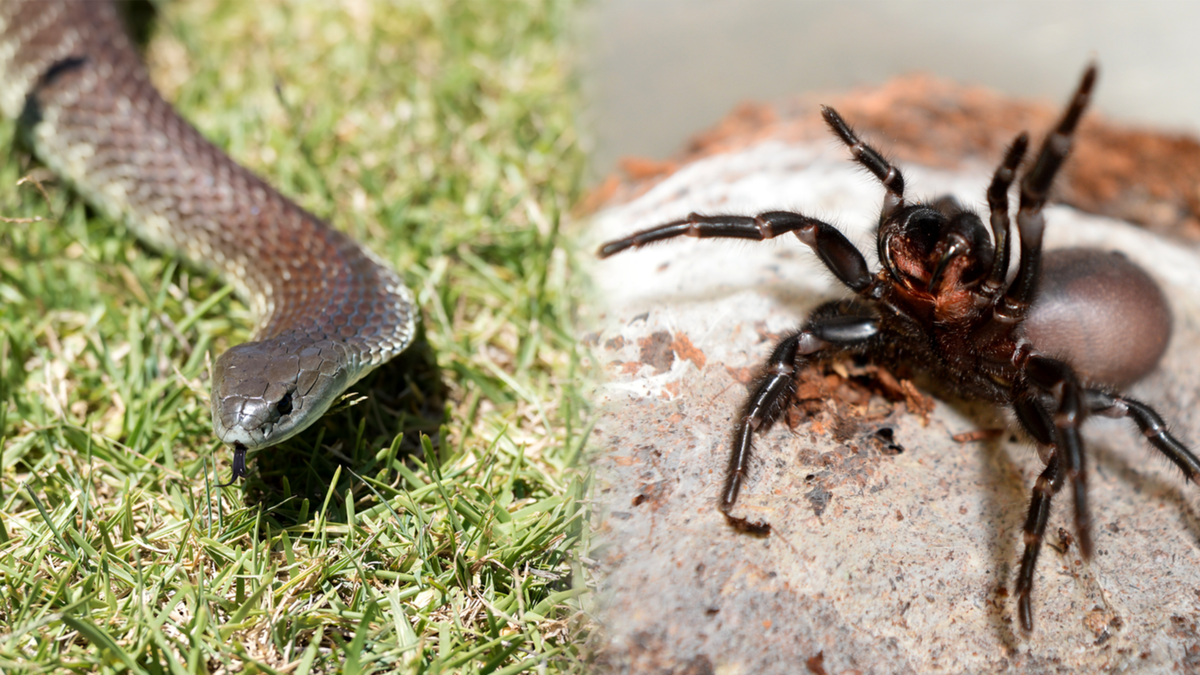
    “We have some of the most venomous critters in the world, from the brown snake to the funnel-web spider,” Ms Adamo said.
    “While bites from these types of creatures are rare, it’s important to know what to do and act quickly, as it could just save your life or the life of a friend or loved one.”
    What to do if someone is bitten by a snake?
    NSW Health warns even if you just suspect a loved one has suffered a snake bite, it is essential you act immediately.
    “If someone has collapsed following a snake bite start CPR immediately, this can be lifesaving,” NSW Health warned.
    “If someone is bitten you should keep them still, call an ambulance and apply a pressure immobilisation bandage.”
    Symptoms from a venomous bite can include nausea, vomiting and a headache, however, first aid should be applied regardless of whether these symptoms are present, NSW Health advises.
    What should you do if someone is bitten by a spider?
    While most spider bites are harmless, if someone is bitten by a big black spider or funnel-web, this is a medical emergency.
    NSW Health warns a bite from a funnel-web can cause severe pain, sweating, vomiting, difficulty breathing and muscle twitching.
    A redback spider bite may result in pain and redness, but it is not considered life threatening so does not require bandaging.
    “The most important thing to know in a situation like this is how to perform the correct first aid. This can make a significant difference to treatment and outcomes,” Ms Adamo said. 9News

  • Federal Health Minister Hunt, confirms domestic travellers don’t have to pay for COVID-19 tests

    Federal Health Minister Hunt, confirms domestic travellers don’t have to pay for COVID-19 tests

    There has been confusion over whether it would be a user-pays requirement for entry into Queensland, at a cost of up to $150 per person.

    States such as South Australia, Queensland, Tasmania and Western Australia require negative PCR COVID-19 tests 72 hours before entry under their re-opening border rules.

    Mr Hunt has confirmed in a statement the Commonwealth and States jointly fund tests for people that require one under a public health order, such as a domestic travel requirement.

    Queensland Premier Annastacia Palaszczuk has welcomed the commitment.

    “I said we work best when we work together,” Ms Palaszczuk said. “This proves it.

    Queensland is set to open to fully vaccinated people who return a negative COVID test 72 hours before travel on December 17, or earlier once the state reaches 80 per cent fully vaccinated.

    For days, Queensland ministers have been trying to pressure the federal government to pay for the tests so that travellers would not have to foot the bill.

    Earlier on Tuesday, the Queensland Premier Annastacia Palaszczuk said she did not want to argue with the Commonwealth.

    “Now is not the time to fight. Now is the time to work together,” Ms Palaszczuk said.

    “Greg Hunt can quite easily make it a Medicare rebate. He can do that with the stroke of a pen.”

    Mr Hunt had written to the Queensland Health Minister to “raise concerns” over why the state is testing travellers and questioning why it wasn’t considering rapid antigen testing.

    He referenced an Australian Health Protection Principal Committee statement saying “large-scale, non-targeted, asymptomatic testing in Australia should be strongly discouraged”.

    Turns out, it’s free for travellers
    The days of back-and-forth over whether a family of four would pay $600 for testing to enter seems to be a moot point.

    Mr Hunt’s office confirmed travellers do not have to pay if they require a test as a result of a state or territory public health order and only a text message is required for the result.

    “This includes travel domestically as a result of a state’s border restriction, close contacts without symptoms — i.e., where a positive case may have attended a shopping centre — [and] workplace testing requirements in high-risk settings,” Mr Hunt said in a statement.with abcnews

  • NSW’s most wanted man, Mostafa Baluch, found on Queensland border

    The most wanted man in NSW has allegedly been found hiding in the back of a truck after a costly search spanning four states and several weeks ended in a “great day” for police.

    Police say they pulled over the truck as it crossed the Queensland border about 1am today.

    Officers claim they knocked on a shipping container the truck was transporting and that Mostafa Baluch, who had been on the run since last month, knocked back.

    Police allege Mr Baluch was hiding in a Mercedes 4WD which was inside the container.

    Police had been searching for the 33-year-old since he allegedly cut off an ankle tracking bracelet and disappeared from his home on Sydney’s northern beaches on October 25 while on bail.

    Mr Baluch was charged over an attempt to import 900 kilograms of cocaine into NSW and just days before he disappeared he had been granted bail.

    A multi-agency investigation involving police in NSW, Queensland, Victoria and South Australia has been working around the clock for the past 17 days in an attempt to find him.

    Police said the truck was stopped after officers received a tip off Mr Baluch could be hiding inside a vehicle trying to cross the border.

    Police claim they had been checking trucks travelling through Tweed Heads when they noticed an unlocked container on the back of the truck Mr Baluch was on.

    Detective Superintendent Robert Critchlow said Mr Baluch was a “bit shocked” he had been found.

    He was arrested and remains in custody in Southport. He is expected to face court later today.

    Detectives are now travelling to Queensland to seek Mr Baluch’s extradition to NSW.

    Police Minister David Elliott said he would be “skipping around all day”.

    “Today will be considered one of the great days of NSW Police,” he said.

    Mr Elliott described the decision to grant the 33-year-old bail as “questionable” and said it proved the current review into the state’s bail laws was justified.

    NSW Police Assistant Commissioner Stuart Smith said the investigation had cost an “extraordinary” amount of money.

    “I’d have nightmares if I even started to think about it. But if it’s $1, it’s $1 unnecessarily spent,” Mr Elliott said.

    The man police claim was driving the truck has been arrested in Grafton in northern NSW and will face charges in relation to conveying a wanted person out of a jurisdiction.

    The trucking company which he works for will now be investigated by police with a “fine-toothed comb”, Detective Superintendent Critchlow said.

    “We understand they’ll have few trucks left on the road tomorrow,” he said.

    Last week, police alleeged Mr Baluch had a “senior role” in a wider criminal network and that they had concerns for the public’s safety while he remained at large.

    In relation to the investigation, police raided two properties in Potts Hill and Yagoona five days ago and seized $250,000 in cash, 200 grams of cocaine, mobile phones, money-counting machines and 458 grams of an “unknown substance”.

    They also seized a black Range Rover with Queensland number plates after it was captured on CCTV driving through the M4 tunnel near Croydon only hours after Mr Baluch fled his Bayview home.

    The state has seized Mr Baluch’s northern beaches home, which was put forward as bail surety.

    Police said the property was valued at $4 million.

    Assistant Commissioner Smith said police would seize more of Mr Baluch’s assets.

    Mr Baluch is facing charges over an alleged attempt to import cocaine into Australia from Ecuador.

    The cocaine was seized from a vessel travelling off the coast of Ecuador in April and had a street value of $270 million. ABC

  • Huge New Zealand potato weighing 7.9kg could claim world record

    A giant 7.9kg potato found in a New Zealand couple’s overgrown garden may set a new world record for the largest of its kind ever to be discovered.

    Colin and Donna Craig-Brown’s were doing a spot of weeding in their Hamilton back yard, when Colin’s hoe hit something below the ground.

    “So I said to Donna this must be one of those white kūmara (sweet potato) that we grew,” he told Stuff, “because some of them just grew massive here.”

    He tasted it, discovered it was potato and set about excavating it from the soil.

    The bulbous tuber weighs the same as an extra-large turkey and would exceed the allowance for check-in luggage. The couple named their new discovery Doug, and have grown pretty fond of him.

    “We put a hat on him. We put him on Facebook, taking him for a walk, giving him some sunshine,” Colin told the NZ Herald. “It’s all a bit of fun. It’s amazing what entertains people.”

    The couple say they’ve applied to Guinness to have Doug recognised and are waiting to hear back.

    The couple could not recall when they last planted potatoes in their garden, but guessed it must have been about two or three years ago. Colin thinks perhaps Doug self-seeded.

    “It’s a mystery to me,” Colin said. “It’s one of nature’s little pleasant surprises.”

    “It’s fair to say our veggie garden can sometimes get a bit feral. There are some parts of the garden you need to pack a lunch and advise your next of kin before heading in to,” he told Stuff.

    The couple have wrapped Doug in plastic-bags to keep him from drying out, and Colin, an amateur brewer, says he is now keen to turn the oversized tuber into vodka. The Guardian

  • Australia purchases 300,000 doses of ‘promising’ COVID-19 pill

    The Australian government has ordered 300,000 doses of a new antiviral pill that has shown signs of slashing COVID-19 deaths and hospitalisations by around 50 per cent.

    Molnupiravir, developed and produced by American Pharmaceutical giant Merck Sharp & Dohme, is currently in late-stage clinical trials.

    “Vaccines and new treatments like this will boost our National Plan to safely reopen Australia and keep Australia safely open,” Prime Minister Scott Morrison said.

    “While our vaccination rate continues to climb, we’ve been investing in and closely monitoring research into COVID-19 treatments and we are securing supply of promising treatments.”

    Molnupiravir has been developed as a first-line treatment for adult coronavirus patients with mild to moderate symptoms.

    The drug company earlier announced trial results showing the treatment reduced hospitalisations and deaths by around 50 per cent.

    Should it be approved by the TGA for use in Australia, its expected the drug will be made available from early 2022.

    Other COVID-19 treatments like Sotrovimab and Remdesivir are already being used by medical professionals to COVID-19 patients.

    A treatment of Molnupiravir consists of capsules taken twice a day for five days by adult patients.

    The drug does not require refrigeration, allowing it to be used by individuals or in high risk locations.

    “An oral pill is obviously a much easier means of helping people,” Mr Hunt told reporters on Monday.

    “These would be made available on the basis of need right across the country.”

    Meanwhile, Australia has received 15,000 additional doses of the antibody treatment sotrovimab, which is used to stop the virus replicating.

    The national stockpile of the drug, administered by intravenous infusion within five days of patients developing symptoms, is expected to exceed 30,000 doses this year.

    It has been shown to reduce hospitalisation or death in patients with mild or moderate infections and who are at high risk of severe illness.

    “It helps activate the body and its immune system to fight against COVID,” the health minister said.

    “In many cases, it will mean the difference between hospitalisation or no hospitalisation, ICU or no ICU, and in some cases it will prevent the loss of life.”

    While vaccines remain the first port of call for beating coronavirus, University of South Australia epidemiologist Adrian Esterman has emphasised the importance of finding new treatments.

    “There has been not much emphasis placed on research into treatment since the start of this pandemic,” he said.

    “Even with 100 per cent of the population fully vaccinated, there will still be virus circulating because none of the vaccines is 100 per cent effective against transmission.”

    At the same time, ensuring the world is vaccinated will drastically reduce the severity of the disease and the need for treatment.

    “It’s early days yet for the treatments and we’re still waiting for many of the trials to complete to see what other treatments are potentially helpful against coronavirus,” Professor Esterman said.

    “Over the next few years, we can see ongoing improvements in vaccine technology, in particular to handle these different variants, and this could be a constant battle between new variants of vaccines.” SBS

  • Regional GP fights to fit car with lights and sirens to attend emergencies

    Regional GP fights to fit car with lights and sirens to attend emergencies

    Earlier this year, Dr Michael Livingston drove “at speed” in his own car to reach the toddler who was turning blue at a medical clinic about 30 minutes away.

    Dr Livingston oversees GP clinics in the isolated south coast towns of Hopetoun and Ravensthorpe, about two hours west of Esperance.

    He also responds to emergency call outs at Ravensthorpe Health Service which serves the small town of about 1,700 people.

    After reflecting on the experience, he believes warning lights on his vehicle would help him to work safely.

    Wait feels like hours

    In mid-March Ravensthorpe mum Sharon Atkins was caring for her then one-year-old daughter Ava who had contracted bronchiolitis, a respiratory infection common in young children.

    Two weeks after contracting the virus, Ava’s symptoms worsened.

    “She was having trouble breathing,” Ms Atkins said.  “She was on Ventolin every 20 minutes.”

    While she was at the Ravensthorpe Health Service seeking medical attention, Ava’s changed colour.

    “She started to turn blue and stopped breathing.”

    While the service is staffed with nurses, it lacks a full-time doctor who can administer emergency treatments such as adrenaline.

    Dr Livingston, who was in Hopetoun at the time, was urgently called upon to treat Ava’s escalating condition.

    “I was inconsolable at the time,” Ms Atkins said.

    “It felt like it was hours at the time.”

    Dr Livingston recalled being told there was a child at the health service who had stopped breathing.

    “As I’m driving there I’m thinking, ‘Will I just arrive at the end … as in, [will the child be] dead?”

    Dr Livingston worked on Ava for about 30 minutes before she was flown by the Royal Flying Doctors Service (RFDS) to Perth Children’s Hospital.

    Ms Atkins said watching Ava’s treatment was difficult.

    “It definitely was distressing seeing your little girl lifeless and needing to be resuscitated and given all these needles,” Ms Atkins said.

    Ava recovered and was discharged three days later.

    Ms Atkins says without Dr Livington’s quick response and immediate treatment the outcome may have been different.

    “If we didn’t have Michael, I probably wouldn’t have my daughter today.”

    It’s a perennial problem with very few answers — how to get doctors and other healthcare workers to regional and rural parts of the country.

    The ordeal has also caused Dr Livingston to reflect on the response time required for Ava’s life-saving treatment.

    “I had to put myself at risk, drive at speed,” he said.

    “Why can’t I be afforded the same protection as any other emergency service?

    “Why am I forced into emotionally loaded situations and expected to lay it all on the line?”

    He decided to apply for an Emergency Vehicle Status (EVS) from the Department of Transport — a license authorising any vehicle to be fitted with lights and sirens while responding to emergencies.

    Approved drivers are also exempt from complying with specified road rules and must be trained in driving in operational conditions.

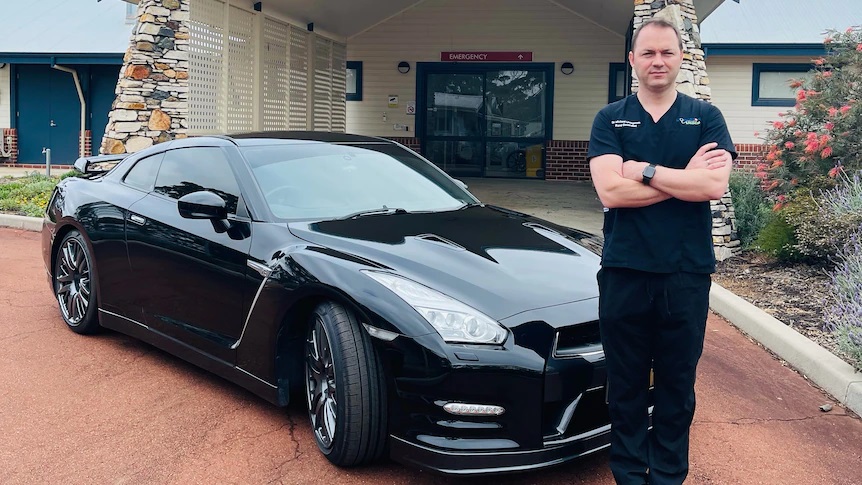
    In April, Dr Livingston submitted his application after completing the necessary driver training for his Nissan GT-R, but has since been refused.

    In an email sent to Dr Livingston, a Department of Transport representative cited a range of reasons for refusal including that “male drivers are more likely to be involved in high-speed driving and have high-risk taking behaviours”.

    Furthermore, the email raised concerns over Dr Livingston’s car and the likelihood of the vehicle’s “low nose” to direct an animal into the windscreen or cabin in the event of an animal strike.

    “A dead or severely injured doctor is of no benefit to the current emergency, your community or any future patients,” it stated.

    A Department of Transport spokesperson said applications were generally only approved if vehicles were part of the state’s emergency service network and assessed by numerous bodies including WA Police, Department of Health, St John Ambulance and DFES.

    Despite Dr Livingston’s car being an unusual “ambulance”, he wanted to use it to highlight “the real disparity of rural care”.

    While he continues negotiations with the department, he says emergency care needs continual investment.

    “Rural health is in a mess and has always been handballed from government to government.

    “If somebody doesn’t try at least in these regions it’s just going to be a failure … the same media cycle.

    “Meanwhile people out there are suffering.” ABCNews

  • Scott Morrison issues threat to premiers to open borders by Christmas

    Scott Morrison has lashed premiers for casting doubt over border reopenings, insisting Aussie families will be reunited at Christmas.

    Prime Minister Scott Morrison has thrown down the gauntlet to state premiers over ongoing border closures, insisting political leaders owe it to Australians to allow families to reunite at Christmas.

    Mr Morrison said he couldn’t see any reason why people should be kept apart by state borders after the 80 per cent national vaccination target was reached.

    “It’s important that we do move forward. We can’t stay in second gear. We’ve got to get to top gear in living with the virus … that’s where we need to be,” he told Weekend Sunrise on Sunday.

    “My message is to Australians that what I‘d like them to have for Christmas is their lives back.”

    Mr Morrison slammed Queensland premier Annastacia Palaszczuk and WA’s Mark McGowan for their unwillingness to commit to granting Australians that same wish.

    “There comes a time when you’ve got to honour the arrangement you’ve made with the Australian people, and that is when you get to 80 per cent vaccination, it’s very clear that you can start opening up,” the PM said.

    “I think that puts the big challenge on the premiers. I mean, they’ve had the power to do what they’ve been doing. They’re not new powers. They’ve always had them.

    “But, you know, there comes a time when you just got to move on and get on with it.”

    But the Queensland and WA premiers have held firm in their resistance of the national plan.

    Ms Palaszczuk has demanded more research into the effects of Covid-19 on children before she says her state will embrace the reopening targets agreed on at national cabinet.

    Mr McGowan has shown similar defiance, insisting WA is unlikely to reopen its borders until 2022.

    But Mr Morrison slapped down both premiers’ claims, insisting the entire country should reopen at the 80 per cent vaccination target, which is expected to be reached before the end of the year.

    “Once you get to 80 per cent of your population that’s vaccinated, it’s very clear. I can’t see any reason why Australians should be kept from each other,” he said.

    “(Reopening by Christmas) is within the gift of governments. And that’s a gift I’d like to see us give them.”

    The PM also made it clear that the country would not wait for vaccine-hesitant Aussies to make up their minds, insisting the national plan will go ahead as planned whether people decide to get their jab or not.

    “Once we get to 80 per cent – the fact is that everybody has had the chance to get vaccinated by that point,” he said.

    “If you’ve chosen not to get vaccinated, that’s your choice … but we must go into the next chapter.” News

  • Three members of Tamil family from Biloela granted 12-month bridging visas

    Three members of the asylum-seeking Tamil family from the Queensland town of Biloela have been granted 12-month bridging visas, allowing them to remain in the country.

  • Covid patient In Sydney was released from hospital after 399 days

    The heartfelt moment a Sydney Covid patient was released from hospital after 399 days has been captured, and he had one important message.

    A Covid-19 patient who spent more than a year recovering in a Sydney hospital has urged people not to wait and get vaccinated now.

    David Avila Mellado, 69, was finally released from Westmead Hospital earlier this month after a marathon 399 days of treatment.

    “I have in my heart everybody I remember,” he said.

    “When I do exercise in the corridor, I know everyone, everyone they say to me, ‘hello David’. I feel happy because I don’t remember many people, but they know me.”

    He was first admitted in July last year and his condition deteriorated rapidly, landing him in ICU for seven weeks.

    Once he was well enough he was transferred to the respiratory observation unit.

    Mr Avila Mellado then worked with speech pathologists, physios and other medical professionals to help regain his strength.

    His tracheostomy tube was removed in August after more than a year of not being able to breathe on his own or talk.

    Staff formed a wall of honour and clapped him as he walked out of the hospital that had been his home for 399 days.

    But his journey to recovery doesn’t end there.

    Western Sydney Health said Mr Mellado will continue rehabilitation beyond Westmead Hospital.

    Respiratory observation nurse unit manager Trudy Darling described Mr Avila Mellado as part of the family.

    “We miss him and it’s sad to see him go, but he needs to get back to his family,” she said.

    While leaving hospital Mr Avila Mellado issued an impassioned plea to Australians.

    “Many people, they don’t want the vaccine. But it’s (Covid-19) real. So they have to understand, they have to get the vaccine, they have to help the other people too,” he said.

    “My recommendation and the final idea is tell the people: don’t wait. Try to get the vaccine as soon as possible.”

    There are 1231 Covid-19 cases being treated in NSW hospitals now, with 231 of those in intensive care – 108 of whom are on a ventilator. NEWS