Adem Yavuz Arslan*
For Turkish citizens trying to understand whether their country could become embroiled in Yemen’s war, the most revealing recent statement came from Washington.
Speaking to reporters before departing for Alaska on October 13, President Donald Trump suggested he might ask Turkey to help counter Houthi attacks on Saudi Arabia. He appeared confident about the answer: “President Erdogan, I think, would do as I ask.”
There is no announced Turkish combat deployment to Yemen. Trump’s remark establishes neither that a request has been made nor that President Recep Tayyip Erdoğan has accepted one. But it raises a question with implications beyond the conflict: Why does an American president speak so confidently about his ability to secure another country’s military cooperation?
Part of the answer may lie in Trump’s habitual exaggeration of his influence. Another part lies in the way Erdoğan governs. By concentrating authority at home and making personal access central to foreign policy, Turkey’s president has made himself the indispensable negotiating partner. He has also made his own vulnerabilities more consequential for the country.
The Yemen crisis could test how much room that leaves him to refuse Washington.
Turkey’s involvement already extends beyond diplomatic expressions of solidarity. Ankara had decided to provide Saudi Arabia with defensive and technical assistance, including drone operators, intelligence sharing and logistical support, according to an October 7 Reuters report citing Turkish and US officials.
The broader framework is the Mecca Joint Defence Agreement, signed by Turkey, Pakistan and Saudi Arabia in August. Its publicly announced principle is sweeping: An armed attack on one signatory is to be treated as an attack on all three. That establishes a collective security commitment but does not, by itself, explain which military actions each government must undertake in a particular crisis.
Parliament had yet to approve the agreement when Foreign Minister Hakan Fidan discussed it on October 8. He ruled out Turkish participation in offensive operations while describing support for Saudi Arabia’s defense.
On October 15 Turkey’s Defense Ministry said parliamentary approval of the agreement and the necessary authorization procedures for sending Turkish forces abroad had yet to be completed. Reuters reported that assistance provided before ratification was largely bilateral.
Erdoğan has left greater flexibility. In responses to Newsweek published on September 25, he said the extent of assistance would depend on the threat and could include more advanced military support. He also cautioned against assuming that every incident would automatically trigger a military response.
These statements leave substantial questions unanswered about the limits of Turkey’s commitment. They do not justify claiming that Ankara has already agreed to fight in Yemen. Nor does Trump’s confidence prove that Washington possesses a secret undertaking. It does, however, sharpen the need to explain how Turkish decisions will be made — and whose priorities will determine them.
Saudi Arabia has compelling reasons to seek help. Houthi attacks have brought the war into the kingdom’s economic and political centers. A strike on Riyadh’s King Khalid International Airport on October 10 killed at least 13 people and wounded more than 300.
The threat reaches beyond the immediate casualties. Disrupted aviation, vulnerable energy infrastructure and uncertainty over the security of major cities undermine the conditions on which Saudi Arabia’s economic transformation depends.
Military assistance would also carry substantial risks. The Houthis have demonstrated an ability to penetrate defenses supplied at enormous expense, exposing the difficulty of protecting a vast territory against adaptable missile and drone attacks.
For Turkey, helping intercept an incoming missile and joining a campaign against launch sites inside Yemen would entail different objectives, legal questions and risks. Yet those missions can become connected. Personnel sent to operate defensive equipment may require protection. An attack on them may generate pressure for retaliation. Retaliation may create demands for further operations.
Such escalation is a possibility, not an inevitability. Preventing it requires that clear limits be established before a deployment becomes politically difficult to reverse.
Trump’s language offers little reassurance that he views those limits as central.
On June 24, during a meeting with NATO Secretary-General Mark Rutte, he praised Erdoğan and Turkey’s military while saying he had asked the Turkish leader to stay out of the Iran war and that Erdoğan had complied.
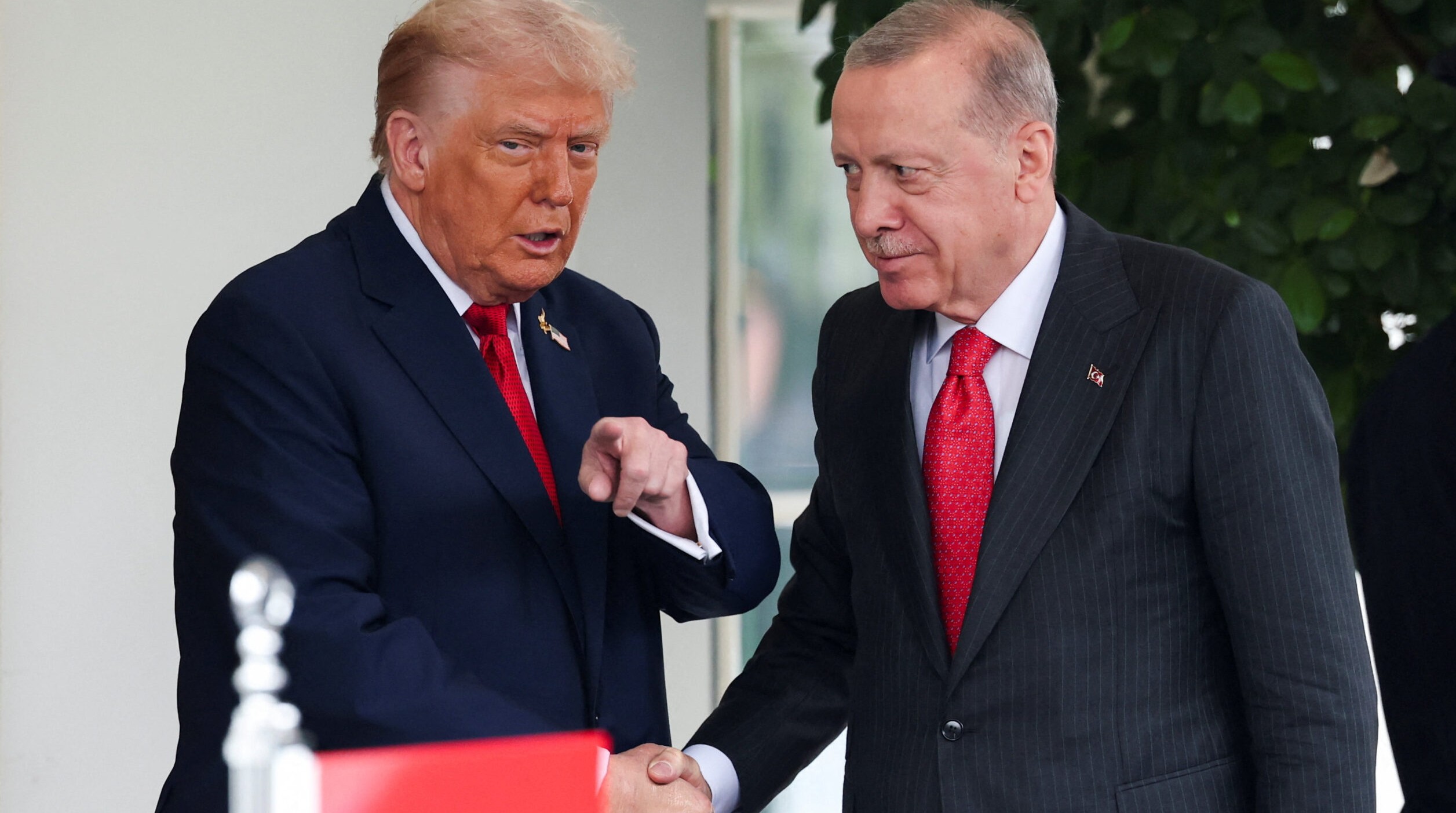
Whether that account accurately captures Ankara’s reasoning is a separate matter. Its significance lies in the relationship Trump presents to the public: He makes a request and Erdoğan delivers.
Erdoğan benefits from this presentation in one respect. A friendly American president offers recognition and access. But the same arrangement allows Trump to portray Turkey’s policy choices as personal accommodations.
That can weaken Erdoğan’s negotiating position. If cooperation is publicly treated as evidence of friendship, refusal becomes a test of the relationship. A disagreement over national interests acquires the character of a personal rebuff.
Trump has previously shown that praise can coexist with coercion. In October 2019 he threatened to destroy Turkey’s economy and sent Erdoğan a letter containing the admonition, “Don’t be a fool!”
The friendly language of the present cannot erase that history. Erdoğan is dealing with a president who has demonstrated a willingness to use economic pressure against Turkey and to advertise that pressure publicly.
The resolution of the Halkbank prosecution adds another dimension.
On June 17 US District Judge Richard Berman dismissed the criminal indictment against the Turkish state-owned lender after an agreement with the Trump administration. The decision ended a prosecution that had weighed on relations between the two countries for years.
There is no public evidence connecting that outcome to a Turkish commitment over Yemen. Any claim of an exchange would exceed the available facts.
Nevertheless, a favorable outcome in a politically important case can influence a relationship without a documented bargain. Trump may regard the resolution as an accomplishment for which Erdoğan owes him consideration. Whether Erdoğan shares that understanding is unknown.
The distinction matters. An analysis of potential leverage should not become an allegation of a secret deal. But neither should the absence of evidence for a specific bargain end scrutiny of the incentives surrounding future decisions.
Turkey’s exposure to financial pressure supplies another constraint. A confrontation with Washington can affect investor expectations and the perceived stability of the economy. For any Turkish government, those costs would require consideration. In a system centered on one leader, they may also intersect with concerns about political survival and international acceptance.
Erdoğan is not without leverage. Turkey’s military capabilities and strategic position give Washington reasons to seek cooperation. His willingness to pursue policies opposed by Western allies also makes blanket descriptions of obedience unconvincing.
The question is narrower: Can he use Turkey’s assets to negotiate clear limits, or does his reliance on a personal relationship make those limits harder to defend?
Accountability is essential to answering it.
Unresolved corruption allegations and politically sensitive financial cases become foreign policy concerns when the public cannot determine whether they influence decisions. Their existence does not prove that a leader is being coerced. The danger arises when independent institutions cannot credibly investigate potential conflicts between the leader’s interests and those of the state.
Under those conditions even a defensible military decision can become difficult to assess. Citizens cannot know whether their government is responding to a genuine security threat, honoring a clearly defined obligation or protecting a relationship whose full terms remain beyond scrutiny.
Religious solidarity could further complicate that assessment. A deployment presented as protecting Mecca and Medina would carry emotional force in Turkey. But the protection of holy sites cannot settle questions about command, geographic limits, escalation or withdrawal. Those require specific answers.
The decisive issue, then, is not Erdoğan’s personal courage in confronting Trump. It is whether Turkey has a decision-making process capable of distinguishing the country’s interests from its president’s needs.
Before any expanded military commitment, Ankara should explain the threat it intends to address, the limits of its mission and the conditions for ending it. Parliament and the public need enough information to judge those choices.
Trump may believe Erdoğan will do as he asks. Turkey’s institutions should ensure that belief is never sufficient grounds for sending Turkish soldiers to war.
*Adem Yavuz Arslan is a journalist with over two decades of experience in political reporting, investigative journalism and international conflict coverage. His work has focused on Turkey’s political landscape, including detailed reporting on the 2016 coup attempt and its aftermath, as well as broader issues related to media freedom and human rights. He has reported from conflict zones such as Bosnia, Kosovo and Iraq, and has conducted in-depth research on high-profile cases, including the assassination of Turkish-Armenian journalist Hrant Dink. Arslan is the author of four books and has received journalism awards for his investigative work. Currently living in exile in Washington, D.C., he continues his journalism through digital media platforms, including his YouTube channel, Turkish Minute, TR724 and X.
Disclaimer: The views expressed in this opinion piece are those of the author and do not necessarily reflect the editorial stance of Turkish Minute. Turkishminute