Jailed İstanbul Mayor Ekrem İmamoğlu, President Recep Tayyip Erdoğan’s main political rival, on Wednesday accused Turkey’s government of using prosecutions and pressure on the media to shield corruption as he began his defense in a trial he says is intended to block his presidential bid.
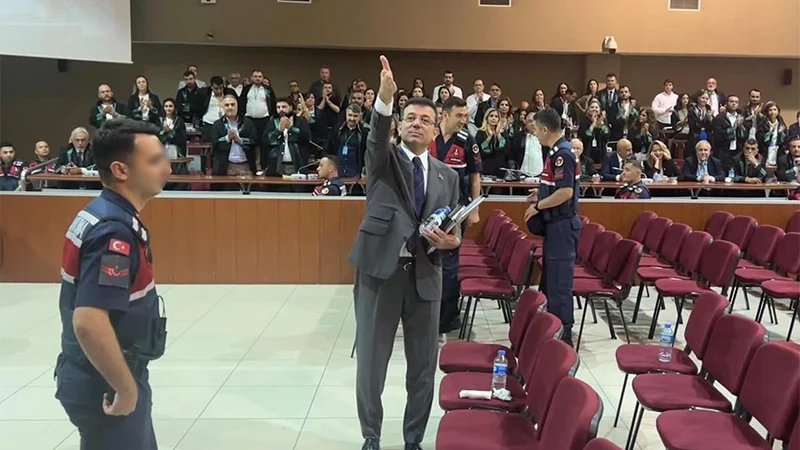
İmamoğlu began presenting his defense nearly 19 months after he was jailed pending trial, appearing before a court at the Marmara Prison complex in Silivri, west of İstanbul, where he has been imprisoned since March 23, 2025.
The case concerns allegations of bribery, bid rigging, money laundering and an organized crime network at the İstanbul Metropolitan Municipality, with 436 defendants, 53 of them in pretrial detention.
İmamoğlu denies the accusations and faces more than 2,400 years in prison if convicted on all counts, with prosecutors alleging that he used municipal resources to enrich himself and finance his political ambitions.
In the opening of his defense, he accused those behind his prosecution of protecting people involved in Turkey’s investment fund scandal while portraying him as the leader of a criminal organization, according to a transcript published by the Medyascope news website.
“They looked in the mirror and wrote what they saw into the indictment against me,” he said.
İmamoğlu focused on Justice Minister Akın Gürlek, who was İstanbul’s chief public prosecutor when the investigations into the mayor began, accusing him of pursuing opposition politicians while failing to act with the same urgency over suspected financial wrongdoing.
He told the court that Gürlek’s office sent a request to the Capital Markets Board (SPK), Turkey’s securities regulator, concerning investment funds on February 26, 2025, but failed to follow it with further investigative demands or police operations, the Bianet news website reported.
He contrasted that response with letters prosecutors sent to İstanbul University on February 24 and March 11, 2025, which he described as pressure to revoke his diploma before police detained him on March 19.
The university revoked his degree on March 18, 2025, citing alleged irregularities in his university transfer decades earlier, a decision that threatens his presidential candidacy because Turkey requires candidates to have a university degree.
The fund crisis erupted in September after some funds could not meet withdrawal requests amid suspected share-price manipulation, prompting the regulator to order the liquidation of 131 funds managed by seven companies with 455,758 individual investors.
İmamoğlu accused officials of failing to secure evidence and allowing companies implicated in the scandal to continue operating, arguing that political connections explained the difference between their treatment and the dawn raids against municipal officials.
He also condemned Wednesday’s takeover of Halk TV, a broadcaster that covers the opposition, linking the intervention to efforts to prevent the public from hearing about the fund scandal and his defense.
Police raided the station’s İstanbul headquarters and halted live broadcasts as the state-run Savings Deposit Insurance Fund (TMSF) took control under an investigation into owner Cafer Mahiroğlu over alleged bribery, bid rigging and money laundering.
İmamoğlu urged people to support Halk TV and journalists, arguing that viewers should decide whether a broadcaster survives and that the government was using the judiciary to compensate for its losses at the ballot box.
He cited the imprisonment of journalists Mustafa Balcı and Şaban Sevinç and the house arrest of İsmail Saymaz and Murat Ağırel, whose cases concern coverage of alleged links between government figures and the fund scandal.
Turning to his own trial, İmamoğlu argued that pretrial detention had become a means of punishment and accused officials of transferring defendants to distant prisons and pressuring them after they refused demands he described as unlawful.
He also challenged the ban on his book, “Millet Şahidimdir” (The Nation Is My Witness), which contains the defense he prepared after a dispute over speaking time prevented him from presenting it in July.
Police initially justified their intervention at the printing house by alleging that the book lacked required publication labels but switched to examining its contents after the labels were found, he told the court.
Beyond the allegations against him, İmamoğlu argued that Turkey’s institutions had lost their ability to restrain executive power and that prosecutions against elected politicians threatened the public’s right to replace the government through elections.
“The real test of popular sovereignty is not how a government is elected, but whether the people can change it,” he said.
İmamoğlu is the presidential candidate of the opposition New Party, whose leader, Özgür Özel, attended Wednesday’s hearing.
Özel founded the party in July after he and 90 other lawmakers left the Republican People’s Party (CHP), following a court ruling that removed him as CHP leader and reinstated his predecessor, Kemal Kılıçdaroğlu.
İmamoğlu won İstanbul’s mayoral election in 2019, ending decades of rule by Erdoğan’s political camp in Turkey’s largest city, and won again in a rerun after the first result was annulled before securing re-election in 2024.
İmamoğlu and his lawyers have been allotted four days, through October 17, to present their defense in the trial, which began on March 9.