Tag: İstanbul

  • Thousands protest media crackdown in Turkey

    Thousands protest media crackdown in Turkey

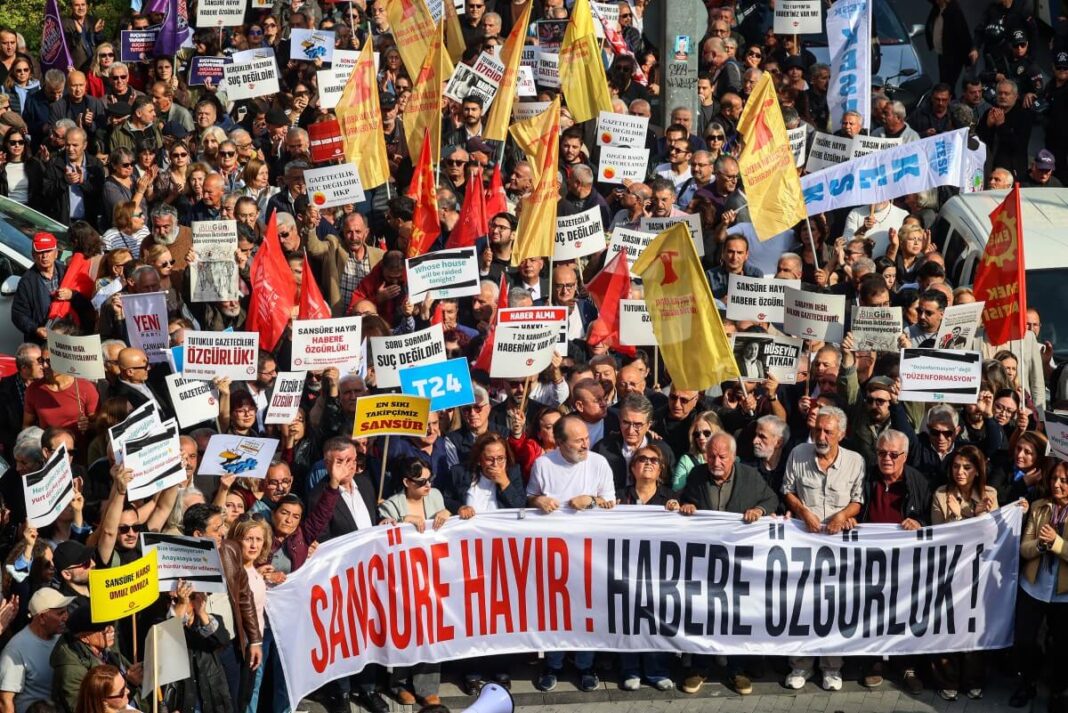
    Thousands rallied in İstanbul and Ankara on Saturday against what they described as growing pressure on journalists in Turkey, including arrests, media shutdowns and the appointment of government administrators to run news outlets.

    Press freedom has been increasingly constrained in Turkey since a failed coup attempt in 2016, with sweeping prosecutions, digital censorship and government accusations that journalists are spreading fake news.

    “Enough!” shouted marchers, mainly journalists, rights activists and opposition party representatives. “We can no longer breathe!”

    On İstanbul’s Asian side, protesters held up photos of jailed journalists, chanting: “We will not be silenced. Enough is enough!” and “We will not bow to pressure”.

    At least 3,000 people attended each protest, according to police counts.

    Recent weeks have seen what rights advocates describe as mounting pressure on independent journalism.

    Eleven journalists have been jailed in the past two months and several media outlets shut down, according to the Turkish Journalists’ Union (TGS).

    Earlier this month, police raided Turkey’s most-watched news channel, Halk TV, halting broadcasts and installing a government-appointed administrator.

    The takeover was the latest move against media outlets seen as critical of President Recep Tayyip Erdoğan and his government.

    It followed the blocking of leading digital news outlet T24’s website and social media accounts over what Turkish officials described as “LGBT propaganda”.

    ‘Intimidation’

    “This gathering is not simply about standing up for journalists,” veteran journalist Zafer Arapkirli told Agence France-Presse after the İstanbul protest.

    “It is also about defending respect for society’s right to access information and news through journalists and independent media,” said the columnist for the BirGün daily.

    Arapkirli, who himself faces lawsuits, said the response and determination to resist must grow as the pressure intensifies.

    “What the regime wants is to intimidate, silence and frighten society through such pressure — by arresting individual journalists, seizing media outlets, banning news coverage and blocking access to social media,” he said.

    “We must show that we will not allow this to happen.

    “We have done so up to now. I believe we are now moving towards demonstrating this determination on a much larger scale”.

    TGS President Gökhan Durmuş said the nature of “the government’s attacks” on the media had changed.

    “If we look at the recent restrictions, access bans and trustee appointments, they have targeted some of the most widely followed and watched broadcasters, news channels and media platforms,” he told AFP.

    “We are seeing a system emerge in which everything is uniform: one voice, one source of news, one centralised operation,” he said.

    ‘Let us do our job’

    In Ankara, protesters chanted against censorship and called for the release of jailed journalists.

    “Today’s protest was important both because it brought journalists together to make their voices heard and because it defended citizens’ right to access information,” T24 journalist Gökçer Tahincioğlu told AFP in Ankara.

    “Journalists are determined to get one message across: we want to practise journalism, and we want to be able to do so freely,” he said.

    The government has repeatedly denied that journalists are arrested or imprisoned for doing their jobs.

    At the Ankara protest, a letter from jailed BirGün journalist İsmail Arı was read to the crowd.

    “I am being held in prison for no reason other than doing my job as a journalist. Days are being stolen from my life,” Arı wrote from Sincan prison on the outskirts of Ankara.

    “We will defend journalism to the very end. Take your hands off us, comply with the constitution and let us do our job.”

    Arı was jailed pending trial on October 21 for the second time in seven months, accused of publicly disseminating misleading information following a complaint by former broadcasting watchdog chief Ebubekir Şahin. He was also investigated on suspicion of insulting a public official.

    © Agence France-Presse
  • Mayoral defections, removals affect 156 municipalities since opposition victory in 2024 elections

    Mayoral defections, removals affect 156 municipalities since opposition victory in 2024 elections

    Turkey’s government has undermined voters’ choices in 156 municipalities since the March 2024 local elections through mayoral defections, trustee appointments and judicial action, an opposition lawmaker argued on Tuesday, the ANKA news agency reported.

    İbrahim Arslan, a lawmaker from the main opposition New Party representing the central province of Eskişehir, released a study based on Supreme Election Council (YSK) data examining changes in municipal administrations through October 12.

    The study put the municipalities’ combined electorate at 36,564,021, a figure Arslan compared with the 57,766,800 people eligible to vote in mayoral elections nationwide in 2024, calculating a share of 63.3 percent.

    Candidates who won the municipalities for opposition parties received 13.9 million votes, accounting for 50.45 percent of valid ballots cast there, the study calculated.

    Arslan counted 106 mayors who had joined President Recep Tayyip Erdoğan’s ruling Justice and Development Party (AKP) after being elected from other parties or as independents. Of those, 42 were elected from the Islamist New Welfare Party (YRP) and 36 from the Republican People’s Party (CHP).

    He accused the government of using threats, blackmail, the prospect of criminal investigations and its control over municipal funding to pressure mayors into switching parties.

    The study also identified 13 municipalities where elected mayors were replaced by government-appointed trustees, unelected officials who administer municipalities after mayors are removed from office, and 11 where arrests and changes in city council membership enabled the ruling bloc to take control.

    These three categories brought another 130 municipalities under government control after the elections, expanding its reach from the 541 mayoralties won by the AKP in 2024 to 671 municipalities, Arslan calculated.

    The broader total of 156 also covers municipalities where elected mayors were jailed or suspended and had not been reinstated.

    “The AKP added 130 municipalities it had not won at the ballot box to its tally through methods used after the elections,” he said.

    Of the 411 municipalities won by CHP candidates in March 2024, 50 had passed into the government’s control through defections, trustee appointments and changes in city council control, leaving 361 governed by the CHP and the New Party, the study found.

    Ten trustee appointments affected municipalities won by the pro-Kurdish Peoples’ Equality and Democracy Party (DEM Party), while three affected municipalities won by the CHP.

    The study identified interventions in nine metropolitan municipalities: Adana, Antalya, Aydın, Bursa, İstanbul, İzmir, Mardin, Mersin and Van. Their combined electorate totaled 24.3 million.

    The March 2024 elections dealt Erdoğan’s AKP its worst electoral defeat in more than two decades, with the CHP finishing first nationwide and retaining İstanbul and Ankara.

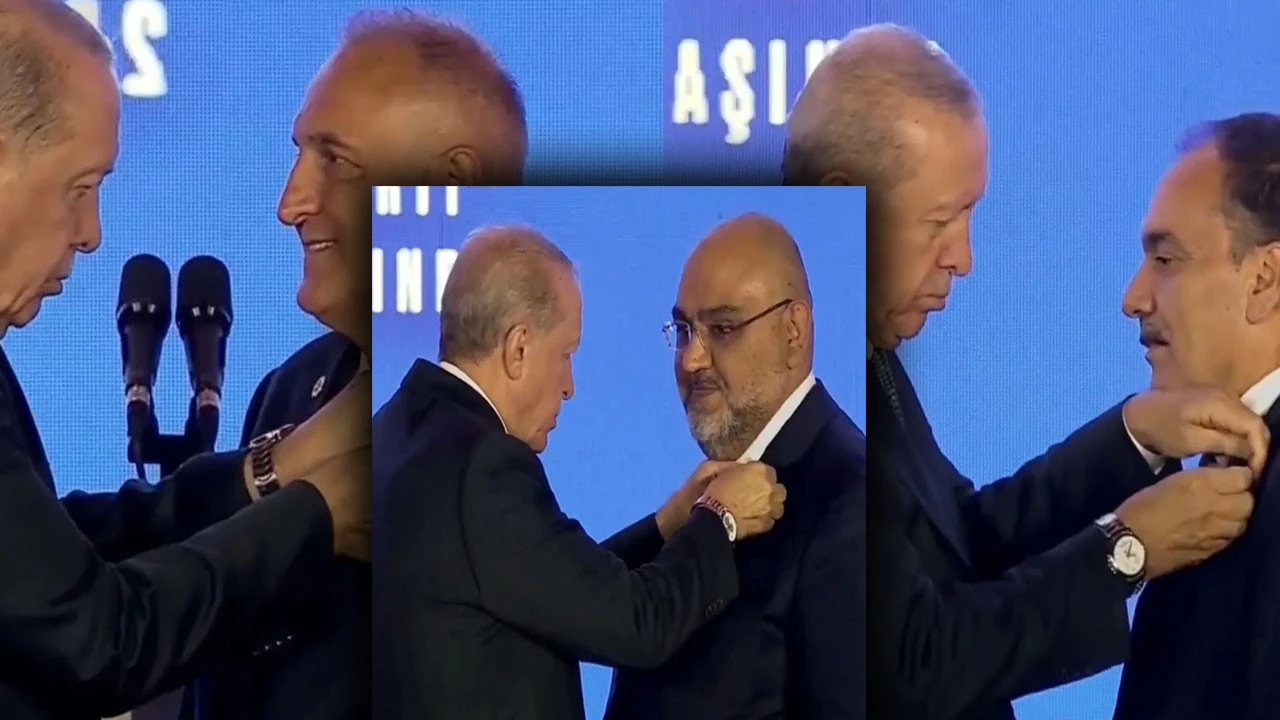
    The AKP took control of İstanbul’s Ataşehir district on Saturday after its elected mayor, Onursal Adıgüzel, and his replacement, Murat Güneş, were jailed and suspended. Six city council members elected on the CHP ticket had joined the AKP before the vote to select a new acting mayor.

    Forty mayors elected from the CHP have been arrested since the 2024 elections, a tally published by the İlke TV news website showed last week. The cumulative figure covers mayors who were subsequently released and does not represent the number currently in jail.

    The crackdown on opposition municipalities intensified after İstanbul Mayor Ekrem İmamoğlu, a political rival of Erdoğan, was jailed pending trial in March 2025.

    The New Party was formed in July by Özgür Özel and 90 other lawmakers after a court removed Özel from the CHP leadership in May and reinstated former party leader Kemal Kılıçdaroğlu.

    Opposition parties accuse the government of using the judiciary to reverse their election gains.

    Arslan urged opposition parties, civic groups and voters to defend election results through joint action, arguing that abandoning the ballot box would give the government more freedom to override voters’ choices.