Tag: AKP

  • Thousands protest media crackdown in Turkey

    Thousands protest media crackdown in Turkey

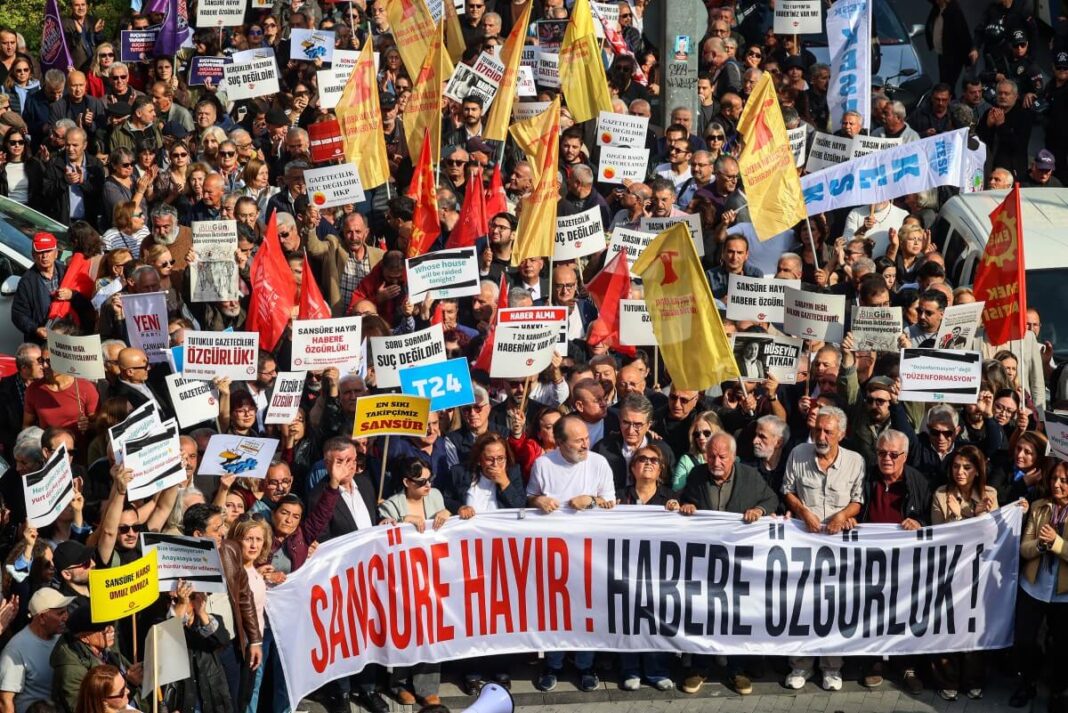
    Thousands rallied in İstanbul and Ankara on Saturday against what they described as growing pressure on journalists in Turkey, including arrests, media shutdowns and the appointment of government administrators to run news outlets.

    Press freedom has been increasingly constrained in Turkey since a failed coup attempt in 2016, with sweeping prosecutions, digital censorship and government accusations that journalists are spreading fake news.

    “Enough!” shouted marchers, mainly journalists, rights activists and opposition party representatives. “We can no longer breathe!”

    On İstanbul’s Asian side, protesters held up photos of jailed journalists, chanting: “We will not be silenced. Enough is enough!” and “We will not bow to pressure”.

    At least 3,000 people attended each protest, according to police counts.

    Recent weeks have seen what rights advocates describe as mounting pressure on independent journalism.

    Eleven journalists have been jailed in the past two months and several media outlets shut down, according to the Turkish Journalists’ Union (TGS).

    Earlier this month, police raided Turkey’s most-watched news channel, Halk TV, halting broadcasts and installing a government-appointed administrator.

    The takeover was the latest move against media outlets seen as critical of President Recep Tayyip Erdoğan and his government.

    It followed the blocking of leading digital news outlet T24’s website and social media accounts over what Turkish officials described as “LGBT propaganda”.

    ‘Intimidation’

    “This gathering is not simply about standing up for journalists,” veteran journalist Zafer Arapkirli told Agence France-Presse after the İstanbul protest.

    “It is also about defending respect for society’s right to access information and news through journalists and independent media,” said the columnist for the BirGün daily.

    Arapkirli, who himself faces lawsuits, said the response and determination to resist must grow as the pressure intensifies.

    “What the regime wants is to intimidate, silence and frighten society through such pressure — by arresting individual journalists, seizing media outlets, banning news coverage and blocking access to social media,” he said.

    “We must show that we will not allow this to happen.

    “We have done so up to now. I believe we are now moving towards demonstrating this determination on a much larger scale”.

    TGS President Gökhan Durmuş said the nature of “the government’s attacks” on the media had changed.

    “If we look at the recent restrictions, access bans and trustee appointments, they have targeted some of the most widely followed and watched broadcasters, news channels and media platforms,” he told AFP.

    “We are seeing a system emerge in which everything is uniform: one voice, one source of news, one centralised operation,” he said.

    ‘Let us do our job’

    In Ankara, protesters chanted against censorship and called for the release of jailed journalists.

    “Today’s protest was important both because it brought journalists together to make their voices heard and because it defended citizens’ right to access information,” T24 journalist Gökçer Tahincioğlu told AFP in Ankara.

    “Journalists are determined to get one message across: we want to practise journalism, and we want to be able to do so freely,” he said.

    The government has repeatedly denied that journalists are arrested or imprisoned for doing their jobs.

    At the Ankara protest, a letter from jailed BirGün journalist İsmail Arı was read to the crowd.

    “I am being held in prison for no reason other than doing my job as a journalist. Days are being stolen from my life,” Arı wrote from Sincan prison on the outskirts of Ankara.

    “We will defend journalism to the very end. Take your hands off us, comply with the constitution and let us do our job.”

    Arı was jailed pending trial on October 21 for the second time in seven months, accused of publicly disseminating misleading information following a complaint by former broadcasting watchdog chief Ebubekir Şahin. He was also investigated on suspicion of insulting a public official.

    © Agence France-Presse
  • 19 more jailed in investigation targeting Süleymanlılar religious community

    19 more jailed in investigation targeting Süleymanlılar religious community

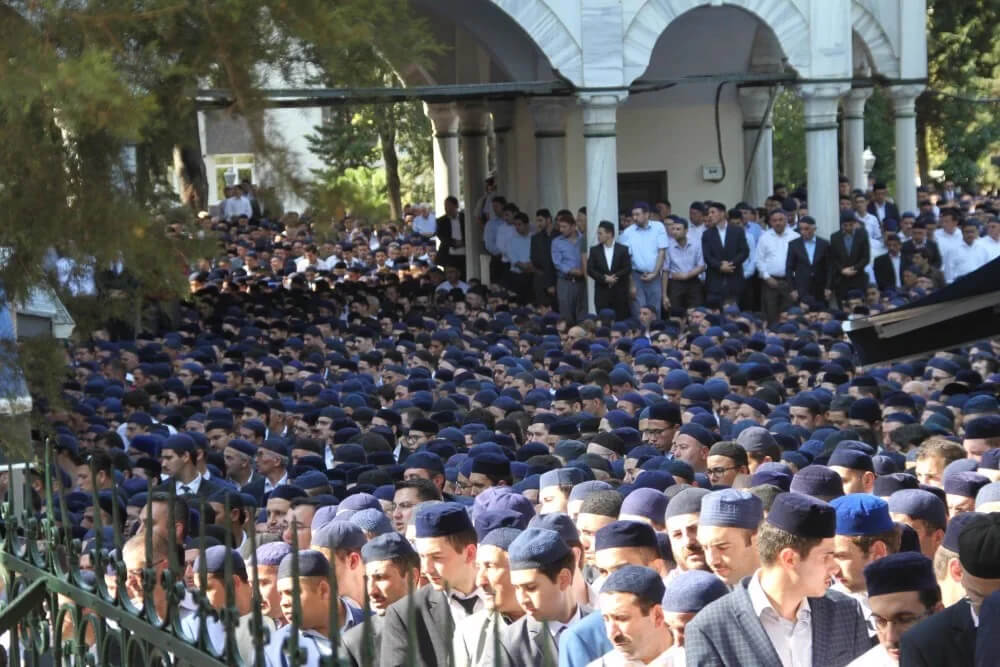
    A Turkish court has ordered the pretrial detention of 19 people in the latest phase of a financial crimes investigation targeting individuals linked to the Süleymanlılar religious community, the DHA news agency reported on Friday.

    Five others were released under judicial supervision after 24 suspects were brought before a court following questioning by police and prosecutors.

    The decisions follow the fifth round of raids in the investigation, led by the Ankara Chief Public Prosecutor’s Office. Police searched 28 homes and 16 workplaces across 12 provinces after prosecutors issued detention warrants for 38 people.

    Twenty-two people were initially detained in the October 19 raids. The number subsequently rose to 24, according to DHA.

    Prosecutors are investigating allegations of establishing, leading or belonging to a criminal organization, money laundering, defrauding public institutions and violations of tax laws.

    The investigation has targeted community leader Alihan Kuriş, who has been jailed pending trial since August. Kuriş has denied leading a criminal organization or participating in money laundering or fraud.

    The case has expanded through successive operations targeting people and businesses linked to the community. In September, prosecutors issued warrants for 29 suspects and secured the appointment of court-supervised trustees to 23 companies.

    The Süleymanlılar trace their roots to Islamic scholar Süleyman Hilmi Tunahan. The community runs Quran courses, student dormitories, charities and businesses in Turkey and Europe, particularly Germany. Kuriş, a grandson of Tunahan, became its leader in 2016.

    The investigation has prompted questions about possible political motives. The community has remained outside President Recep Tayyip Erdoğan’s ruling Justice and Development Party’s (AKP) close circle of religious allies and has at times reportedly supported opposition parties.

    Former education minister Hüseyin Çelik, a founding AKP member, warned in August that investigations into religious communities risked becoming a way to punish groups whose leaders opposed the government.

    He questioned whether the Süleymanlılar would have faced similar action had their leadership supported the ruling party.

    The government denies targeting the community over its beliefs or political position. Justice Minister Akın Gürlek has claimed that the investigation concerns alleged financial crimes rather than religious activities.

  • Azerbaijan seeks to contain Azerbaijan dispute ahead of regional summit

    Azerbaijan seeks to contain Azerbaijan dispute ahead of regional summit

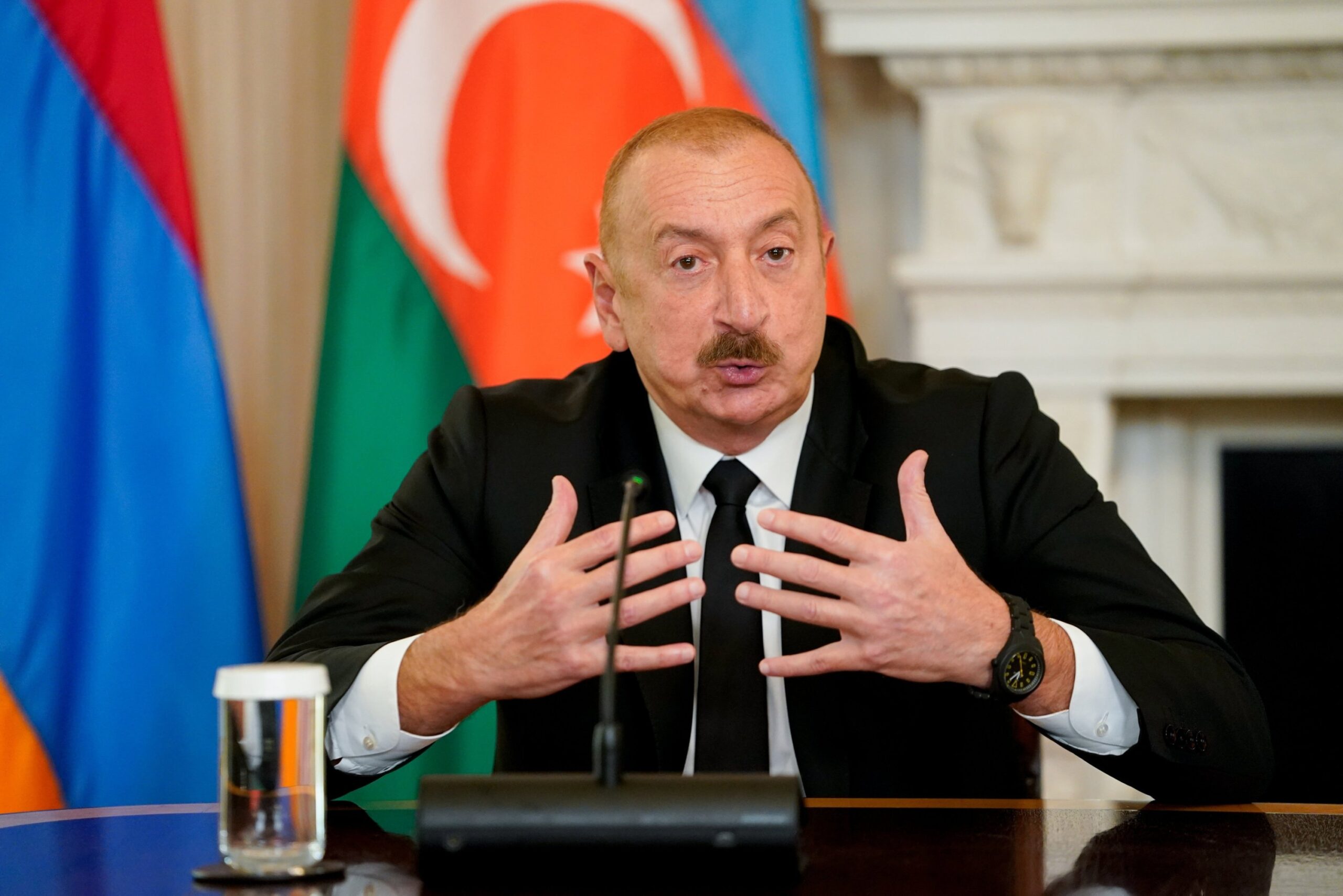
    Turkey is seeking to contain a growing dispute with Azerbaijan over criticism of school headscarf restrictions, as reports of demands from Baku and uncertainty over President Ilham Aliyev’s attendance at an upcoming regional summit put the relationship under pressure.

    Azerbaijan’s decision to bar 31 Turkish nationals from entering the country on Wednesday expanded the dispute beyond the seven Turkish citizens facing arrest in absentia over alleged calls to overthrow the Azerbaijani government. The entry ban list includes opposition politicians, media figures and religious writers, with Azerbaijani officials accusing those named of making statements that threaten the country’s sovereignty and national security.

    The dispute began after Azerbaijan amended its school uniform rules on September 21 to prohibit clothing considered incompatible with prescribed uniforms or secular education. Although the rules do not explicitly mention headscarves, reports that girls wearing them were turned away from classrooms prompted protests and criticism from Turkish politicians.

    On October 12 Oktay Saral, a chief adviser to Turkish President Recep Tayyip Erdoğan, called the restrictions unacceptable and urged Azerbaijan to reverse them. Members of Erdoğan’s ruling Justice and Development Party (AKP) also criticized the policy. The following day, Azerbaijan’s ruling New Azerbaijan Party (YAP) accused Saral and AKP lawmakers of making “populist and irresponsible” statements and interfering in the country’s domestic affairs.

    A Middle East Eye report published October 19, citing three officials and a source familiar with the matter, said Baku had asked Ankara to dismiss Saral, prosecute social media commentators who had insulted Aliyev and block accounts identified by Azerbaijani officials. Turkey blocked some of the accounts but had taken no further action.

    Azerbaijani media outlets close to the government subsequently accused Turkish Foreign Minister Hakan Fidan of encouraging unrest against Aliyev following Fidan’s visit to Baku. The Turkish Embassy rejected the allegations, denying that Fidan had held secret meetings or issued instructions to interfere in Azerbaijan’s domestic affairs. Azerbaijani news outlet Qafqazinfo removed passages targeting Fidan after the embassy’s denial. Azerbaijan’s Press Council also criticized some Turkish media coverage, accusing outlets of exceeding the bounds of press freedom.

    Turkish political figures have sought to limit the fallout. Former prime minister Binali Yıldırım said Saral’s comments did not represent official Turkish policy, while Nationalist Movement Party (MHP) leader Devlet Bahçeli called for common sense.

    The dispute comes as Turkey and Azerbaijan prepare for the 13th summit of the Organization of Turkic States in Ankara, where Turkey is due to take over the group’s chairmanship from Azerbaijan. Foreign ministers are scheduled to meet on October 29, followed by the heads-of-state summit on October 30.

    Turkish Foreign Ministry sources told the Cumhuriyet newspaper that all leaders had been invited and that Aliyev’s attendance was expected. Middle East Eye’s sources, however, said his participation remained unconfirmed.

    Separately, Turkey’s Center for Combating Disinformation, part of the Presidential Communications Directorate, said on October 20 that social media claims that someone had attempted to remove the Turkish flag in Azerbaijan relied on old footage. The center said the flag had not been taken down and accused those circulating the footage as recent of seeking to damage relations between the two countries.

    Azerbaijan’s Interior Ministry has said 37 people were detained during protests against enforcement of the school uniform rules. The dispute has put pressure on a relationship built on close political, military and cultural ties, which the two governments often describe with the phrase “one nation, two states.”

  • [OPINION] Corruption behind the mask of religion

    [OPINION] Corruption behind the mask of religion


    When allegations emerged that Fatma Betül Sayan Kaya, a former minister and one of the most senior figures in President Recep Tayyip Erdoğan’s ruling Justice and Development Party (AKP,) and her husband had turned a combined investment of about 163 million Turkish lira ($3.3 million) into more than 2 billion lira (about $41 million) in proceeds from stock sales within months, Kaya resigned from her positions in the party.

    The figures were recently disclosed by opposition politician Zeynel Emre.

    Yet while Turkey and the world were watching what has been described as one of the country’s biggest financial scandals, Kaya had been part of Erdoğan’s delegation at the United Nations summit, appearing as though nothing unusual had happened.

    The Kaya couple, who are widely regarded as being close to the Erdoğan family and his political circle, reportedly invested about 163 million lira between them, much of it in Özata Denizcilik shares, beginning in April 2026.

    According to allegations made by New Party spokesperson Emre, Kaya invested about 63.4 million lira ($1.3 million) and later withdrew about 1.34 billion lira ($27.3 million), while her husband, İlyas Kaya, invested about 99.7 million lira ($2 million) and withdrew about 826 million lira ($16.9 million). Emre alleged that they sold their holdings before the financial crisis and market turmoil that erupted in mid-September.

    Meanwhile, hundreds of thousands of ordinary Turkish investors were caught in the collapse. The crisis has affected more than 450,000 investors across 131 funds, with more than $18 billion in assets held in funds now being liquidated.

    The Kaya couple have reportedly transferred approximately 2.2 billion lira ($44.9 million) to an account designated by the Ministry of Treasury and Finance.

    But returning the money does not, by itself, establish that they committed a crime or constitute a legal admission of wrongdoing. Their transactions, their source of information and the circumstances surrounding the trades still require independent investigation.

    Prosecutors have since moved to freeze the assets of Kaya and her husband as part of the fund investigation.

    That raises much bigger questions.

    Why did no one in Erdoğan’s government seriously ask how a senior ruling-party figure and her husband acquired the capital to make such a large investment, why they invested in this particular stock at precisely that time, and how they managed to exit after such a spectacular rise in its value?

    How can a stock rise so dramatically in only a few months without attracting extraordinary scrutiny? And when such extraordinary and potentially manipulative movements occur, why did the institutions responsible for monitoring the stock market and protecting investors fail to intervene earlier?

    These questions are particularly important because the institutions responsible for regulating and overseeing Turkey’s financial markets are headed by people appointed by the government and operating within Erdoğan’s political system.

    And there is an even bigger question.

    How was a crisis involving 131 funds with assets worth more than $18 billion allowed to develop in the first place? Who benefited from the extraordinary price movements now under investigation?

    There is also a striking contrast in the way Erdoğan’s government treats political opponents and figures close to the ruling establishment. Opposition figures, including İstanbul Mayor Ekrem İmamoğlu, have been arrested and imprisoned amid corruption allegations. In Kaya’s case, prosecutors have now moved to freeze her and her husband’s assets, but neither has been detained or charged over the alleged trades. Where is the same level of scrutiny?

    And why did Kaya remain silent when the allegations first emerged? Her resignation statement said she was stepping aside so the allegations could be investigated independently, but she did not directly address Emre’s detailed claims about the trades.

    If opposition politicians had not publicly disclosed her name and the details of the transactions, would she have voluntarily come forward to explain how she and her husband had allegedly made such extraordinary gains from these trades?

    But perhaps the most painful question is not financial. It is moral.

    Erdoğan, Fatma Betül Sayan Kaya and many other figures in the ruling party regularly present themselves to the public through religious language, symbols and imagery.

    What happens to religion when politicians who invoke it so frequently become associated with privilege, extraordinary wealth and allegations of corruption?

    What happens when religious language becomes a political shield against demands for transparency and accountability?

    What does it do to faith when politicians who constantly invoke Islam and religious values are accused of benefiting from extraordinary financial transactions while ordinary citizens bear the losses?

    And do genuinely religious people recognize the damage that this kind of Islamist politics, using religion as a political shield, can inflict on religion itself?

    The AKP’s rise to power was fueled in large part by the sense of grievance created in the 1990s, when Turkey’s secular establishment imposed severe restrictions on women who wore the headscarf, particularly in universities and public institutions.

    Today, however, the AKP has taken the repression it once condemned to a level far beyond what those old regimes imposed on their opponents. And there is a particularly striking irony in the fact that one of the figures now at the center of corruption allegations is herself a woman who wears the headscarf.

    Sadly, this also seems to have vindicated the warnings that Islamist politicians may embrace democracy, justice and freedoms most enthusiastically when they are in opposition. Once they gain power, the temptation can be to treat those principles as instruments rather than universal values.

    Erdoğan himself has long been widely quoted as expressing such an instrumental view of democracy during his years as mayor of İstanbul: “Democracy is like a tram. You ride it until you reach your destination, then you get off.”

    *Abdülhamit Bilici is the former editor-in-chief of the now-defunct Zaman daily who currently lives in exile in Washington, D.C.

    Disclaimer: The views expressed in this opinion piece are those of the author and do not necessarily reflect the editorial stance of Turkish Minute. Turkishminute